Cookware manufacturing partner since 2002 info@cwchangwen.com · +86 180 2296 3948

12 Critical Factors to Check Before Purchasing Cookware in Bulk

⏱ Read Time: 10 minutes
Most Bulk Cookware Orders Go Wrong for the Same Reasons
You’ve found a supplier with attractive prices. The catalog looks good. The samples seem fine.
Then 3,000 units arrive — and the handles feel hollow, the base is thinner than quoted, the logo is off-center, and half the non-stick pans already show coating separation in the box.
This scenario is not rare. It’s one of the most common outcomes in bulk cookware procurement — and it’s almost always preventable.
The difference between a successful bulk cookware order and a costly one comes down to due diligence across 12 specific factors — factors that experienced procurement professionals check every time, with every supplier, on every order.
This guide walks you through each one.
Who This Guide Is For
Before diving in, it’s worth being clear about who benefits most from this framework:
- Restaurant chains and hotel groups stocking commercial kitchens at scale
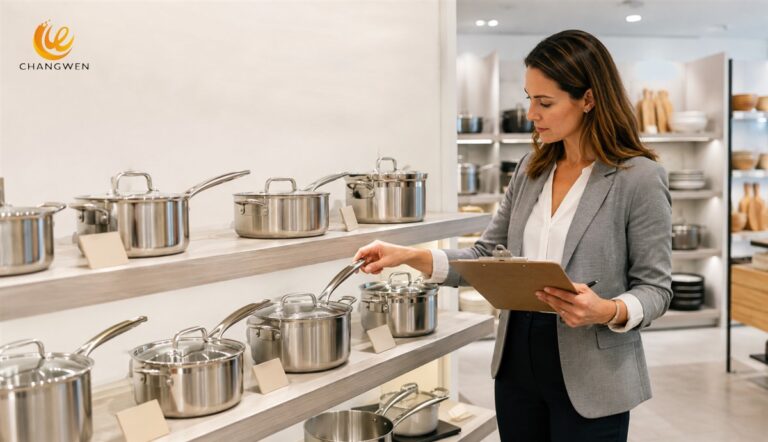
- Importers and distributors sourcing wholesale cookware for retail channels
- Amazon FBA sellers and e-commerce brands building private-label cookware programs
- Wholesale buyers purchasing cookware for resale or institutional use
- First-time OEM buyers placing their first large-volume cookware order with a Chinese manufacturer
If your order is over 500 units — this checklist applies.
The 12-Factor Bulk Cookware Purchasing Checklist
Factor 1: Cookware Type — Are You Buying the Right Product for Your Market?
This seems obvious — but category confusion is more common than you’d think, especially when sourcing across multiple SKUs simultaneously.
Before placing any bulk order, confirm:
What type of cookware are you actually buying?
| Category | Key Sub-Types | Primary Market Use |
|---|---|---|
| Frying pans / skillets | Shallow, deep, grill, omelette, square | Home, restaurant, retail |
| Saucepans | Single-handle, with lid | Home, catering |
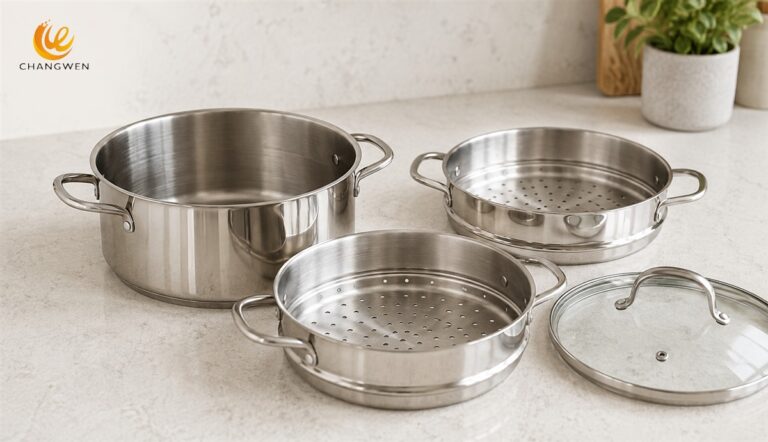
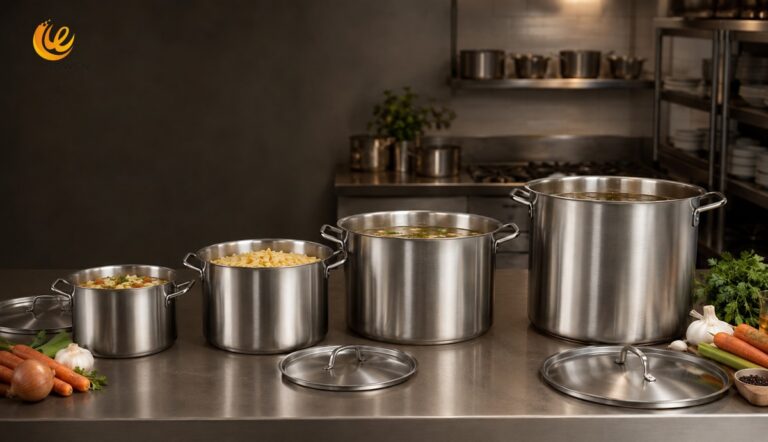
| Stock pots | Various capacities | Restaurant, institutional |
| Woks | Carbon steel, stainless, non-stick | Asian cuisine, restaurant |
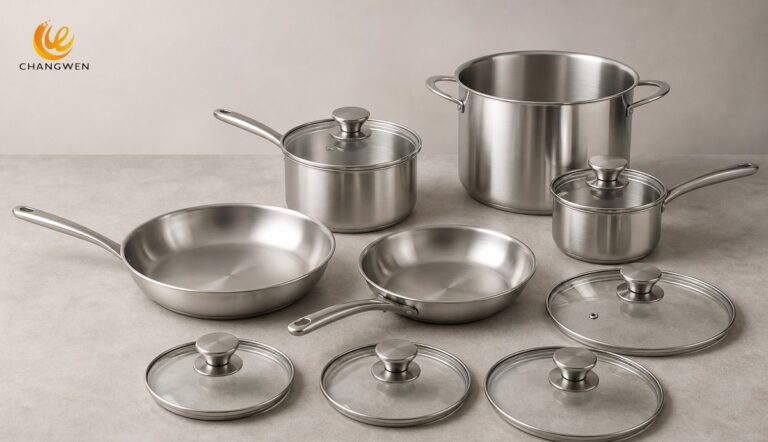
| Cookware sets | 3-piece, 5-piece, 7-piece+ | Retail, gifting |
| Pressure cookers | Stovetop, electric inner pot | Home, commercial |
| Commercial pans | Hotel pans (GN), sheet pans | Foodservice, hospitality |
Why it matters at bulk scale: A restaurant chain buying frying pans for commercial kitchen use needs different specifications than a retailer buying the same product category for consumer resale. Commercial use demands heavier gauge, fully riveted handles, and higher heat tolerance. Retail demands attractive packaging, lightweight ergonomics, and retail-friendly aesthetics.
Getting the product type definition right before sourcing eliminates the most fundamental category mismatches.
Factor 2: Material Quality — Verify, Don’t Trust
Material grade is the single most falsifiable claim in cookware manufacturing — and one of the most frequently misrepresented.
Stainless Steel Grade
| Grade | Composition | Use Case | Key Risk |
|---|---|---|---|
| 201 | 16–18% chromium, 3.5–5.5% nickel | Economy retail, budget hospitality | Faster corrosion in humid environments, lower longevity |
| 18/8 (304) | 18% chromium, 8% nickel | Standard quality retail, commercial | The benchmark — verify against this |
| 18/10 (316) | 18% chromium, 10% nickel | Premium retail, marine/EU markets | Higher cost but superior corrosion resistance |
| 430 | 16–18% chromium, <0.75% nickel | Magnetic exterior layers only | Never food-contact grade |
Practical check: Request the material mill certificate (also called the steel certification or material test report) from your supplier before production. This document confirms the actual alloy composition. Legitimate manufacturers have these on file.
Aluminum
For non-stick cookware with aluminum bodies, verify:
- Alloy grade (1050, 3003, or 6061 are common food-grade options)
- Wall thickness — economy-grade pans often use 1.5mm–2.0mm; quality retail should specify 2.5mm–3.5mm minimum
- Anodized or bare — anodized aluminum provides a harder, more durable surface and is more corrosion-resistant
Cast Iron
Cast iron quality is determined by:
- Iron composition and carbon content
- Casting density — no voids, consistent wall thickness
- Pre-seasoning quality (if specified)
- Enamel coating adhesion and coverage (for enamel-coated products)
Factor 3: Construction & Base Specification
Construction determines heat performance, durability, and the product tier it belongs in. This is where vague supplier claims cause the most damage.
Wall Gauge (Thickness)
| Construction Type | Wall Gauge | What to Expect |
|---|---|---|
| Economy single-ply | 0.4mm–0.6mm | Budget retail, institutional volume |
| Standard single-ply | 0.6mm–0.8mm | Mid-market retail |
| Commercial single-ply | 0.8mm–1.2mm | Restaurant and hotel kitchen use |
| Capsule bottom | 0.6mm body + bonded base | Value-performance retail programs |
| Tri-ply full-clad | 0.2+0.9+0.2mm (approx.) | Premium retail, professional home |
| 5-ply full-clad | Multiple layers | Ultra-premium programs |
Key rule: Always specify gauge in millimeters in your purchase order. “Stainless steel frying pan” means nothing without it. A supplier that can’t confirm gauge in writing should not be trusted with a large order.
Handle Attachment Method
| Method | Strength | Best For |
|---|---|---|
| Riveted | Highest — mechanical fastening | Commercial kitchen, heavy-duty use |
| Welded | High — if done correctly | Consumer retail, lighter commercial |
| Screwed | Medium | Economy retail only |
For commercial kitchen programs (hotels, restaurants), fully riveted handles are the minimum acceptable standard.
Factor 4: Non-Stick Coating & Food Safety Standards
Non-stick cookware is the highest-risk product category in bulk purchasing — both for product quality and compliance.
Coating Types Available
| Coating | Key Properties | Market Fit |
|---|---|---|
| PTFE (Teflon-type) | Proven performance, cost-effective | Mass retail, volume programs |
| Ceramic | PFOA-free, contemporary appeal | EU/AU premium markets |
| Granite-effect | Visual differentiation | Lifestyle retail, gift programs |
| Marble-effect | Premium visual | Department store, premium e-commerce |
| Honeycomb | Reduced contact surface | Health-positioning, chef-targeted |
Critical Safety Questions to Ask Every Supplier
- Is the coating PFOA-free? (Required for EU market; increasingly expected globally)
- What is the heat resistance rating of the coating?
- Does the factory have LFGB test reports for the coating (for EU-bound products)?
- Does the factory have FDA food contact documentation (for US-bound products)?
Non-negotiable: Never accept verbal assurances on coating compliance. Request the actual test report document — not a claim, not a certificate image, the full test report from an accredited laboratory. Coating failures at import are expensive, brand-damaging, and entirely preventable.
Factor 5: Certifications — Match Requirements to Your Market
Every destination market has specific certification requirements for cookware. Buying without verifying certification creates compliance risk that becomes visible — painfully — at the import border or on retail shelves.
| Certification | Market | Covers | Notes |
|---|---|---|---|
| FDA | USA | Food contact safety | Stainless steel, non-stick coatings |
| LFGB | Germany / EU | Food contact, migration limits | Strictest global standard |
| REACH | EU | Chemical substance restrictions | Applies to coatings, handles |
| CA Proposition 65 | California, USA | Heavy metal and chemical disclosure | Required for California retail |
| NSF | USA (foodservice) | Commercial kitchen equipment | Required by some US foodservice buyers |
| BSCI / Sedex | Global | Factory social compliance | Required by major retailers and hotel groups |
| ISO 9001 | Global | Quality management system | Factory-level certification |
How to Verify Certification Claims
- Request the original test report (not a photo or scan)
- Verify the issuing laboratory is accredited (SGS, Bureau Veritas, Intertek, TÜV, Eurofins)
- Check the test report date — reports more than 2 years old may not reflect current production formulations
- Confirm the report covers the specific product you are ordering, not a similar-but-different item
Factor 6: Design & Functionality for Your Use Case
A cookware product that looks great in a catalog may perform poorly in its intended use environment. Evaluate design and functionality specifically against your use case:
For Restaurant & Hospitality Buyers
- Handle length and balance — does it work at commercial burner height?
- Lid fit — does steam vent properly under high-heat commercial use?
- Stack efficiency — can pans be nested for storage in limited kitchen space?
- Dishwasher and commercial cleaning agent resistance
For Retail & E-Commerce Buyers
- Does the product photograph well? (Critical for e-commerce conversion)
- Is the handle ergonomics suitable for the target consumer demographic?
- Does the lid design suit the retail aesthetic?
- Is the product weight within expectations for the price point?
For Hotel & Catering Programs
- Can the cookware withstand multi-shift daily use without degradation?
- Are replacement parts (handles, lids, knobs) available from the supplier?
- Does the aesthetic match the F&B presentation standard of the property?
Factor 7: Customization & OEM Capability
If you’re purchasing at bulk scale, customization capability directly affects your competitive positioning — whether that’s your brand in a hotel kitchen, your logo on a retail shelf, or your packaging on an Amazon listing.
Customization Options to Confirm with Your Supplier
| Customization | What to Verify |
|---|---|
| Logo application | Available methods: laser engrave, emboss, screen print, etch |
| Custom packaging | Can they produce your color box, hang-tag, retail-ready format? |
| Custom handle design | Do they have mold-making capability or partnerships? |
| Surface finish options | Mirror, satin, hammered, PVD color — which are available? |
| Custom specifications | Can they meet a non-standard gauge, capacity, or dimension? |
Factory vs. trading company test: A factory with genuine OEM capability will have an in-house or partner design team, a sample room, and the ability to produce pre-production samples within 2–4 weeks. A trading company will route your customization requests to a third-party factory — adding cost, time, and communication layers.
Factor 8: Minimum Order Quantity (MOQ) — Is It Realistic for Your Program?
MOQ is often treated as a fixed number — it isn’t. Understanding how to navigate MOQ structures is one of the most practically valuable skills in bulk cookware procurement.
Typical MOQ Ranges by Supplier Type
| Supplier Type | Typical MOQ |
|---|---|
| Trading company / wholesale market | 50–200 pieces |
| Factory (standard products) | 300–1,000 pieces |
| Factory (OEM with existing mold) | 500–1,000 pieces |
| Factory (OEM with new mold) | 1,000–3,000 pieces |
| Factory (premium / specialized) | 500–2,000 pieces |
How to Negotiate MOQ Effectively
- Bundle SKUs: Request a combined MOQ across multiple related products — a 3-piece set program with 500 sets total is often acceptable where 500 pieces of each individual item would not be
- Accept higher unit price for lower MOQ: Many factories will drop MOQ by 50% for a 10–20% unit price premium — a worthwhile trade for trial order risk management
- First order vs. repeat order: Establish that the first order is a qualification order with a specific repeat order commitment — this gives the factory confidence to accommodate a lower initial MOQ
Factor 9: Pricing Structure & Payment Terms
Price is rarely as simple as the unit FOB quote. Understanding the full pricing structure prevents budget surprises.
What to Clarify in Every Quotation
| Item | What to Ask |
|---|---|
| Unit price | FOB or EXW? Port of loading? |
| Volume tiers | Price at 500, 1,000, 3,000, 5,000 units |
| Tooling costs | Any mold or setup fees included or additional? |
| Sample costs | What is the sample cost per piece? Is it deductible? |
| Packaging costs | Is custom packaging included or quoted separately? |
| Annual price review | Is the quoted price valid for 12 months? |
Standard Payment Terms in Chinese Cookware OEM
| Term | Typical Structure | Risk Profile |
|---|---|---|
| T/T 30/70 | 30% deposit, 70% before shipment | Industry standard for new relationships |
| T/T 50/50 | 50% deposit, 50% before shipment | Common for smaller orders |
| L/C at sight | Letter of credit, payment on shipping docs | Preferred by buyers for large orders |
| T/T 100% before production | Uncommon — high risk for buyer | Avoid unless extraordinary circumstances |
Caution: Never pay 100% upfront before production for a first order with any new supplier, regardless of how good the communication has been. A 30% deposit is standard and appropriate.
Factor 10: Lead Time & Delivery Reliability
Lead time is not a number — it’s a commitment. And commitment reliability varies enormously between suppliers.
Standard Lead Times for Bulk Cookware Orders
| Stage | Typical Duration |
|---|---|
| Sample production (standard product) | 10–15 business days |
| Sample production (custom mold) | 25–35 business days |
| Sample approval cycle (buyer review) | 5–15 business days |
| Production (500–2,000 units, standard) | 25–35 days |
| Production (2,000–10,000 units) | 35–50 days |
| Production (10,000+ units, peak season) | 45–65 days |
Lead Time Risk Factors to Ask About
- Chinese New Year: Factories close for 2–4 weeks, typically late January to mid-February. Orders that straddle CNY need at least 4 weeks of additional buffer.
- Peak production season: July–October is peak season for Chinese cookware factories serving Western retail markets. Lead times extend by 20–40% during this period.
- Material availability: Steel price spikes or supply disruptions can delay production. Ask your supplier about current raw material lead times before confirming your delivery commitment to your customer.
How to Verify Lead Time Claims
Ask for references from two or three existing international buyers who can speak to actual delivery performance — not just the committed dates.
Factor 11: Quality Control System — How Does the Factory Catch Problems Before You Do?
A factory’s QC system is the difference between receiving 3,000 good pans and 3,000 mostly-good pans with 200 rejects mixed in.
What a Quality Control System Should Include
| Stage | What It Covers |
|---|---|
| Incoming material inspection | Steel grade verification, gauge measurement, surface quality |
| In-process inspection | Dimensional checks during forming, handle attachment review |
| Pre-shipment inspection | Final check against golden sample, AQL standard |
| Golden sample retention | Approved reference sample kept at factory for batch comparison |
| Lot traceability | Production batch records tied to shipping documentation |
Questions to Ask Every Supplier
- Do you have a dedicated QC department separate from production?
- What AQL level do you apply to finished goods inspection?
- Do you retain the golden sample throughout the production period?
- Can we arrange a third-party inspection before shipment?
- What is your defect rate on the last three export orders?
A factory that welcomes third-party inspection is a factory that is confident in its own quality. A factory that discourages or resists third-party inspection is sending you a signal you should not ignore.
Factor 12: Supplier Credibility — Factory vs. Trading Company, and How to Tell the Difference
This is the factor that underpins every other factor on this list. If your supplier is a trading company pretending to be a factory, none of the other due diligence steps produce reliable results — because the person you’re talking to doesn’t control the factory that makes your product.
How to Identify a Genuine Manufacturer
| Signal | Factory | Trading Company |
|---|---|---|
| Can invite you for a factory audit | ✅ Yes | ❌ No (or deflects) |
| Provides original mill certificates | ✅ Yes | Sometimes — forwarded from real factory |
| Can discuss wall gauge technically | ✅ Yes | Often vague |
| Has in-house design / sample team | ✅ Usually | Rarely |
| Business registration shows manufacturing | ✅ Yes | Shows trade/import-export |
| Directly controls production timeline | ✅ Yes | No — depends on factory capacity |
| Price explains itself with no middleman | ✅ Transparent | Often unclear why pricing fluctuates |
Verification Steps for New Suppliers
- Request a video factory tour — insist on a live walkthrough, not a pre-recorded video
- Request the business license (营业执照) — verify it lists manufacturing (制造) not trading (贸易) as the registered business type
- Search the factory’s export records — platforms like ImportYeti or Panjiva allow you to verify actual shipping records for Chinese exporters
- Request the most recent third-party audit report — BSCI, Sedex, or similar social compliance audits confirm factory existence and operating conditions
- Ask for two buyer references — and actually contact them
Summary: The Bulk Cookware Purchasing Checklist
Before placing any bulk cookware order, run through this checklist:
| # | Factor | ✅ Confirmed? |
|---|---|---|
| 1 | Cookware type matches intended use case | |
| 2 | Material grade verified with mill certificate | |
| 3 | Wall gauge and construction specified in writing | |
| 4 | Non-stick coating certification (LFGB/FDA) confirmed | |
| 5 | Required market certifications obtained and verified | |
| 6 | Design evaluated for target use environment | |
| 7 | OEM/customization capability confirmed | |
| 8 | MOQ negotiated and agreed in writing | |
| 9 | Full pricing structure (unit + tooling + packaging) confirmed | |
| 10 | Lead time committed and risk factors discussed | |
| 11 | QC system and third-party inspection arranged | |
| 12 | Supplier verified as genuine manufacturer |
If any box is unchecked before production begins, that’s where your risk lives.
Why Changwen Is Built for Bulk Cookware Buyers
Changwen Cookware and Kitchenware Co., Ltd. was designed for exactly the kind of buyer this checklist describes — one who asks the right questions and expects a manufacturer that can answer all of them.
Here’s how Changwen performs against every factor on this list:
| Factor | Changwen |
|---|---|
| Cookware type coverage | Full range: pans, pots, sets, woks, kettles, tools |
| Material verification | Mill certificates available; 304 stainless standard |
| Construction specification | Gauge confirmed in writing on every order |
| Non-stick certifications | LFGB, FDA, REACH documentation available |
| Market certifications | FDA, LFGB, CA Prop 65, BSCI, REACH |
| OEM/customization | Full: logo, packaging, mold development |
| MOQ flexibility | From 300 pieces; volume tiers available |
| Pricing transparency | Factory-direct, fully itemized quotes |
| Lead time reliability | 30–45 days production; proactive communication |
| Quality control | Incoming, in-process, pre-shipment; 3rd party welcome |
| Supplier credibility | Factory direct, 20+ years, exported to 80+ countries |
20+ years of OEM/ODM manufacturing experience. Exported to 80+ countries. Factory direct — no middlemen.
Start Your Bulk Cookware Order the Right Way
Ready to work with a manufacturer that checks every box on this list?
Tell us:
- 🍳 Product categories and specifications required
- 📊 Estimated order quantities per SKU
- 🌍 Destination market and certification requirements
- 🎨 OEM / branding requirements
- 📅 Target delivery timeline
We’ll respond within 24 hours with a factory-direct quotation, full specification sheet, and available certification documentation.
Frequently Asked Questions
What is the most important factor when buying cookware in bulk? Material grade verification and supplier credibility are the two highest-impact factors — they determine whether everything else on the checklist is meaningful. A falsely-graded material or a trading company misrepresenting itself as a factory cannot be corrected after production.
How do I verify that a Chinese cookware supplier is a real factory? Request a live video factory tour, ask for the business license (which should list manufacturing, not trading, as the registered type), and ask for two existing international buyer references that you can contact independently.
What certifications do I need for selling cookware in the US? FDA food contact documentation is the baseline requirement. For products sold in California, CA Proposition 65 heavy metal testing is also required. Non-stick-coated products need specific coating safety test reports.
What is a realistic MOQ for a first bulk cookware order? For standard products with an existing mold, 300–500 pieces per SKU is a reasonable first-order quantity with established factories. For custom handle or body designs requiring new molds, minimum quantities typically start at 1,000–2,000 pieces.
Should I use a factory or a trading company for bulk cookware sourcing? A factory direct relationship is strongly preferable for bulk orders — it gives you direct access to production control, quality oversight, and specification accountability. Trading companies are useful for mixed-category small orders but introduce cost, communication layers, and accountability gaps that become serious problems at volume.