Cookware manufacturing partner since 2002 info@cwchangwen.com · +86 180 2296 3948

OEM Tri-Ply Stainless Steel Cookware: The Complete Manufacturer’s Guide

⏱ Read Time: 14 minutes
The Construction That Changed Professional Cookware — And What It Actually Takes to Get It Right
Tri-ply stainless steel cookware is one of the most significant engineering developments in the history of cookware manufacturing.
That’s not marketing language. It’s the reason professional kitchens worldwide — from Michelin-starred restaurants to hotel chains with hundreds of properties — have standardized on it. It’s the reason the premium tier of the global retail cookware market is built around it. And it’s the reason that “tri-ply” has become one of the most searched terms in B2B cookware sourcing.
But here’s the reality that most sourcing guides don’t tell you: tri-ply is a construction category, not a quality guarantee. The word describes a three-layer bonded structure. It says nothing about the thickness of those layers, the grade of the steel, the purity of the aluminum, whether the layers are full-clad or capsule-bonded, or whether the manufacturing process produces a pan that actually delivers the thermal performance the construction is capable of.
A poorly executed tri-ply pan will underperform a well-built single-ply commercial pan on every practical cooking test.
This guide is for buyers who want to source, specify, and commission OEM tri-ply stainless steel cookware that performs the way tri-ply is supposed to — not just a product that carries the label. Whether you’re a brand building a premium cookware line, a wholesaler expanding your catalog, an importer evaluating manufacturers, or a retail buyer developing private-label programs, everything you need to know is here.
Part 1: What Tri-Ply Stainless Steel Cookware Actually Is
The Three-Layer Structure — And What Each Layer Does
Tri-ply stainless steel cookware is manufactured from a composite metal sheet consisting of three permanently bonded layers. The layers are fused together under high pressure through a process called roll-bonding before the pan body is formed — meaning the layers behave as a single, unified material rather than three separate sheets that happen to be in contact.
Understanding each layer is essential to understanding why construction quality matters so much:
| Layer | Material | Primary Function | Quality Variables |
|---|---|---|---|
| Inner (Layer 1) | 18/8 (304) or 18/10 (316) stainless steel | Food-safe cooking surface — non-reactive, corrosion-resistant, durable | Steel grade (304 vs 201), surface finish, layer thickness |
| Core (Layer 2) | Aluminum (pure or alloy) | Heat conduction — spreads thermal energy rapidly and evenly | Aluminum purity/grade, layer thickness, uniformity |
| Outer (Layer 3) | 430 magnetic stainless steel | Structural support + induction compatibility | Magnetic permeability, surface finish, layer thickness |
The aluminum core is the engineering heart of tri-ply construction. Aluminum conducts heat approximately 13 times more efficiently than stainless steel. By placing it between two stainless steel layers — which provide food safety, durability, and structural support — tri-ply achieves what neither material can do alone: the food-contact safety and longevity of stainless steel, combined with the rapid, even heat distribution of aluminum.
Full-Clad vs. Capsule Bottom — The Most Important Distinction in Tri-Ply Manufacturing
The single most consequential specification question for any OEM tri-ply program is whether the construction is full-clad or capsule-bottom. Both can be — and frequently are — marketed as “tri-ply.” They are not equivalent products.
Full-Clad Tri-Ply Construction All three bonded layers extend the complete height of the pan — from base to rim. When food contacts the sides of the pan during sautéing, tossing, and sauce reduction, those surfaces conduct heat with the same efficiency as the base. This is genuine tri-ply construction, and it is what the performance claims associated with tri-ply are based on.
A full-clad tri-ply pan can be identified by examining a cross-section of the pan wall at mid-height (not the base). All three distinct layers should be visible, with consistent thickness across the section.
Capsule-Bottom Construction A single-ply stainless steel body with a multi-layer disc bonded only to the base. The sides of the pan are single-ply stainless — they conduct heat differently and significantly less efficiently than the base. Some products with this construction are marketed using terms like “tri-ply base” or “encapsulated base” — technically accurate descriptions that can be confusingly similar to full-clad claims.
For OEM programs targeting mid-to-premium price tiers, quality retail channels, or professional kitchen applications: full-clad construction is the correct specification. Capsule-bottom construction is appropriate for economy programs where the price point reflects the construction honestly.
The OEM buyer’s rule: Always specify “full-clad” or “clad body” explicitly in your purchase order. “Tri-ply” alone is insufficient — it describes only the layer count, not the extent of coverage.
Why the Aluminum Core Specification Matters More Than Most Buyers Know
Not all aluminum performs equally as a thermal conductor. The two variables that matter most are:
Aluminum Purity High-conductivity pure aluminum — Grade 1050 or 1060 — has a thermal conductivity of approximately 220–235 W/m·K. Aluminum alloys commonly used in less expensive constructions (3000-series or 5000-series alloys) conduct at 150–180 W/m·K. This 25–35% difference in thermal conductivity translates directly to measurable differences in heat-up speed, distribution uniformity, and cooking performance.
A tri-ply program using high-purity aluminum core delivers the heat distribution that premium market claims rest on. One using lower-grade alloys delivers meaningfully less.
Core Layer Thickness The aluminum core thickness determines how much thermal energy is stored and distributed. Quality full-clad tri-ply programs specify:
- Frying pans: 1.8mm–2.2mm aluminum core (total wall thickness 2.6mm–3.0mm)
- Saucepans: 1.6mm–2.0mm aluminum core
- Stock pots: 1.5mm–1.8mm aluminum core
Factories that reduce aluminum core thickness to cut material costs are producing a product with compromised thermal performance — the most important functional characteristic of the entire construction.
Part 2: The Complete OEM Tri-Ply Product Range
A qualified Tri-Ply Stainless Steel Cookware manufacturer for OEM programs should be capable of producing the complete range of tri-ply products across all formats and configurations.
Core Individual Products
Tri-Ply Frying Pans and Skillets The flagship product of any tri-ply cookware line. Available in 8-inch (20cm) through 14-inch (36cm) diameters. Full-clad construction means the flared sides — where food travels during sautéing and tossing — conduct heat as evenly as the base. This matters specifically for tasks like omelette-making, large-surface searing, and sauce-based cooking where the entire pan surface needs to perform.
The 10-inch (24cm) and 12-inch (30cm) are the two highest-volume sizes for retail and OEM programs. A 12-inch tri-ply frying pan is typically the hero SKU for mid-to-premium cookware brands in English-speaking markets.
Tri-Ply Saucepans Single long-handle vessels in 1Qt, 1.5Qt, 2Qt, 3Qt, and 4Qt capacities. Full-clad construction in a saucepan is especially significant: sauces, custards, caramel, and dairy-based preparations are precision-temperature applications where the even, responsive heat of full-clad tri-ply prevents the scorching and hot spots that single-ply vessels produce.
Tri-Ply Sauté Pans Wide, straight-sided vessels in 3Qt and 5Qt configurations — deeper than a frying pan, wider than a saucepan. The workhorse of professional kitchens for searing, braising, and volume cooking. Full-clad construction makes the vertical sides as thermally active as the base, which matters for cooking techniques that use the full height of the vessel.
Tri-Ply Stock Pots Large-capacity vessels from 6Qt to 20Qt. Tri-ply construction in stock pots provides more even heat distribution across the base than single-ply alternatives — reducing scorching during long-cook applications — and better structural rigidity that maintains the base geometry over years of commercial use.
Tri-Ply Woks An increasingly popular OEM category. Tri-ply woks deliver induction compatibility (via the 430 exterior), even heat distribution for large-surface high-heat cooking, and easier maintenance than carbon steel alternatives — at the cost of some of the extreme responsiveness of traditional carbon steel. Strong category for brands targeting Asian cuisine or modern fusion cooking programs.
Cookware Set Configurations
The OEM market for tri-ply cookware sets is dominated by these configurations:
| Set Size | Typical Contents | Market Fit |
|---|---|---|
| 5-piece | 8″ skillet, 10″ skillet, 2Qt saucepan, 4Qt saucepan, lid | Starter sets, entry into premium category |
| 7-piece | Above + 3Qt sauté pan + additional lid | Mainstream premium retail |
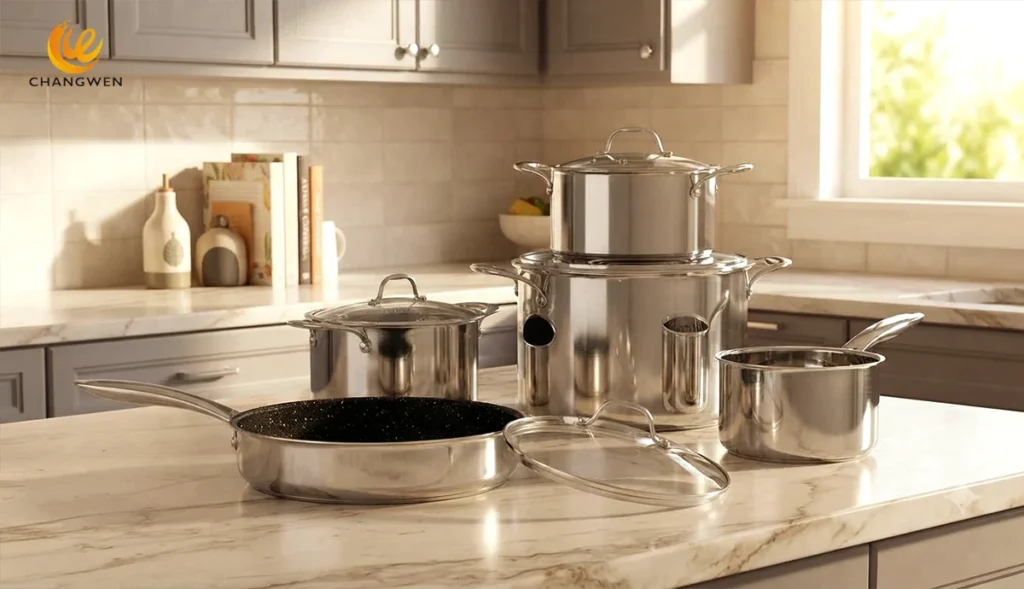
| 10-piece | Comprehensive range: skillets, saucepans, stock pot, lids | Premium retail, gifting programs |
| 12-piece | Full kitchen complement including large stock pot | Department store, premium e-commerce hero |
| 15-piece | Add specialty items (steam insert, sauté pan, etc.) | Top-tier private label programs |
Tri-ply sets with glass lids are the highest-converting retail configuration for consumer-facing programs — buyers strongly prefer the ability to monitor cooking without lifting the lid, and the tempered glass lid is a significant visual differentiator from commercial stainless-only alternatives.
Part 3: OEM Specifications — The Complete Technical Brief
This section provides the technical framework that every OEM tri-ply cookware brief should address. Missing any of these specifications creates ambiguity that translates into production decisions made without your input.
Material Specifications
Inner Layer (Food Contact Surface)
Specify the alloy by designation, not just description:
- 18/8 (Grade 304): Standard specification for most OEM programs. Non-reactive, corrosion-resistant, food-safe under all normal cooking conditions. Minimum acceptable for any quality-positioned product.
- 18/10 (Grade 316): Higher nickel content, superior corrosion resistance. Specified for premium programs, marine/coastal environment positioning, or markets with strict food contact requirements (certain EU product categories).
- Grade 201: Not acceptable for any quality-positioned OEM program. Confirm that 201 is excluded explicitly in your specification.
Request the mill certificate — a document issued by the steel mill confirming the actual chemical composition of the raw material. This is the only document that independently verifies steel grade beyond a supplier’s claim.
Core Layer (Aluminum)
Specify:
- Aluminum grade: 1050 or 1060 pure aluminum preferred; 3003 alloy acceptable in documented medium-duty programs
- Core thickness by product type: e.g., 2.0mm for frying pans, 1.6mm for saucepans
- Purity confirmation: Available from aluminum mill certificate or independent XRF testing
Outer Layer (Induction-Compatible Exterior)
- Grade 430 magnetic stainless steel (17–20% chromium, low nickel)
- Induction compatibility: Verify magnetic permeability meets the minimum threshold for your target induction cooktop standard (typically IEC 60335-2-9 compliance for EU markets)
- Surface finish: Mirror, satin, brushed, hammered, or PVD color coating
Dimensional Specifications
Every OEM brief should specify:
| Dimension | Why It Matters |
|---|---|
| Total wall thickness (mm) | Defines construction quality tier; minimum 2.6mm for full-clad quality |
| Layer breakdown (mm) | 304 layer / Al core / 430 layer; documents individual layer integrity |
| Base thickness (mm) | Often thicker than wall; capsule-bottom products have base-only multi-layer |
| Pan diameter (mm) | Specify both top diameter and base diameter |
| Pan height (mm) | Determines capacity; confirm matches specification |
| Handle length (mm) | Ergonomic specification; confirm for each pan size |
Handle Specifications
Handle design is the most-touched component of a cookware product and the most common source of consumer complaints and warranty claims. Specify completely:
Handle Material Options:
| Material | Heat Resistance | Best For | Durability |
|---|---|---|---|
| Hollow stainless steel | Excellent (stay-cool) | Professional, premium programs | Lifetime |
| Silicone-wrapped stainless | Good (to ~230°C) | Consumer retail, comfort-focused | 5–10 years |
| Bakelite / phenolic | Good (to ~180°C) | Economy-mid retail | 3–7 years |
| Cast stainless | Moderate (conducts heat) | Traditional aesthetic | Lifetime |
Handle Attachment Method:
- Riveted: Mechanical fasteners through pan wall — strongest, industry standard for commercial and quality retail programs
- Welded: Fusion-bonded — acceptable with weld quality confirmation; specify weld penetration requirements
- Screwed: Acceptable only for very light-duty economy programs; not recommended for quality OEM programs
Ergonomic Specifications:
- Handle length: 18–22cm for 10–12″ pans
- Handle angle: 10–15° from horizontal (affects pour comfort)
- Grip diameter: 28–35mm (comfortable for most hand sizes)
- Stay-cool geometry: Hollow construction with air gap specified
Lid Specifications
The lid is frequently underspecified in OEM briefs and is a common source of consumer disappointment. Complete lid specification:
- Type: Tempered glass (consumer-preferred) or stainless steel (professional/commercial)
- Fit: Specify fit tolerance — lid should seat with slight resistance, not rattle, and seal adequately without requiring force
- Steam vent: Specify presence, location, and flow rate
- Knob: Material (stainless, bakelite, silicone-capped), oven-safe temperature rating
- Glass thickness (if applicable): 4mm tempered glass minimum for quality retail programs
- Oven-safe temperature: 350°F / 177°C minimum; higher for full-stainless lids
Surface Finish Options
| Finish | Appearance | Market Positioning |
|---|---|---|
| Mirror polish (8K) | High-shine reflective | Traditional premium, gift retail |
| Satin / brushed | Linear grain, matte | Contemporary premium, North America/EU mainstream |
| Hammered | Textured, artisanal | Luxury lifestyle brands |
| PVD matte black | Bold, modern | Premium design programs |
| PVD gold | Warm, luxury | Latin American markets, lifestyle brands |
| Mixed (polished interior, brushed exterior) | Professional with visual contrast | Most popular premium retail configuration |
Part 4: How to Identify Quality Tri-Ply Construction — The Verification Checklist
OEM buyers commissioning tri-ply cookware cannot rely on catalog descriptions or verbal assurances. These are the verification methods that confirm what’s actually in the pan.
Verification Method 1: Request the Mill Certificate
A mill certificate (material test report) is a document issued by the steel mill or aluminum supplier confirming the actual measured chemical composition of the raw material. It is the independent confirmation of material grade that no factory-issued document can replace.
For a tri-ply pan, you should receive:
- A steel mill certificate confirming 304 grade for the inner layer
- An aluminum mill certificate or purity documentation for the core
- A steel mill certificate confirming 430 grade for the outer layer
A manufacturer that doesn’t have these, or won’t share them, is using materials they can’t independently verify.
Verification Method 2: Request a Cross-Section Sample
Ask the manufacturer to cut a section through the pan wall at mid-height (not at the base where capsule-bottom constructions also show multi-layer construction) and photograph the cross-section under direct lighting. A genuine full-clad tri-ply pan shows three clearly visible, evenly bonded layers across the full height of the cut.
This is the fastest and most definitive test for full-clad vs. capsule-bottom construction. A manufacturer with genuine full-clad production has no reason to refuse this request.
Verification Method 3: Measure Wall Thickness with a Digital Caliper
A $15 digital caliper, applied to the wall at mid-height (on pre-production samples), confirms total wall thickness with direct measurement. Cross-reference against the specification sheet. A wall thickness measurement of 2.6mm or above at mid-height indicates genuine full-clad construction. A measurement below 1.0mm at mid-height on a pan claimed to be full-clad tri-ply indicates either capsule-bottom construction or an undersized layer structure.
Verification Method 4: XRF (X-Ray Fluorescence) Testing
XRF testing uses a handheld instrument to read the elemental composition of the metal surface non-destructively. It can confirm the chromium/nickel ratio of the stainless steel layer (confirming 304 vs. 201) and verify the aluminum purity of exposed core sections.
For buyers placing regular large-volume orders, an XRF instrument represents a modest investment that eliminates material grade uncertainty across an entire supply chain.
Verification Method 5: Infrared Thermal Imaging
A pre-production sample tested with infrared thermal imaging shows exactly how heat distributes across the pan surface during heating. A well-built full-clad tri-ply pan shows a temperature differential of 3°C or less across the base at steady-state temperature. A poorly built tri-ply or single-ply pan typically shows differentials of 10°C or more, with clear hot spots visible around the center base.
This is the test that directly validates the core performance claim of tri-ply construction — not just the material composition.
Verification Method 6: Arrange Pre-Shipment Inspection
For any order above $5,000 in value, a pre-shipment inspection by an accredited third-party laboratory (SGS, Bureau Veritas, Intertek, TÜV) provides an independent quality check against your specifications before goods are loaded. The inspection report documents dimensional measurements, material verification, surface quality, packaging compliance, and quantity accuracy.
A manufacturer that welcomes third-party pre-shipment inspection is demonstrating confidence in their product. One that discourages or resists it is sending a signal that deserves your attention.
Part 5: Certifications for OEM Tri-Ply Programs by Market
Tri-ply stainless steel cookware — as a bare metal, non-coated product — has a simpler certification landscape than non-stick alternatives. However, compliance documentation is still required for legal market entry and retail partner acceptance in most major markets.
Certification Reference Table
| Certification | Market | Scope | Priority |
|---|---|---|---|
| FDA food contact | United States | Stainless steel and material food-contact safety | Essential for US retail and FBA |
| LFGB | Germany / EU | Strict food contact migration limits | Essential for EU distribution |
| REACH | European Union | Chemical substance restrictions across all components | Required for EU import |
| CA Proposition 65 | California, USA | Heavy metals disclosure and limits | Required for California retail |
| NSF | USA foodservice | Commercial kitchen equipment | Required for US foodservice distribution |
| BSCI / Sedex | Global retail chains | Factory social compliance | Required by major retail partners |
| ISO 9001 | Global | Quality management system (factory level) | Strong credibility signal |
Key Compliance Points for Tri-Ply Specifically
Handle Material Compliance Silicone and bakelite handle components require their own food-safe test reports in EU markets (LFGB applies to all food-contact components, including handle materials near the cooking surface). Confirm separately from the stainless body tests.
Nickel Migration Testing LFGB limits nickel migration from food-contact stainless surfaces. Grade 304 (18/8) comfortably passes these limits under standard test conditions. Grade 201 may not — another reason 201 interior steel is incompatible with quality EU market programs.
Documentation Currency Test reports should be dated within the last 2 years and should reference the specific product, not a similar-but-different item. Always request the original document, not a photocopy.
Part 6: The OEM Manufacturing Process for Tri-Ply Cookware
Understanding how tri-ply pans are actually made helps buyers identify manufacturing capabilities that separate serious producers from entry-level operations.
Stage 1: Roll-Bonding the Composite Sheet
The three metal layers — 304 stainless, aluminum, 430 stainless — are fed simultaneously through high-pressure rolling equipment that permanently bonds them into a single composite sheet. The bonding pressure (typically 15,000–22,000 psi in quality operations) determines the bond strength and the uniformity of layer thickness across the sheet.
Why this matters for OEM buyers: The roll-bonding process is where quality factories separate from commodity producers. Inadequate bonding pressure produces sheets with inconsistent layer thickness and weaker inter-layer adhesion — leading to delamination risk under thermal stress. Ask manufacturers specifically about their roll-bonding equipment and bonding strength testing protocol.
Stage 2: Annealing
The roll-bonded composite sheet is annealed — heated to a specific temperature and slowly cooled — to relieve internal stresses introduced by the bonding process. Proper annealing restores the material’s ductility, making it formable without cracking. Insufficient annealing produces material that may crack during the forming stage, or that may show stress-related failures in use.
Stage 3: Blanking and Deep Drawing
The annealed composite sheet is cut into circular blanks and formed into pan bodies through a multi-stage deep drawing process using hydraulic presses and carefully designed tooling. Each drawing stage incrementally forms the blank into the final pan body profile.
Full-clad construction requires more drawing stages than capsule-bottom — the composite material must be drawn to the full pan height while maintaining the integrity of all three layers without delamination or inconsistency. This is where manufacturing process sophistication directly determines construction quality.
Stage 4: Trimming and Edge Finishing
The formed pan body is trimmed to final height and the rim is finished — rolled, flattened, or beaded depending on the design specification. Rim quality affects lid fit, sealing performance, and the tactile experience of handling the pan.
Stage 5: Surface Treatment
The exterior surface receives its finish — mirror polish (buffing and polishing to 8K), satin (brushing with abrasive belt), hammered texture (machine or hand hammering), or PVD color coating. The interior cooking surface is typically polished to a smooth finish that facilitates food release and cleaning.
Stage 6: Handle Fabrication and Attachment
Handles are manufactured separately — hollow stainless handles are typically formed from stainless tube stock with welded or formed end caps. Handles are attached to the pan body by riveting (through pre-drilled holes in pan wall and handle bracket) or welding.
Stage 7: Quality Control and Testing
A rigorous QC program covers:
- Incoming material verification (steel grade, aluminum purity)
- In-process dimensional checks (wall thickness, diameter, height)
- Bonding quality assessment (visual and test samples)
- Surface quality inspection (finish consistency, defect detection)
- Handle attachment strength testing (pull test to specified load)
- Lid fit verification
- Final visual inspection against golden sample standard
Stage 8: Packaging
Custom packaging — color box, gift set, FBA-compliant outer — is produced and applied according to the OEM specification. Barcode labeling, care instruction inserts, and brand materials are added at this stage.
Why Changwen Is the Right OEM Tri-Ply Stainless Steel Cookware Manufacturer
Changwen Cookware and Kitchenware Co., Ltd. has been manufacturing and exporting OEM tri-ply stainless steel cookware for over 20 years, supplying brands, wholesalers, and importers in 80+ countries worldwide.
Here is what that means in practical terms for an OEM buyer:
Construction Standards That Deliver on the Specification
Every Changwen tri-ply program is built to full-clad specification — all three layers extending the complete height of the pan body. Our standard layer construction:
| Layer | Specification | Verification |
|---|---|---|
| Inner (304 SS) | 18/8, 0.4–0.5mm | Mill certificate available |
| Core (aluminum) | High-conductivity pure aluminum | Purity documentation available |
| Outer (430 SS) | 17% Cr magnetic grade | Induction compatibility confirmed |
| Total wall thickness | 2.6mm–3.0mm (confirmed per order) | Cross-section available on request |
Transparent Material Documentation
Changwen provides mill certificates for stainless steel raw material upon request. We provide aluminum purity documentation for core layer specification. We welcome cross-section sample verification before production commitment. Third-party pre-shipment inspection from any accredited laboratory is accommodated as standard practice.
We don’t ask buyers to trust our claims. We provide the documentation that makes claims verifiable.
Full OEM / Private Label Service
| Service | Changwen Capability |
|---|---|
| Logo application | Laser engraving, embossing, screen print, etching |
| Packaging design | Color box, gift set, FBA-ready, multilingual |
| Handle customization | Material, color (gold/black/chrome), custom profile |
| Surface finish | Mirror, satin, hammered, PVD color |
| Set configuration | 5-piece through 15-piece, custom configurations |
| Mold development | Custom handle shapes, lid profiles, body designs |
| Certification support | FDA, LFGB, REACH, CA Prop 65, BSCI |
| MOQ | From 300 pieces (trial orders) |
| Sample lead time | 2–3 weeks from brief approval |
| Production lead time | 35–50 days from order confirmation |
20+ Years of Export Experience Across All Major Markets
We have shipped tri-ply cookware programs to EU buyers (meeting LFGB and REACH requirements), US retail buyers (meeting FDA and Amazon FBA requirements), Australian importers, Middle Eastern hospitality procurement programs, and Latin American distributors.
We don’t learn your market compliance requirements at your expense. We arrive with the knowledge and documentation already in place.
Full Cookware Range — One Supplier Relationship
Beyond tri-ply, Changwen manufactures the complete cookware spectrum: 5-ply full-clad, capsule-bottom, hammered stainless, non-stick (PTFE and ceramic), cast iron, carbon steel, dinnerware, kitchen tools, and whistling kettles. Build your full product catalog with a single manufacturing relationship.
Frequently Asked Questions
What is the difference between full-clad tri-ply and capsule-bottom tri-ply? Full-clad tri-ply has all three bonded layers (304 stainless / aluminum / 430 stainless) extending the complete height of the pan — from base to rim. Capsule-bottom has the multi-layer disc only at the base, with single-ply stainless steel extending up the sides. Full-clad delivers even heat across the entire cooking surface including sides; capsule-bottom only delivers multi-layer performance at the base. For premium OEM programs, specify full-clad explicitly in your purchase order.
How do I verify that a manufacturer is producing genuine full-clad tri-ply? Request a cross-section photograph of the pan wall at mid-height. All three layers should be clearly visible and consistently bonded. Measure wall thickness with a digital caliper — a reading of 2.6mm or above at mid-height confirms genuine full-clad construction. Request the mill certificate for the stainless steel inner layer to confirm 304 grade. Arrange a third-party pre-shipment inspection that includes dimensional measurement.
What aluminum grade should be used in the tri-ply core? High-conductivity pure aluminum — Grade 1050 or 1060 — delivers the thermal performance that tri-ply construction is specified for (approximately 220–235 W/m·K conductivity). Lower-grade aluminum alloys (3000-series or 5000-series) conduct at 25–35% lower rates and represent a material substitution that compromises performance without being visible in product photography.
What is the correct total wall thickness for a quality tri-ply pan? Quality full-clad tri-ply construction should produce a total wall thickness of 2.6mm–3.0mm for frying pans and similar vessels. Below 2.5mm at mid-height typically indicates either capsule-bottom construction or undersized layer thicknesses that compromise thermal performance. Above 3.0mm is 5-ply territory and appropriate for explicit ultra-premium positioning.
What certifications do I need for tri-ply cookware sold in the EU? The primary requirement is LFGB certification — Germany’s food contact standard that functions as the benchmark for the broader EU market. REACH compliance is also required for chemical substance regulations. For products with non-stainless components (silicone handles, glass lids), each component requires its own food-contact certification. Request current test reports (dated within 2 years) from accredited laboratories.
What is the minimum order for an OEM tri-ply cookware program with Changwen? Standard minimum for OEM tri-ply programs starts from 300 pieces per SKU for trial and initial orders. Standard production programs operate at 500–1,000 units per SKU. Volume pricing improves at 2,000, 5,000, and container-volume tiers.
Get Your OEM Tri-Ply Quote
Ready to source verified, full-clad tri-ply stainless steel cookware from a manufacturer who can document every specification?