Cookware manufacturing partner since 2002 info@cwchangwen.com · +86 180 2296 3948

Private Label Cookware: The Complete Step-by-Step Guide to Starting Your Own Brand in 2026

⏱ Read Time: 13 minutes
The Brand You’ve Been Thinking About Is More Within Reach Than You Think
Most people who want to start a cookware brand believe they need three things they don’t have: a factory, an engineering team, and a million-dollar budget.
They’re wrong about all three.
Private label cookware is the fastest, most capital-efficient path from “I want to build a kitchen brand” to “here’s my product in a box with my name on it.” It’s how most cookware brands that exist today actually started — not with years of product development and a custom manufacturing facility, but with a smart sourcing decision, a clear brand idea, and a reliable cookware manufacturer who knew what they were doing.
This guide is everything you need to start that journey. Whether you’re an entrepreneur with a market opportunity, a retailer looking to develop your own product line, a social media creator ready to convert your audience into customers, or a wholesale buyer who wants to own the brand relationship rather than just distribute someone else’s — the private label cookware path is available to you.
Here’s exactly how it works.
What Is Private Label Cookware — And How Is It Different from OEM?
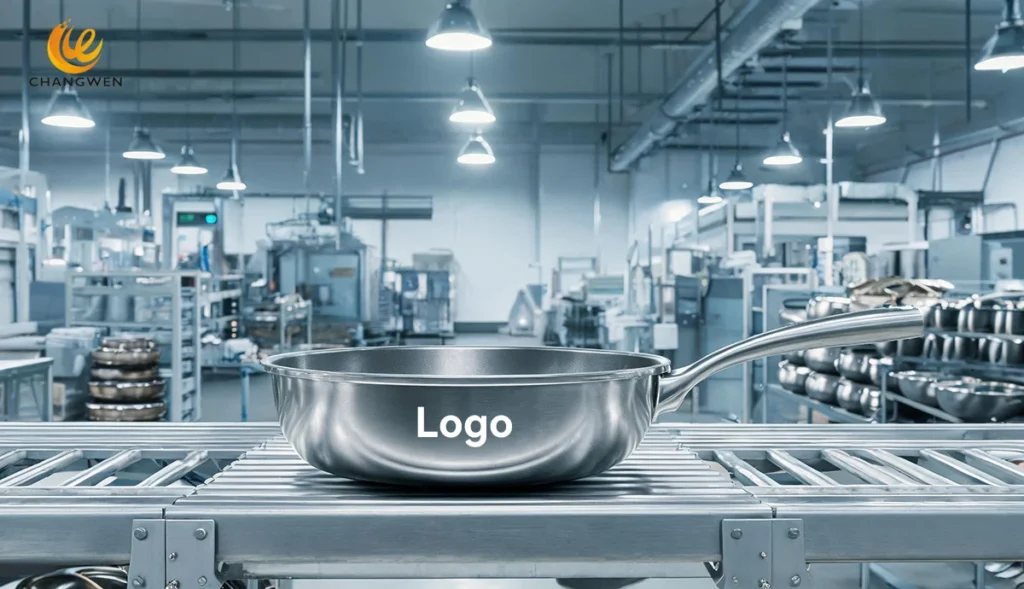
Private label cookware means cookware manufactured by a third-party factory and sold under your own brand name. The factory builds the product. You own the brand. You control the price, the positioning, the packaging, and the customer relationship.
This is meaningfully different from simply reselling someone else’s cookware. When you private label, the product carries your identity — your logo, your packaging, your story. Customers who buy from you are building a relationship with your brand, not the factory’s.
Private label vs. OEM — understanding the distinction:
| Private Label | OEM (Custom Manufacturing) | |
|---|---|---|
| Product origin | Existing factory design, branded for you | Designed from scratch to your specifications |
| Customization level | Logo, color, packaging, minor modifications | Full product design, tooling, materials |
| Time to market | Fast — 3–5 months | Longer — 6–12 months |
| Upfront investment | Lower — no tooling costs | Higher — tooling and development costs |
| Exclusivity | Variable — base design may be shared | High — unique to your brand |
| Best for | New brands, fast market entry, concept testing | Established brands, unique IP, deep differentiation |
In practice, many successful brands move along this spectrum: they start with private label to validate the market and build revenue, then layer in OEM customization as volumes justify deeper investment. A capable cookware manufacturer should support both modes — and the transition between them.
Why Start a Private Label Cookware Brand in 2026?
The cookware market is not saturated — it’s stratified. The categories that are overcrowded are generic, unbranded, commodity products with no story and no differentiation. The categories that are wide open are branded programs with clear identity, specific customer focus, and genuine quality claims.
The market opportunity is real:
- Global cookware market projected to exceed $18 billion by 2028
- Online cookware purchasing continues to grow as a share of total sales — opening the market to new brands that don’t need physical retail presence to launch
- Consumer willingness to pay a premium for brands that clearly communicate quality, values, and purpose has never been stronger
- The shift from non-stick to stainless steel, and from single materials to multi-ply construction, is creating new premium sub-categories where branded players can win
The operational model works: A private label cookware business separates brand building (which you do) from manufacturing (which your factory partner does). You focus on customer acquisition, storytelling, quality assurance, and distribution — the activities where brand value is actually created. The factory focuses on making a great product to your specifications and delivering it consistently.
This model requires less capital than founding a manufacturing company and scales more efficiently than most physical product businesses.
Step 1 — Define Your Brand Position and Target Customer
The most important step in starting a private label cookware brand happens before you contact a single supplier. Brand clarity determines product selection, price point, channel strategy, and every design decision downstream. Skipping this step leads to a generic product with nothing to say — and generic cookware at any price point is a hard place to build a business.
Find Your Specific Niche
The cookware market has clearly differentiated segments, and winning brands occupy one of them clearly:
| Segment | What It Requires |
|---|---|
| Professional-grade home cooking | Technical spec credibility, chef endorsement, premium materials |
| Eco-conscious / non-toxic | PFOA-free, ceramic coatings, sustainable sourcing claims |
| Aesthetic / lifestyle | Strong visual identity, premium packaging, social media presence |
| Cultural / cuisine-specific | Deep knowledge of the target cuisine, authentic product design |
| Value-premium | Best quality at the most accessible price — clear spec at fair cost |
| Hospitality / commercial | Commercial-grade specs, volume programs, institutional relationships |
Define Your Target Customer in Specific Terms
“Home cooks” is not a target customer. “25–45 year old home cooks in the US and Canada who are upgrading from non-stick and want to learn proper stainless steel technique” is a target customer. The more specific you are, the more every downstream decision — product selection, pricing, copywriting, channel — becomes obvious rather than difficult.
Answer the Three Brand Questions
Before any supplier conversation, have clear answers to:
- What makes your cookware brand worth choosing over what’s already available?
- What is the experience you’re selling — not the product?
- What does your brand look, sound, and feel like at every customer touchpoint?
These answers are your brand brief. They should inform every decision you make.
Step 2 — Choose Your Core Product Category
Private label cookware spans a wide range of materials, constructions, and product formats. Choosing the right starting point depends on your target customer, price point, and what the cookware manufacturer you work with can deliver at quality.
Materials and Their Market Positioning
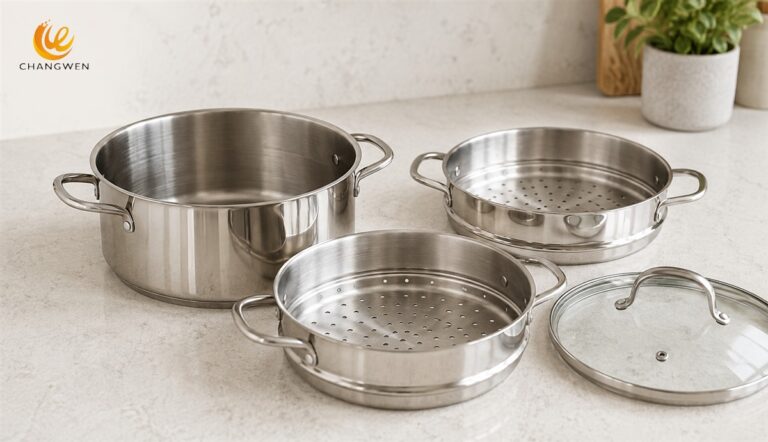
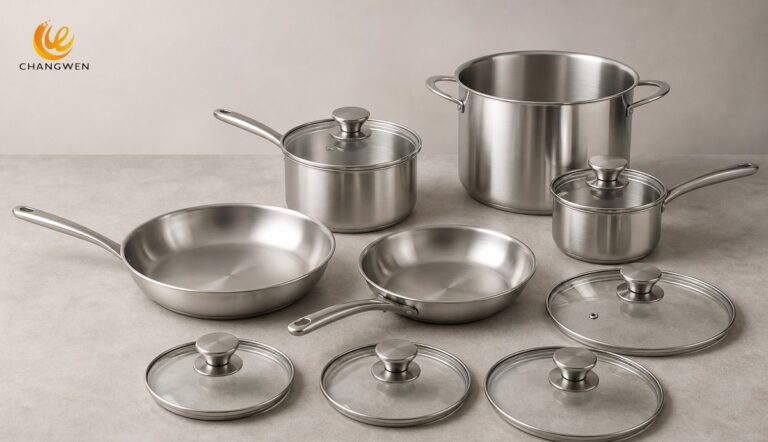
Stainless Steel Cookware (Tri-Ply / 5-Ply) The premium-to-professional tier of the market. Stainless steel carries strong perceived quality, has no coating degradation concerns, and commands loyalty among serious cooks. Tri-ply full-clad construction is the performance standard that premium retail buyers recognize. Appropriate for brands targeting serious home cooks, culinary professionals, and the premium end of the Amazon market.
Non-Stick Aluminum Cookware The highest-volume consumer segment. PTFE-based coatings remain dominant; ceramic-coated options are growing for brands with an eco or health positioning. High accessibility at entry price points makes this the most competitive segment — brand differentiation through design and packaging is especially important here.
Cast Iron Cookware A loyal, enthusiast-driven segment. Cast iron commands strong word-of-mouth and high lifetime value as a customer relationship. Heavier, requiring more care, but valued deeply by its audience. Pre-seasoned and enamel-coated variants expand accessibility.
Carbon Steel Cookware Growing category driven by professional chef influence. Lighter than cast iron, develops natural seasoning, high-heat capable. Strong positioning for chef-influenced brands.
Hammered Stainless Steel A premium aesthetic variant that differentiates visually on retail shelves and in e-commerce photography. The hammered exterior adds scratch resistance and a handcrafted luxury appearance at a meaningful price premium over smooth equivalents.
Start Focused — The Single Hero Product Strategy
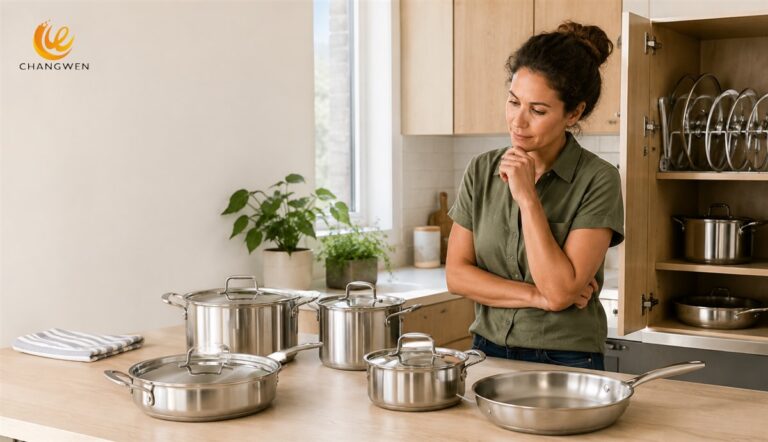
The most common mistake in launching a private label cookware brand is starting with too many SKUs. A 20-item product range requires 20 times the inventory capital, 20 times the photography budget, and 20 times the complexity — while providing no more market validation than a focused 3-item launch.
Start with one to three hero products. A signature frying pan. A flagship cookware set. A distinctive hero item that can lead every marketing conversation. Build depth from a validated foundation, not from an unvalidated wishlist.
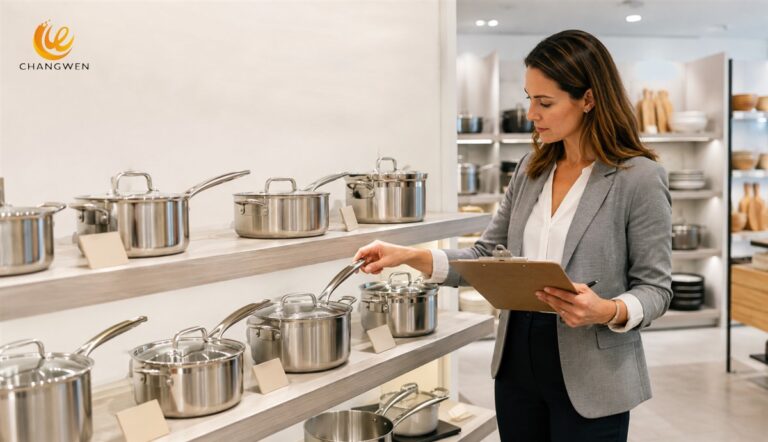
Step 3 — Find the Right Cookware Manufacturer
Your manufacturing partner is the most important external relationship in your brand’s life. A great manufacturer isn’t just a vendor who makes your product — they’re a technical advisor, a quality partner, and a supply chain anchor. Choosing poorly here costs you in quality failures, specification surprises, and supply reliability problems that cascade into customer service crises.
What to Look For in a Private Label Cookware Manufacturer
Manufacturing Experience and Specialization A cookware manufacturer with 15+ years of dedicated cookware production brings tooling knowledge, material expertise, and quality control systems that generalist factories lack. Ask directly: what percentage of their production is cookware? What’s their longest-standing export relationship? What markets do they currently serve?
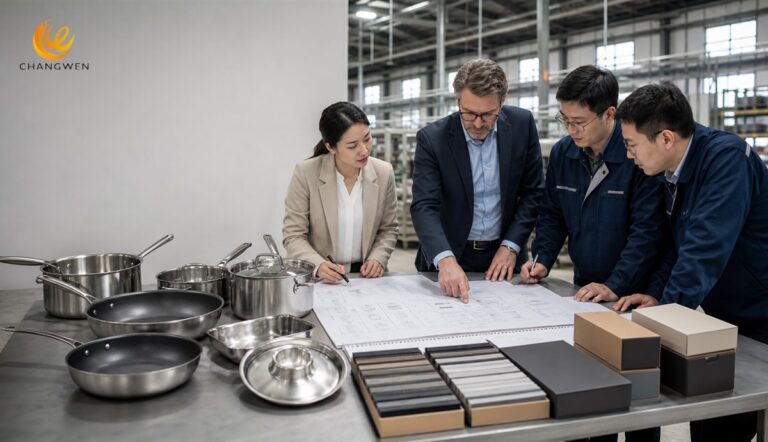
OEM and Private Label Infrastructure A factory capable of supporting private label programs has specific operational capabilities beyond production: an in-house or partner design team for logo and packaging development, a sample room for pre-production prototype approval, packaging sourcing relationships, and the documentation systems to support your compliance requirements.
Export Experience to Your Target Market A manufacturer with active export history to the US understands FDA compliance. One exporting to Germany understands LFGB requirements. One serving Australian retailers understands ACCC standards. Market-specific compliance knowledge is not transferable — a factory that has never exported to your market will be learning at your expense.
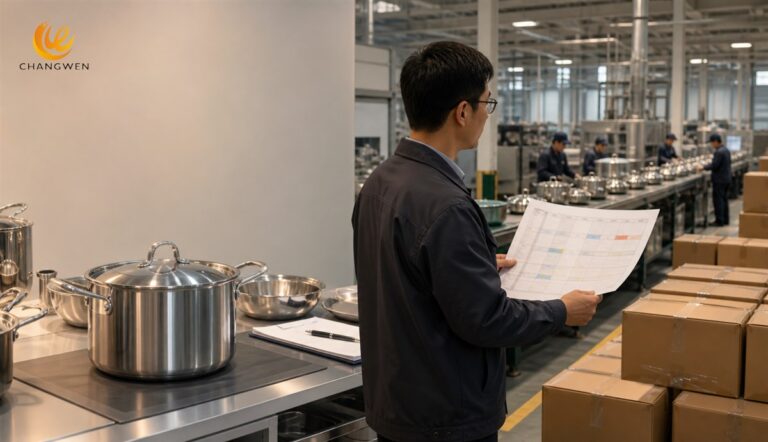
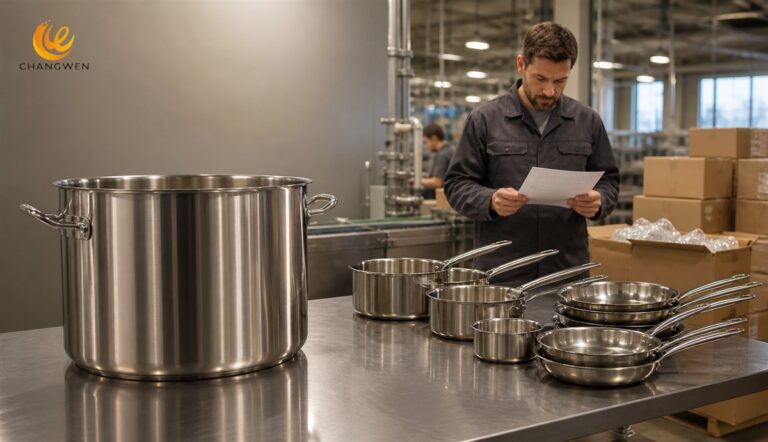
Quality Control Systems Incoming material inspection, in-process checkpoints, pre-shipment inspection, and golden sample retention are the components of a quality control system that protects your brand. Ask specifically how defects are identified and handled at each stage. A factory that welcomes third-party pre-shipment inspection is a factory that stands behind its product.
Certification Documentation For US market sales: FDA food contact documentation. For EU/European market: LFGB certification. For broader compliance: REACH, CA Proposition 65. These should be current documents from accredited laboratories — not claims, not dated certificates, not certificates for different products.
Communication and Response Speed A manufacturer who responds to inquiries within 24 hours, who can discuss specifications technically, and who provides complete quotations with full documentation is demonstrating organizational capability, not just politeness. Slow, vague, or evasive communication at the inquiry stage previews the communication you’ll experience during production.
Factory vs. Trading Company — The Decision That Determines Everything
A trading company aggregates products from multiple factories and resells them with a margin. They’re useful for mixed-category small orders. They are not the right partner for a private label brand that needs consistent quality, direct specification control, and the ability to verify its production process.
A genuine cookware manufacturer controls its own production. You can visit. You can audit. You can see the equipment, meet the QC team, and trace your product from raw material to finished goods. This is where accountability lives — and accountability is what brand quality depends on.
How to tell them apart: a factory welcomes third-party inspection, can show you their production equipment, provides original mill certificates for steel, and has a business license that lists manufacturing (not trading) as its registered activity.
Step 4 — Customize Your Product and Brand Identity
Private label gives you a foundation — now you make it yours. Even working from an existing factory product format, the range of customization available can produce a distinctly branded product that looks nothing like the factory’s catalog offering.
Surface Finish and Color
Exterior color is often the single most impactful visual element. A matte black exterior reads as contemporary and premium. A hammered copper-effect PVD finish reads as artisan and luxury. A deep slate blue reads as design-conscious and modern. Ceramic-coated pastel exteriors read as lifestyle-friendly and accessible.
Your signature color isn’t just an aesthetic choice — it’s a brand recognition tool. A customer who sees your signature color in a kitchen photo, in an Instagram story, or on a store shelf is receiving a brand impression. Make it deliberate.
Logo Application Methods
| Method | Appearance | Durability | Best For |
|---|---|---|---|
| Laser engraving | Precision, fine line | Permanent — dishwasher-proof | Premium lines, handles, pan base |
| Embossing / debossing | Raised or recessed mark | Permanent | Handle branding, tactile premium |
| Screen printing | Full-color capability | Good with quality ink | Colorful logos, detailed marks |
| Etching | Fine decorative detail | Permanent | Artisan aesthetics, pattern work |
| PVD color coating | Metallic color over full surface | Very durable | Full-surface brand color |
Handle Design and Materials
Handles communicate quality before the food is ever cooked. They are the first tactile experience a customer has with your product. Options include:
- Hollow stainless steel (stay-cool, premium appearance, full oven compatibility)
- Silicone-wrapped stainless (comfortable grip, heat insulation, contemporary)
- Bakelite / phenolic (heat-resistant, lightweight, economic)
- Cast stainless (solid, heavy, professional)
Handle color can be customized via PVD coating (gold, rose gold, black, gunmetal) or material selection, giving your brand a signature palette that extends across the full product range.
Packaging — The First Physical Brand Impression
For a cookware brand selling direct-to-consumer or through retail, packaging is a critical brand touchpoint. It’s what customers photograph. It’s what appears in unboxing content. It’s what retail buyers evaluate at trade shows.
Private label packaging options:
- Retail color box — full-color branded packaging with product imagery, specification callouts, and brand story
- Gift set box with insert — premium configuration for gifting programs, seasonal retail, and department store placement
- Hang-tag and sleeve — minimalist approach for cookware displayed on retail hooks or in open-box formats
- FBA-compliant packaging — poly bag, barcode label, suffocation warning label, and packaging dimensions that meet Amazon’s fulfillment center requirements
- Spanish/multilingual packaging — essential for Latin American markets; Portuguese for Brazil; bilingual English/Spanish for US-Hispanic retail
Product Inserts That Build Customer Relationships
The materials inside the box — care instructions, cooking guides, warranty cards, brand story inserts — are the only communication you have with your customer after the purchase and before the next one. Use them:
- A brief care guide prevents the most common product use errors (not preheating stainless steel, using abrasive cleaners on non-stick)
- A recipe card or cooking tip creates a positive first experience with the product
- A brand story insert communicates who you are and why the product matters
- A QR code linking to video content, your website, or a loyalty program builds the digital relationship
Step 5 — Navigate Certifications and Market Compliance
Cookware is a food-contact product. Every major import market regulates it — and the regulations determine whether you can legally sell in that market, whether retail partners will accept your products, and whether online platforms will allow your listings.
Getting this right before you place your first production order protects your business. Getting it wrong after shipment is expensive, sometimes brand-ending.
Certification by Market
| Market | Required / Strongly Recommended | Covers |
|---|---|---|
| United States | FDA food contact documentation | Stainless steel, coatings, handles |
| California (US) | CA Proposition 65 | Heavy metals, chemical disclosure |
| Germany / EU | LFGB | Strictest food contact migration standards globally |
| Full EU | REACH | Chemical substance compliance |
| Australia / NZ | ACCC / food contact regulations | Material safety in food applications |
| Amazon (all markets) | Market-specific compliance documentation | Platform requirements for listing |
| Retail chains | BSCI / Sedex (social compliance) | Factory ethics and working conditions |
Working with Certified Manufacturers
The most practical compliance strategy for a new private label brand is to work with a manufacturer who already holds the relevant certifications for your target market — and to request documentation that confirms those certifications cover the specific products you’re ordering.
“Our factory is FDA compliant” is a claim. “Here is the current FDA food contact test report from an accredited laboratory for this specific product” is documentation. Know the difference, and always request the documentation.
Step 6 — Build Your Go-to-Market Strategy
Product and supply chain in place, the question becomes: how do customers find you, decide to buy, and come back?
Direct-to-Consumer via E-Commerce
A branded Shopify store gives you full margin, full customer data, and full brand expression. It requires investment in traffic — paid media, SEO, email, content — but it’s where long-term brand value is built. Every customer who buys on your website becomes a direct relationship you own.
SEO for cookware brands is a long-term investment that compounds. Articles that answer specific cookware questions — how to choose a stainless steel pan, what tri-ply means, how to care for cast iron — build organic traffic that converts at higher rates than paid traffic because the intent is already established.
Amazon and Marketplace Selling
Amazon is a discovery engine for cookware. Buyers searching for “12-inch stainless steel frying pan” or “non-stick cookware set” are ready to buy — capturing that intent with a well-optimized listing generates immediate revenue.
The trade-off: Amazon compresses margins, limits brand expression, and owns the customer relationship. Most successful cookware brands use Amazon as a customer acquisition channel and their own website as the loyalty and retention channel.
Wholesale and Retail Distribution
Specialty kitchen retailers, department stores, and regional grocery chains offer scale — but require higher inventory commitments, longer sales cycles, and product presentation that works in a physical retail environment. The hammered or premium-finish cookware that photographs beautifully online also performs well on a retail shelf.
For Latin American and emerging markets, wholesale distribution through regional distributors is often the most effective market entry strategy — partnering with buyers who have existing retail relationships and market knowledge.
Social Commerce and Content
Cookware brands with a culinary point of view — recipe content, cooking technique education, behind-the-scenes brand content — build audience engagement that converts. TikTok and Instagram are particularly effective channels for cookware because the product is inherently visual and the cooking content niche has a deeply engaged, purchasing-intent audience.
Step 7 — Manage Your Supply Chain and Scale
Private label cookware requires inventory investment and supply chain discipline. Getting both right is what separates brands that scale from brands that run out of stock at the wrong moment or get stuck with unsold inventory.
Inventory Planning Fundamentals
Start conservative, learn fast. Your first order should be sized to test the market and gather customer feedback, not to fill a warehouse for 18 months. The learnings from your first 1000 units will change your product, your messaging, and your channel decisions in ways you can’t predict from a spreadsheet.
Know your lead time. Standard private label cookware production lead time from a China-based manufacturer is 30–45 days from order confirmation. Add 15–30 days for ocean freight to most destinations. Total time from reorder to arrival: 6–10 weeks. Your reorder point should be set far enough in advance to never run out.
Build safety stock. Once you have reliable demand data, maintain 4–6 weeks of safety stock to absorb production delays, shipping disruptions, or unexpected demand spikes.
Scaling the Manufacturing Relationship
A manufacturer relationship that works at 500 units needs to be evaluated for its ability to perform at 5,000 units and 50,000 units. Discuss production capacity, peak season scheduling, and pricing at volume tiers before you need them. A manufacturer who has grown with customer programs understands what scaling support looks like — and provides it proactively.
Why Changwen Is the Right Manufacturing Partner for Your Private Label Cookware Brand
Changwen Cookware and Kitchenware Co., Ltd. is a professional cookware manufacturer with over 20 years of OEM/ODM manufacturing experience, supplying private label cookware programs to brands, wholesalers, and importers in 80+ countries worldwide.
Choosing Changwen as your private label manufacturing partner means choosing a factory that has already solved the problems most new brands encounter:
Full Private Label Service — End to End
| Service | What Changwen Delivers |
|---|---|
| Logo application | Laser engraving, embossing, screen print, etching — your choice |
| Packaging design | Color box, gift set, FBA-ready, multilingual — full customization |
| Handle customization | Color (gold, chrome, black, rose gold), material, ergonomic profile |
| Surface finish | Mirror, satin, hammered, PVD color, mixed-finish combinations |
| Set configuration | 3-piece, 5-piece, 7-piece, 10-piece, 12-piece, 72-piece — flexible |
| Custom mold development | Unique handle shapes, lid profiles, body designs |
| Certification support | FDA, LFGB, REACH, CA Prop 65, BSCI documentation |
20+ Years Manufacturing Experience — Across Every Cookware Category
Changwen’s manufacturing scope covers the full cookware product spectrum:
- Stainless steel cookware — tri-ply, 5-ply, capsule bottom, hammered, smooth
- Non-stick cookware — PTFE, ceramic, granite-effect, marble-effect coatings
- Cast iron cookware — plain and enamel-coated
- Carbon steel cookware — traditional and modern wok formats
- Dinnerware — porcelain, ceramic, stainless steel
- Kitchen tools & utensils — coordinated stainless steel sets
- Whistling kettles — standard and gooseneck, full finish range
- Knives & cutlery — chef’s sets, OEM cutlery programs
Build your entire product catalog — across categories and price tiers — with a single manufacturing partner.
Factory Direct — Transparent Pricing, Direct Accountability
Changwen is a factory, not a trading company. You talk to the people who make the product. Every specification question gets a production answer, not a relay through a sales agent who may not know the answer either.
Factory-direct pricing on a container order can represent thousands of dollars in recovered margin versus trading-company pricing for equivalent goods. That margin is yours — to invest in marketing, to price competitively, or to take as profit.
Flexible MOQ — Start Where You Are
Private label programs at Changwen start from 800 pieces per SKU for trial orders — enough to test the market without overcommitting capital. Standard production programs typically operate at 1,000 units per SKU, with volume pricing that improves at 2,000, 5,000, and container-volume scale.
We would rather build a 10-year supplier relationship starting from a 800-piece trial order than push a new brand into an oversized commitment that doesn’t fit their current position.
Global Market Experience — We Know Your Destination
Changwen has shipped to buyers across North America, Europe, Australia, Latin America, the Middle East, and Southeast Asia. We know what LFGB auditors look for in Germany, what Amazon FBA packaging requirements look like in the US, what NOM-adjacent documentation Mexican importers need, and what hotel procurement programs in the Gulf region require.
We don’t learn your market at your expense. We arrive with the experience already in place.
Frequently Asked Questions
What is the minimum order quantity for a private label cookware program? Changwen’s minimum for private label programs starts from 800 pieces per SKU for trial and initial orders. Standard production programs typically operate at 500–1,000 units per SKU. For new brand programs, we recommend starting with 2–3 core SKUs at 800–1000 units each to validate demand before scaling.
How long does it take to receive my first private label cookware order? From initial brief to first delivery, plan for 10–14 weeks: 2–3 weeks for sample development and approval, 1–2 weeks for pre-production confirmation, 30–45 days for production, and 15–30 days for ocean freight. Air freight is available for urgent initial orders at higher cost.
Do I need my own certifications, or does the manufacturer’s certification cover my products? Manufacturer certifications (FDA, LFGB, REACH) apply to the materials and production processes used — including the products manufactured using those approved materials. Request documentation specific to your products and confirm that your items are covered by the certificates provided. For retail channel partners who require independent third-party testing, Changwen supports third-party inspection arrangements.
Can I start with just one product? Absolutely — and for most new brands, starting with one or two hero products is the smarter strategy. A focused launch reduces inventory risk, simplifies your marketing message, and generates the market feedback you need before committing to a broader product range.
What’s the difference between private label and full OEM with Changwen? Private label means branding an existing Changwen product format with your logo, colors, and packaging. OEM means custom-developing a product to your unique specifications — new handle shapes, unique body profiles, proprietary coating formulations. Changwen supports both, and the transition from private label to deeper OEM customization as your program scales is a natural evolution we actively support.
Can Changwen produce packaging in Spanish or Portuguese for Latin American markets? Yes. Changwen’s packaging design support includes Spanish-language and Portuguese-language text, bilingual layouts, and regional compliance formatting for Latin American retail channels.
Start Building Your Private Label Cookware Brand Today
Your brand idea is worth pursuing. The market is ready for brands that show up with clarity, quality, and a genuine point of view. Private label cookware gives you the fastest, most capital-efficient path from that idea to a product your customers can hold, use, and recommend.
Tell us about your brand:
- 🍳 Product categories you want to launch (stainless steel, non-stick, cast iron, etc.)
- 🎨 Brand aesthetic and handle/finish preferences
- 📦 Packaging format requirements (retail box, FBA-ready, gift set)
- 📊 Target launch quantity per SKU
- 🌍 Destination market and certification requirements
- 📅 Target launch timeline
We’ll respond within 24 hours with a product recommendation, specification sheet, and factory-direct quotation.