Cookware manufacturing partner since 2002 info@cwchangwen.com · +86 180 2296 3948

What Are The Best Stainless Steel Skillet

⏱ Read Time: 11 minutes
The Pan That Will Either Change the Way You Cook — Or Collect Dust in the Back of Your Cabinet
Maria bought her first stainless steel skillet on a Tuesday afternoon after watching a cooking video online.
By Wednesday morning, she had scrambled eggs fused to the surface, a pan that looked like a crime scene, and the sinking feeling that she had made a terrible mistake.
By the following Sunday — after learning one thing that nobody had told her — she seared the best steak of her life in that exact same pan.
The skillet had not changed. Her understanding of it had.
This is the story of the stainless steel skillet: a pan that punishes ignorance and rewards those who understand it with a cooking experience that no non-stick surface can match. It is the most misunderstood pan in the kitchen — and, used correctly, the most powerful one.
This guide tells you everything you actually need to know: what makes a stainless steel skillet great, how to choose the right one, what the best options look like on the market, and what to watch for whether you’re buying one for your own kitchen or sourcing thousands for a brand, wholesale, or hospitality program.
Why Stainless Steel? The Case for the Pan That Doesn’t Baby You
Before we talk about which skillet is best, it’s worth being honest about what stainless steel is — and what it isn’t.
Stainless steel is not beginner-friendly. It requires adequate preheating, appropriate cooking fat, and a willingness to let food develop a crust before trying to move it. Ignore those requirements and food sticks. Follow them and stainless steel outperforms every other surface in the kitchen.
Stainless steel is not forgiving — but it is durable. A non-stick pan needs to be treated gently, replaced every few years, and kept away from high heat. A quality stainless steel skillet survives metal utensils, high-heat searing, oven temperatures above 500°F, dishwasher cycles, and a decade of daily use — and looks roughly the same at the end of it.
Stainless steel is not just a cooking surface — it’s a cooking teacher. The discipline it demands — preheat properly, use fat, wait for the crust — makes you a better cook at everything, including with pans that don’t require it.
Why Cooks Who Learn Stainless Never Go Back
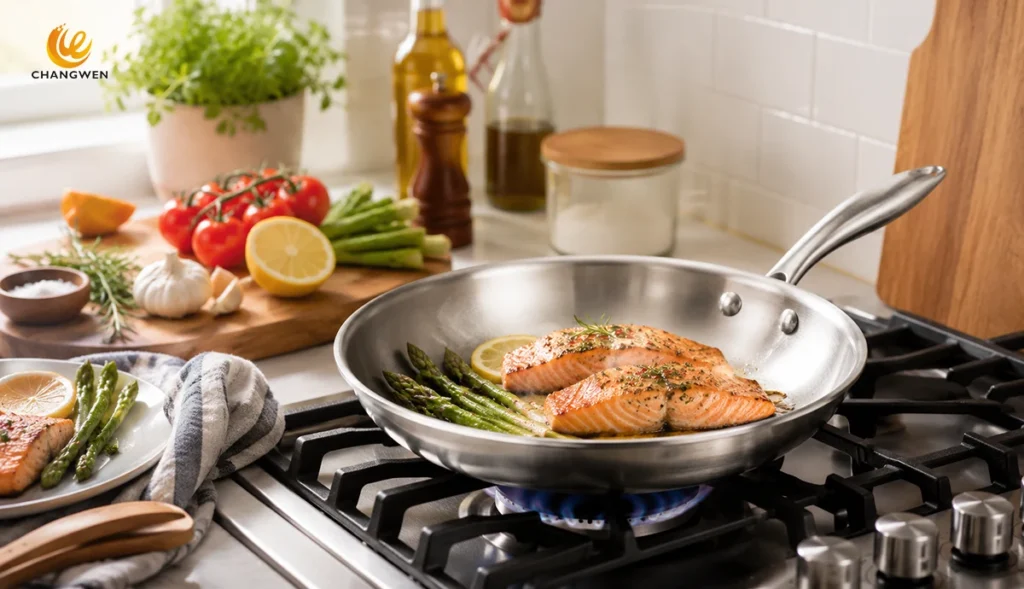
A stainless steel skillet builds fond — the browned, caramelized residue that accumulates on the bottom of the pan during high-heat cooking. That fond is flavor. It’s the base of pan sauces, the depth in a braise, the reason restaurant food tastes the way it does. Non-stick surfaces can’t build fond properly. Carbon steel can. Cast iron can. Stainless steel can — and does it in a lighter, easier-to-maintain package than both.
The cook who masters a stainless steel skillet has access to a cooking technique that non-stick users simply cannot replicate. That’s the real reason it matters.
What Makes a Stainless Steel Skillet Great — The 7 Criteria That Actually Matter
Every skillet review lists features. Very few explain which features matter and why. Here’s the framework.
1. Construction: Full-Clad vs. Capsule Bottom
The most important specification in any stainless steel skillet is whether it’s full-clad or capsule-bottom.
Full-clad construction bonds multiple metal layers — stainless steel, aluminum, stainless steel — across the entire body of the pan, from base to rim. Heat travels evenly up the sides as well as across the base. When you push food up the side of the pan during a sauté, that surface is conducting heat at the same rate as the center of the base.
Capsule-bottom construction bonds the multi-layer disc only to the base of a single-ply pan. The sides of the pan are single-ply stainless steel. They still conduct heat — but unevenly, and significantly slower than the base. Food that rests against the sides during cooking is effectively in a cooler zone.
For everyday cooking — scrambled eggs, sautéed vegetables, simple pan sauces — this difference is noticeable but not catastrophic. For high-heat searing, braising, and the kind of cooking where the whole pan surface needs to perform — full-clad wins, clearly and consistently.
The best stainless steel skillets are full-clad. This is the specification to look for first.
2. Ply (Layer Count): Tri-Ply vs. 5-Ply
Tri-ply (three bonded layers: stainless / aluminum / stainless) is the performance standard that most serious home cooks and professional kitchens rely on. It heats quickly, distributes heat well, and performs reliably across the full range of cooking tasks.
5-ply (five bonded layers) adds an additional aluminum conductive layer and a structural stainless steel core. It heats marginally more slowly than tri-ply but distributes heat with greater uniformity and resists warping better under thermal stress. The performance advantage over quality tri-ply is real but subtle for most everyday cooking.
The honest verdict: a high-quality tri-ply skillet outperforms a cheap 5-ply skillet. Layer count is not a quality guarantee — construction quality, layer thickness, and steel grade are the variables that determine actual performance.
For buyers and brands: tri-ply full-clad is the sweet spot of performance and price-to-value for most market positions. 5-ply full-clad earns its premium when construction specifications are verified.
3. Steel Grade: The Interior Matters Most
The interior cooking surface of a stainless steel skillet should be 18/8 (Grade 304) stainless steel — food-safe, non-reactive, and corrosion-resistant.
Grade 201, which looks identical and costs less, has lower nickel content and significantly lower corrosion resistance. It performs adequately in dry environments initially, but develops rust spots, pitting, and discoloration over time in conditions that Grade 304 handles without issue.
Rule: if the interior steel grade isn’t specified, ask. If it can’t be confirmed as 304, look elsewhere.
4. Size: Matching the Pan to the Kitchen
Skillet size determines what you can cook and how well you can cook it. Here’s the practical guide:
| Size | Diameter | Best For |
|---|---|---|
| 8-inch / 20cm | Small | 1–2 eggs, single portions, small sauces |
| 10-inch / 24cm | Medium | 2–3 person households, most everyday cooking |
| 12-inch / 28–30cm | Large | Family meals, large sears, high-volume cooking |
| 14-inch / 35cm | Extra-large | Restaurant volume, large family batches |
The 12-inch stainless steel skillet is the most searched, most purchased, and most versatile size for home kitchens and retail programs. If you’re building a product line or choosing a single pan, the 12-inch is the anchor SKU.
5. Handle Design: The Feature Everyone Forgets Until They’re Holding a Hot Pan
A stainless steel skillet handle has one job that overrides all aesthetic considerations: staying cool while the pan is hot.
The best handles are hollow stainless steel — the air cavity inside insulates the grip from the heat conducted through the metal. A solid stainless handle conducts heat straight into the hand.
Handle length matters for balance. Too short and the hand is close to the cooking surface. Too long and a full pan becomes unwieldy. An 18–22cm handle on a 10–12-inch pan is the proportional standard that professional kitchen design has refined over decades.
The handle attachment point — where handle meets pan body — is where quality failures happen. Riveted attachment (mechanical fasteners through the pan wall) provides the strongest bond and is the correct specification for commercial kitchen use and quality retail programs. Welded attachment is acceptable when weld quality is confirmed. Screwed attachments loosen with use.
6. Lid Compatibility: The Specification That Changes What the Pan Can Do
A stainless steel skillet used with a lid becomes a different tool. The lid traps steam, creates an oven-like environment inside the pan, and enables cooking techniques — braising, steaming, finishing proteins — that an open pan cannot.
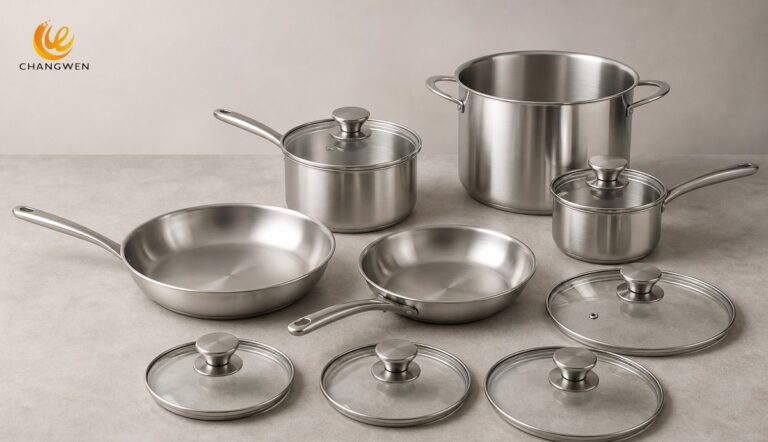
The best stainless steel frying pan with lid and the stainless steel skillet with lid configurations are consistently among the highest-converting product variations in retail and e-commerce because buyers understand intuitively that a pan with a lid is more useful than a pan without one.
Lid options for stainless steel skillets:
- Tempered glass lid: Allows monitoring without lifting. Preferred by home cooks. Handles up to 350°F in most configurations.
- Stainless steel domed lid: Higher heat tolerance, suitable for oven use. Standard in commercial and professional kitchen configurations.
- Vented vs. sealed: Vented lids release steam during simmering. Sealed lids retain moisture for braising and steaming applications.
For OEM programs targeting retail or e-commerce, a skillet sold with a tempered glass lid typically converts significantly better than the same skillet sold pan-only — the perceived value addition exceeds the cost addition.
7. Oven-Safe Temperature Rating
A skillet that can go from stovetop to oven unlocks the full range of professional cooking techniques: starting a thick steak on the stovetop and finishing in the oven; pan-roasting vegetables; baking a frittata; reverse-searing proteins.
Oven-safe temperature is determined by the most heat-sensitive component of the pan. A bare stainless steel pan with a stainless steel handle is typically oven-safe to 500°F / 260°C or higher. Pans with silicone-wrapped handles are typically rated to 400°F / 204°C. Pans with bakelite or plastic handles are typically rated to 350°F / 177°C or lower.
For the most versatile cooking experience — and the highest-value product proposition — specify full stainless steel construction without plastic or silicone components, delivering maximum oven compatibility.
The Best Stainless Steel Skillet Specifications: A Framework for Every Use Case
Rather than a brand-comparative ranking (brands change; good specifications don’t), here is a specification framework for each use case — the attributes that define the best skillet for each context.
Best Stainless Steel Skillet for the Serious Home Cook
A serious home cook needs a pan that rewards technical cooking without adding unnecessary complexity. The ideal specification:
- Construction: Full-clad tri-ply (all layers extend full pan height)
- Interior steel: 18/8 (304) stainless steel
- Total wall thickness: 2.6mm–3.0mm
- Size: 10-inch or 12-inch
- Handle: Hollow stainless steel, stay-cool, riveted attachment
- Lid: Tempered glass with steam vent, matching size
- Oven-safe: To 500°F / 260°C
- Induction compatible: Yes (430 magnetic exterior)
- Surface finish: Brushed or satin interior for better cooking visibility; mirror or satin exterior
This configuration handles every serious home cooking task — searing, sautéing, braising, pan sauces, oven finishing — with the kind of performance that makes the price justifiable over a lifetime of use.
Best Stainless Steel Frying Pan with Lid for Versatile Everyday Use
The best stainless steel frying pan with lid for everyday cooking prioritizes versatility — a pan that works as a sauté pan, a braiser, a steam vessel, and a roasting pan depending on what the lid is doing:
- Construction: Full-clad tri-ply
- Size: 12-inch (the versatility sweet spot)
- Lid: Tempered glass, vented, matching diameter
- Handle: Hollow stainless, sufficient length for lid-on balance
- Helper handle: Yes — a 12-inch pan with lid and food weighs enough that a helper handle significantly improves safety
- Induction compatible: Yes
- Oven-safe rating: Lid and pan both rated to 400°F+ minimum
The stainless steel skillet with lid in 12-inch is the retail and e-commerce configuration that consistently performs as a hero SKU — it photographs beautifully, has obvious functional appeal, and positions clearly against both non-stick alternatives and bare pans.
Best Stainless Steel Skillet for Commercial Kitchen / Restaurant Use
Commercial kitchen requirements are more demanding than any home cooking specification. The pan needs to survive multiple daily uses, extreme thermal cycling, commercial cleaning agents, and handling by multiple staff without degrading:
- Construction: Full-clad tri-ply or 5-ply; alternatively heavy-gauge single-ply (1.2mm+) for budget commercial
- Steel grade: 18/8 (304) interior minimum; 316 for highest-specification professional programs
- Wall thickness: 1.0mm minimum for single-ply commercial; 3.0mm+ for full-clad
- Handle attachment: Fully riveted — non-negotiable for commercial use
- Handle material: Full stainless only — no silicone, bakelite, or plastic
- Oven-safe: To 500°F+ for oven-finishing applications
- Certifications: NSF commercial kitchen certification for US foodservice distribution
Best Stainless Steel Skillet for Amazon FBA / E-Commerce Programs
E-commerce buyers purchase differently from in-store buyers — they can’t feel the weight or see the finish in person, so specification clarity and packaging presentation drive conversion:
- Construction: Full-clad tri-ply — clearly stated in the listing title and bullet points
- Steel grade: 304 — stated explicitly, not implied
- Size: 12-inch as primary SKU; 10-inch as companion SKU
- Lid configuration: Include a tempered glass lid — with-lid listings consistently convert better than pan-only
- Packaging: Retail-ready color box with clear specification callouts; FBA-compliant dimensions
- Photography: The satin or brushed finish photographs better than mirror polish under e-commerce lighting — less glare, more detail visible
The Surface Finish Guide: Why It Matters More Than Most Buyers Realize
The exterior finish of a stainless steel skillet affects retail shelf appeal, e-commerce photography performance, and daily maintenance — and it’s one of the most overlooked specifications in OEM program development.
Mirror Polish (8K)
A high-shine, reflective finish that communicates premium quality at point of sale. Mirror-polished pans are visually striking on retail shelves and in gift packaging. The maintenance consideration: mirror polish shows fingerprints, water spots, and surface scratches more readily than textured alternatives.
Best market fit: Gift retail, premium department stores, packaging-forward programs.
Satin / Brushed Finish
A linear-grained matte finish that is the contemporary design standard in North American and Northern European kitchenware markets. Fingerprint-resistant, easier to maintain than mirror polish, and photographs exceptionally well under both natural and studio lighting.
Best market fit: Premium e-commerce, mainstream retail, any program targeting the design-conscious consumer.
Hammered Finish
An embossed texture that creates a distinctive artisanal aesthetic — and a subtle functional advantage on bare stainless surfaces, where the micro-texturing reduces food-to-surface contact area, improving natural release. Hammered pans command a meaningful retail price premium and differentiate strongly on retail shelves.
Best market fit: Lifestyle brands, farmhouse kitchen aesthetic, premium gifting, differentiated retail programs.
PVD Color Coating
Physical vapor deposition allows permanent metallic color finishes — matte black, gold, rose gold, gunmetal, brushed copper — on stainless steel surfaces. PVD coatings are harder and more durable than paint and resist chipping, fading, and scratching significantly better than spray coatings.
Best market fit: Fashion-forward kitchenware brands, seasonal collections, high-visibility retail programs.
The Most Common Stainless Steel Skillet Mistakes — And How to Avoid Each One
The stainless steel skillet’s reputation for difficulty comes almost entirely from these avoidable errors. Knowing them before you cook — or before you source — changes everything.
Mistake 1: Not Preheating the Pan
The most common reason food sticks to a stainless steel skillet is cooking in an inadequately preheated pan. Stainless steel has microscopic pores in the surface that expand and close at different rates. When the pan is properly preheated, those pores are uniformly open — and fat applied to a properly preheated surface fills them, creating a temporary non-stick layer.
The water test: Sprinkle a few drops of water in the preheated pan. If they scatter into small beads and dance across the surface (the Leidenfrost effect), the pan is at the correct temperature. If they evaporate immediately, the pan is too hot. If they just sit and simmer, the pan needs more preheat time.
This one test, communicated to end users through packaging inserts or product listings, eliminates the majority of “food sticks” returns and negative reviews.
Mistake 2: Adding Cold Fat to a Cold Pan
Fat added to a cold pan and heated together with the pan doesn’t behave the same way as fat added to a properly preheated surface. Add oil after preheat — it should shimmer and thin slightly within seconds of contact with the hot surface. That’s the right moment to add food.
Mistake 3: Moving Food Too Soon
Food sticks to a stainless steel surface during the initial contact phase and then releases — naturally — when the crust has developed. The instinct to move, shake, or scrape food that seems stuck is counterproductive. A protein that’s ready to release will move freely when nudged. One that resists is telling you it needs more time.
Mistake 4: Using the Wrong Size Pan
Overcrowding — fitting too much food into a pan that’s too small — prevents proper browning. Food releases moisture as it cooks; too much food in too small a pan creates steam, and steamed food doesn’t brown. For searing, choose a pan with at least 1–2 inches of clearance around each piece of protein.
Mistake 5: Thermal Shock
Putting a very hot stainless steel pan under cold water immediately after cooking can cause warping — especially in thinner, lower-quality pans. Allow the pan to cool for a few minutes before washing, or wash with warm water rather than cold.
How to Source the Best Stainless Steel Skillets for Your Brand or Program
For importers, brands, wholesalers, and hospitality buyers, sourcing quality stainless steel skillets requires the same specification rigor that separates great end-user products from disappointing ones.
The specifications in this guide — full-clad construction, 304 interior, riveted handles, verified wall thickness — are the same specifications that define a great consumer skillet and a great OEM sourcing decision. The difference is scale and documentation.
What a reputable stainless steel cookware manufacturer provides:
- Steel grade confirmed in writing (18/8 Grade 304) with mill certificate available
- Wall thickness and layer construction specified and documented
- Full-clad construction confirmed with cross-section verification available
- Pre-production sample for physical evaluation before production commitment
- Pre-shipment inspection accommodation (third-party welcome)
- Certification documentation: FDA, LFGB, REACH, CA Prop 65
A manufacturer who hesitates on any of these is a manufacturer whose specifications cannot be trusted at volume.
Why Changwen Builds Skillets That Perform Like the Specification Promises
Changwen Cookware and Kitchenware Co., Ltd. is a professional stainless steel skillet manufacturer with over 20 years of OEM/ODM manufacturing experience, supplying premium stainless steel skillets and cookware to brands and distributors in 80+ countries worldwide.
Every skillet specification described in this guide — full-clad tri-ply and 5-ply, 304 interior, riveted handles, verified wall thickness, tempered glass lid options, full range of surface finishes — is available as a standard or custom OEM program from Changwen.
The Changwen Stainless Steel Skillet Program
| Specification | Changwen Standard |
|---|---|
| Available sizes | 6″, 8″, 10″, 12″, 14″ (custom sizes available) |
| Construction | Full-clad tri-ply or 5-ply; capsule-bottom on request |
| Interior steel | 18/8 (304) — mill certificate available |
| Wall thickness | 2.6mm–3.4mm (confirmed per order) |
| Handle | Hollow stainless, stay-cool, riveted (standard) |
| Lid options | Tempered glass (vented) or stainless steel |
| Surface finish | Mirror, satin, hammered, PVD color, mixed |
| Oven-safe | To 500°F / 260°C (full stainless construction) |
| Induction compatible | Yes (430 magnetic exterior) |
| Certifications | FDA, LFGB, REACH, CA Prop 65, NSF (on request) |
| OEM customization | Logo, packaging, custom handle, custom finish |
| MOQ | From 300 pieces per SKU (trial orders) |
| Lead time | Sample: 2–3 weeks · Production: 30–45 days |
Factory Direct — The Difference That Shows Up in Your Product
When you work with Changwen, you work directly with the people who build the pan. Not a sales agent relaying specifications to a factory they’ve never visited. Not a trading company adding a margin between you and the actual manufacturer.
Factory direct means: when you ask if the construction is full-clad, a production manager answers. When you ask for the wall thickness in millimeters, a QC engineer confirms it. When you request a pre-shipment inspection, it happens — because we have nothing to hide about the product we’re putting in your container.
Frequently Asked Questions
What is the best stainless steel skillet for everyday home cooking?
For everyday home cooking, a full-clad tri-ply stainless steel skillet in 10-inch or 12-inch, with 304 interior, hollow stainless handle, and a tempered glass lid, represents the optimal combination of performance, versatility, and price-to-value. The 12-inch is the single most useful size for a household that cooks a variety of meals.
Why does food stick to my stainless steel skillet?
The most common cause is insufficient preheating. Stainless steel requires full preheat before fat is added and food is introduced. Use the water test: water drops should bead and dance across the surface (Leidenfrost effect) before fat is added. This indicates the pan has reached the temperature where natural non-stick behavior activates.
Is a stainless steel frying pan with lid worth buying?
Yes — a stainless steel skillet with lid is significantly more versatile than a pan-only configuration. The lid enables braising, steaming, finishing proteins, and moisture-controlled cooking that an open pan cannot. For retail and e-commerce programs, with-lid configurations consistently demonstrate higher conversion rates than pan-only listings.
What’s the difference between tri-ply and 5-ply stainless steel skillets?
Both are full-clad constructions with multiple bonded metal layers. Tri-ply has three layers (stainless / aluminum / stainless) and heats up slightly faster. 5-ply has five layers and distributes heat with greater uniformity and resists warping better. For most everyday cooking, the performance difference between quality tri-ply and quality 5-ply is subtle. The quality of construction matters more than the layer count.
What size stainless steel skillet should I choose?
A 12-inch (30cm) stainless steel skillet is the most versatile single choice for most kitchens — large enough for family meals and protein searing, manageable enough for everyday use. For a two-pan setup, a 10-inch and 12-inch pair covers virtually every cooking scenario.
Get a Quote for Your Stainless Steel Skillet Program
Whether you’re sourcing for retail, e-commerce, hospitality, or your own kitchen, Changwen’s team is ready to help you specify and produce a stainless steel skillet program that performs exactly the way this guide says it should.
Tell us:
- 🍳 Sizes and configurations required
- 📐 Construction specification (tri-ply, 5-ply, wall thickness)
- 🫕 Lid requirements (tempered glass / stainless / none)
- 🎨 Surface finish and OEM branding requirements
- 📦 Packaging specification (retail box, FBA-ready, gift set)
- 📊 Target order quantity per SKU
- 🌍 Destination market and certifications required
We respond within 24 hours with a factory-direct quotation.