Cookware manufacturing partner since 2002 info@cwchangwen.com · +86 180 2296 3948

Are Hammered Stainless Steel Cookware Worth Buying?

⏱ Read Time: 12 minutes
Yes. Hammered stainless steel cookware is worth buying if you want durable cookware with an attractive handcrafted appearance and excellent heat performance. The distinctive hammered texture isn’t just decorative — it adds structural strength, hides minor scratches better than smooth surfaces, and gives any kitchen a premium aesthetic that lasts for years.
Hammered stainless steel cookware has become increasingly popular across home kitchens, professional restaurants, hotel programs, and private-label retail brands. But popularity alone doesn’t answer the question of whether it’s right for your kitchen — or your business.
In this complete guide, we’ll cover exactly what hammered stainless steel cookware is, why it’s gained such strong market traction, its real advantages and honest disadvantages, how it compares to smooth alternatives, what materials to look for, how to identify quality construction, and where to source it reliably at wholesale or OEM scale.
By the end, you’ll have everything you need to make a confident decision.
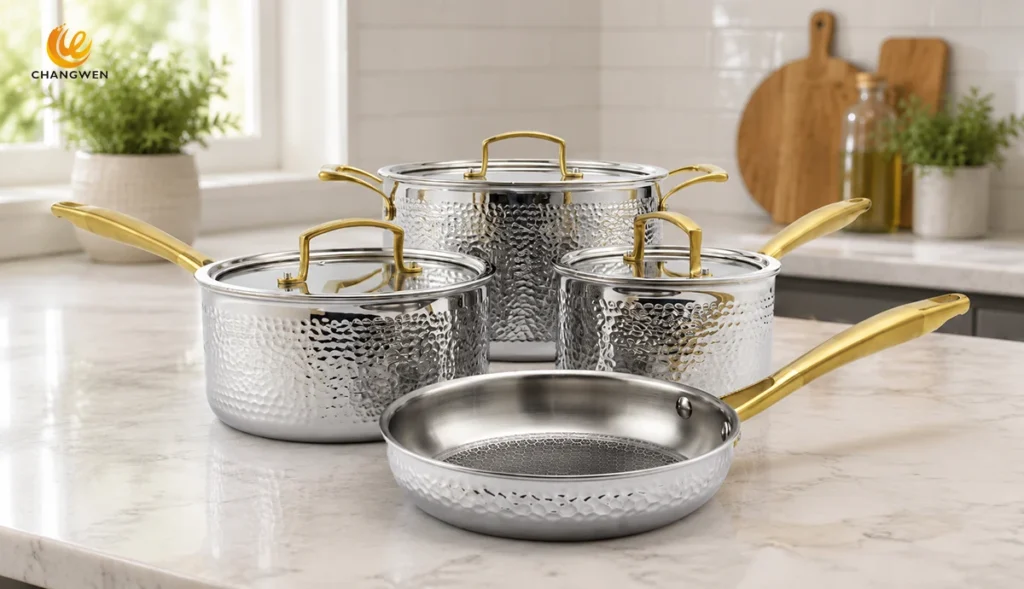
What Is Hammered Stainless Steel Cookware?
Hammered stainless steel cookware is cookware — pots, pans, skillets, woks, and sets — made from stainless steel with a distinctive textured exterior finish created by a hammering process that leaves a pattern of small, overlapping indentations across the surface.
The hammered finish is not merely cosmetic. Each indentation slightly deforms and compresses the metal surface at that point, creating a micro-hardened texture that is structurally more resistant to denting than an equivalent smooth surface. The overall appearance — a rippling, artisanal pattern of light-catching facets — gives hammered cookware a handcrafted luxury aesthetic that stands out distinctively against the uniformity of mirror-polished or satin-brushed alternatives.
How the Hammered Finish Is Made
There are two primary production methods:
Hand Hammered Traditional hand hammering uses a metal hammer or mallet applied by a skilled artisan to the exterior surface of the formed pan. Each strike creates an individual indentation, and the variation between strikes gives hand-hammered pieces their characteristic organic, non-uniform texture — no two pans are identical. Hand hammering is time-intensive and adds meaningful cost, but produces an authenticity and visual depth that machine processes cannot fully replicate. It’s the preferred production method for high-end artisan cookware lines and luxury private-label programs.
Machine Hammered Modern production facilities use CNC-controlled pneumatic hammering equipment or textured pressing dies to apply a consistent hammered pattern across the exterior surface at production scale. Machine hammering produces a uniform texture — the indentations are evenly spaced and consistent in depth — that reads as elegant and premium in retail contexts. It’s the standard method for quality wholesale and OEM hammered cookware programs, allowing the aesthetic to be delivered at volumes and price points that hand hammering cannot support.
Both methods are used in Changwen’s production — hand hammering for premium artisan programs, machine hammering for scalable OEM and wholesale programs — and both produce genuine hammered surface quality rather than embossed or printed simulations.
Why Is Hammered Cookware So Popular?
The market for hammered cookware sets and individual hammered pieces has grown significantly over the past decade. Five factors explain the demand:
1. Elegant Appearance That Works in Any Kitchen Context
The unique handcrafted texture of hammered stainless steel creates a luxury design aesthetic that performs at point of sale, in open-kitchen restaurant settings, in social media photography, and in the daily visual experience of a home kitchen. Hammered cookware doesn’t hide at the back of a cabinet — it displays well, photographs beautifully, and communicates quality to anyone who sees it.
For open-kitchen restaurants, hotel kitchens with guest visibility, and any retail program where shelf presence drives purchase decisions, the hammered finish is a meaningful commercial advantage over smooth alternatives.
2. Better Scratch Resistance in Daily Use
The hammered texture creates a visual environment where minor surface scratches — the inevitable result of daily cooking use, utensil contact, and storage — are absorbed into the existing texture pattern rather than standing out against a uniform surface. A scratch on a mirror-polished pan is immediately visible. The same mark on a hammered surface blends into the texture and becomes visually invisible.
For buyers concerned about long-term aesthetic maintenance, this is a genuine practical advantage. Hammered cookware looks good for longer in daily use than equivalent smooth-finish alternatives.
3. Stronger Surface Resistance to Dents
The mechanical hammering process work-hardens the metal at each indentation point, creating a surface that is more resistant to denting and deformation under impact than the same gauge smooth surface. For cookware that sees regular handling, storage stacking, and the occasional kitchen accident, this structural advantage extends the product’s presentable lifespan.
4. Excellent Heat Distribution — Especially with Tri-Ply Construction
The hammered finish is applied to the exterior surface only — the interior cooking surface remains smooth and food-safe. Heat distribution performance is determined by the construction type (tri-ply, 5-ply, capsule bottom, single-ply), not the exterior finish.
Hammered tri-ply cookware — combining the full-clad three-layer aluminum core construction with a hammered exterior — delivers the same even, responsive heat distribution as smooth tri-ply, with the additional aesthetic and structural benefits of the hammered finish. The combination is the most popular configuration in premium hammered cookware programs.
5. Long Service Life from Quality Materials
Hammered stainless steel pots and pans built with 304 food-grade stainless steel, heavy-duty construction, and quality handle attachment deliver a service life that justifies the higher initial investment compared to coated non-stick alternatives. The 304 stainless interior doesn’t degrade, chip, or require replacement. The hammered exterior maintains its appearance longer than smooth finishes. The structural work-hardening of the hammered surface resists the physical wear of daily kitchen use.
Pros of Hammered Stainless Steel Cookware
| Advantage | Description |
|---|---|
| Beautiful appearance | Unique luxury design that elevates any kitchen aesthetic |
| Durable construction | Work-hardened hammered surface and stainless steel core for extended service life |
| Scratch resistant | Textured surface absorbs and conceals minor scratches from daily use |
| Dent resistant | Hammered texture is structurally stronger than smooth equivalent |
| Easy to clean | Smooth interior cooking surface; exterior texture releases food residue easily |
| Induction compatible | 430 magnetic stainless steel exterior works on all cooktop types |
| Food safe | 304 (18/8) stainless steel interior — non-reactive, PFOA-free, PTFE-free |
| Versatile | Suitable for all stovetop types, oven use, and most cooking techniques |
| Premium shelf appeal | Outperforms smooth cookware in retail and e-commerce visual presentation |
| Customizable | Ideal for OEM and private-label programs requiring distinctive visual identity |
Cons of Hammered Stainless Steel Cookware
Maintaining objectivity builds Google’s trust — and yours. Here are the genuine disadvantages:
Higher Manufacturing Cost The hammering process — whether hand or machine — adds production time and cost compared to smooth-finish cookware at equivalent construction specifications. This translates to a higher retail price point. For buyers with strict budget constraints, comparable smooth tri-ply cookware offers the same performance at lower cost.
Usually More Expensive The retail price premium for hammered over smooth is typically 15–30% for equivalent construction quality. This premium is justified by aesthetic value and structural advantages, but it is real.
Slightly Heavier The material density of the hammered areas and the thicker overall construction common in quality hammered cookware makes it marginally heavier than thinner smooth alternatives. For most buyers this is a non-issue — quality cookware has appropriate weight — but it’s worth noting for buyers with specific weight requirements.
Exterior Cleaning Requires Slightly More Attention While the hammered texture conceals scratches, it also has more surface area with micro-crevices than a smooth finish. Food splatter that settles in the texture requires slightly more thorough wiping than a smooth exterior. The interior cooking surface cleans identically to smooth stainless.
More Limited Style Variety Hammered finish cookware is available in a narrower range of colorways and finish variants than smooth alternatives — the texture itself is the defining visual element, which limits color customization to PVD-coated hammered options rather than spray-painted variants.
However, for most buyers — home users and commercial buyers alike — the advantages clearly outweigh these disadvantages. The higher cost reflects genuine quality and aesthetic differentiation, not arbitrary premium pricing.
Hammered vs. Smooth Stainless Steel Cookware
This is one of the most common buying decision questions in this category. Here’s the honest comparison:
| Feature | Hammered Stainless Steel | Smooth Stainless Steel |
|---|---|---|
| Appearance | Luxury, handcrafted, distinctive | Classic, clean, professional |
| Scratch visibility | Low — texture conceals marks | Higher — marks visible on smooth surface |
| Dent resistance | Higher — work-hardened surface | Standard |
| Interior cleaning | Same — smooth interior | Same |
| Exterior cleaning | Slightly more attention needed | Slightly easier |
| Heat performance | Identical (determined by construction) | Identical (determined by construction) |
| Price | Higher (15–30% premium) | Lower |
| Durability | Excellent | Excellent |
| Retail shelf appeal | Outstanding | Good |
| OEM differentiation | Strong — distinctive brand visual | Moderate |
| Market positioning | Premium, luxury, artisan | Mid-range to premium |
Which One Should You Choose?
Choose hammered stainless steel if:
- You prioritize aesthetics and want cookware that makes a visual statement
- You’re building a private-label or OEM brand that needs a distinctive visual identity
- You operate an open kitchen where cookware is visible to guests
- You’re targeting premium retail or e-commerce channels where shelf presence matters
- You want cookware that maintains its appearance longer under daily-use scratching
Choose smooth stainless steel if:
- Your budget requires the most performance-per-dollar without aesthetic premium
- Your use case is purely functional with no visual presentation requirement
- You prefer a wider range of finish and color options
- You’re sourcing for high-volume institutional programs where appearance is secondary to cost efficiency
What Materials Are Used in Hammered Stainless Steel Cookware?
The hammered finish is a surface treatment applied to the exterior — the interior construction materials are what determine safety, performance, and durability. Here’s the full material picture:
Stainless Steel Grades
304 Stainless Steel (18/8) The food-grade standard for cookware interiors. 18% chromium and 8% nickel composition delivers excellent corrosion resistance, non-reactivity with food, and durability suitable for lifetime use. This is the minimum specification for any quality hammered cookware program.
316 Stainless Steel (18/10) Higher nickel content (10%) for superior corrosion resistance, used in premium programs targeting European markets or marine/hospitality environments where corrosion exposure is elevated.
430 Stainless Steel (Magnetic) Used for exterior layers in induction-compatible construction. Not food-contact grade — its role is to provide the magnetic properties that induction hobs require.
201 Stainless Steel (Economy) Lower nickel content, reduced corrosion resistance. Found in budget-tier products. Not recommended for quality hammered cookware programs targeting discerning buyers.
Construction Types
Tri-Ply (3-Layer Full-Clad) Three bonded layers — 304 stainless interior / aluminum core / 430 stainless exterior — running the full height of the pan. The most popular construction for hammered tri-ply cookware programs. Delivers even heat distribution, induction compatibility, and the structural quality that justifies the hammered finish premium.
5-Ply (5-Layer Full-Clad) Five bonded layers for superior heat uniformity and warp resistance. The premium construction tier — appropriate for explicitly ultra-premium hammered cookware programs where the construction matches the aesthetic positioning.
Capsule Bottom An aluminum or composite disc bonded to the base of a single-ply stainless body. More economical than full-clad. Heat distribution concentrated at base only. Acceptable for entry-level hammered programs but should be disclosed clearly — not marketed as full-clad.
Aluminum Core The conductive layer responsible for the heat-spreading performance of multi-ply construction. High-conductivity pure aluminum (1050/1060 grade) delivers the best thermal performance. Verify aluminum grade in premium programs.
Is Hammered Stainless Steel Cookware Safe?
Yes — hammered stainless steel cookware is entirely safe for food preparation and cooking.
The safety credentials of quality hammered stainless steel cookware are comprehensive:
Food-Grade Interior The interior cooking surface is 18/8 (304) food-grade stainless steel — the same material used in professional food-service equipment worldwide. It is non-reactive with acidic foods, non-reactive with alkaline foods, and does not leach detectable quantities of metal into food at normal cooking temperatures.
PFOA-Free and PTFE-Free Hammered stainless steel cookware contains no PTFE (polytetrafluoroethylene / Teflon-type coating) and no PFOA (perfluorooctanoic acid) — chemicals associated with non-stick coating concerns. The cooking surface is bare stainless steel — no coating of any kind.
Non-Toxic Quality 304 stainless steel has no toxic components. The aluminum core is fully encapsulated between stainless steel layers and never contacts food.
Rust and Corrosion Resistant The chromium content of 304 stainless steel forms a passive oxide layer on the surface that prevents rust and corrosion under normal cooking conditions. Proper care — drying after washing, avoiding prolonged saltwater contact — maintains this protection indefinitely.
Certifications Available Quality hammered stainless steel cookware from established manufacturers can be supplied with FDA food contact documentation (US market), LFGB test reports (European market), and REACH compliance documentation.
How to Choose High-Quality Hammered Stainless Steel Cookware
Eight criteria separate quality hammered cookware from products that use the aesthetic without the substance:
1. Interior Steel Grade
Confirm the interior cooking surface is 18/8 (Grade 304) stainless steel — not 201. Request the mill certificate from suppliers. This single check eliminates the most common quality shortcut in the category.
2. Wall Thickness
Our walls are 2.2mm thick, making them durable.
Specify thickness in millimeters in any purchase order. Vague “heavy gauge” claims without dimensional specification are not verifiable.
3. Base Construction
| Construction | Performance | Best For |
|---|---|---|
| Capsule bottom | Good base distribution | Entry-level, budget programs |
| Tri-ply full-clad | Excellent full-surface distribution | Mid-to-premium retail |
| 5-ply full-clad | Superior uniformity | Ultra-premium programs |
For hammered cookware sets in the mid-to-premium tier, tri-ply full-clad is the correct specification.
4. Handle Design and Attachment
- Material: Hollow stainless steel (stay-cool), silicone-wrapped stainless, or heat-resistant bakelite
- Attachment: Riveted for commercial and premium programs (strongest); welded for consumer retail (acceptable with quality confirmation)
- Ergonomics: Length and angle should maintain comfortable balance with a full pan
Riveted handles are the non-negotiable specification for hammered cookware targeting restaurant, hotel, or quality retail programs.
5. Lid Specification
- Tempered glass: Consumer-preferred; allows monitoring without lifting; rated to 350–400°F
- Stainless steel domed: Higher heat tolerance; professional kitchen standard; oven-safe to 500°F+
- Vented: Steam release during simmering; preferred for sauce and soup applications
The hammered stainless steel pots and pans set with matching tempered glass lids is the most commercially successful retail configuration.
6. Surface Finish Quality
Quality hammered texture should be:
- Consistent in depth and spacing (machine-hammered) or organically varied (hand-hammered)
- Applied cleanly without rough edges or sharp projections at indentation points
- Finished to the same standard on all visible surfaces of the pan
Examine sample pieces under direct lighting to identify inconsistent or shallow hammering that won’t photograph or present as well as it should.
7. Cooktop Compatibility
- Induction: Requires magnetic exterior (430 stainless) — confirm explicitly
- Gas, electric, ceramic: All stainless construction is compatible
- Oven: Temperature rating determined by most heat-sensitive component — full stainless construction rates to 500°F+
For retail and wholesale programs targeting mixed cooktop environments, induction hammered cookware compatibility should be standard specification, not optional.
8. Manufacturer Credentials
- 10+ years of cookware manufacturing experience
- OEM/export experience to your destination market
- Third-party quality inspection welcome
- Certification documentation available (FDA, LFGB, REACH)
- Mill certificates for stainless steel raw material available on request
- Pre-production sample program in place
Applications: Where Hammered Stainless Steel Cookware Performs
The versatility of hammered stainless steel cookware makes it appropriate across a wider range of applications than most buyers initially consider:
Home Kitchen The primary consumer application. Hammered cookware elevates the daily kitchen experience with aesthetics that perform as well as they look. Full-clad tri-ply construction handles every home cooking technique from delicate sauces to high-heat searing.
Restaurant & Professional Kitchen Open-kitchen restaurants and high-end dining operations use hammered cookware as a deliberate visual element of the dining experience. The work-hardened surface resists the physical demands of commercial kitchen use. Premium material specification supports multi-year service life under daily high-frequency use.
Hotel & Hospitality Hotel F&B programs and room service kitchens benefit from hammered cookware’s combination of commercial durability and premium visual presentation. Branded hammered cookware programs — with hotel logo engraving on handles — create a consistent, elevated kitchen identity across multiple properties.
Gift Sets & Premium Retail Hammered cookware sets photograph exceptionally well, present beautifully in gift packaging, and have strong gift-purchase appeal. The premium aesthetic justifies a higher retail price point that supports healthy margins for retail and e-commerce programs.
Wholesale Programs Wholesale buyers targeting mid-to-premium retail channels benefit from the hammered finish’s strong shelf differentiation versus the smooth stainless steel sets that dominate the competitive middle of the market.
OEM & Private Label Brand Programs Hammered cookware is one of the most effective tools for brand differentiation in the OEM cookware category. A private-label brand with hammered-finish cookware occupies a distinct visual identity on retail shelves that smooth alternatives cannot replicate without significant design investment in other areas.
Camping & Outdoor Lightweight hammered stainless construction is increasingly appearing in outdoor and camping cookware programs — the durable surface performs well in the rough handling of outdoor use, and the aesthetic appeals to the lifestyle-oriented outdoor cooking market.
Why Choose Changwen as Your Hammered Cookware Manufacturer?
Changwen Cookware and Kitchenware Co., Ltd. is a professional stainless steel cookware manufacturer with over 20 years of OEM/ODM manufacturing experience, producing hammered stainless steel pots and pans, cookware sets, and kitchenware for brands and distributors in 80+ countries worldwide.
| Capability | Changwen |
|---|---|
| Manufacturing experience | 20+ years OEM/ODM production |
| Hammered finish options | Hand hammered (premium) and machine hammered (volume) |
| Construction | Capsule bottom, tri-ply full-clad, 5-ply full-clad |
| Interior steel | 18/8 (304) standard; 316 on request |
| OEM / Private Label | Full service: logo, packaging, custom handle, custom finish |
| Custom packaging | Color box, gift set, FBA-ready, master carton |
| MOQ | From 1000 pieces per SKU (trial programs) |
| Certifications | FDA, LFGB, REACH, CA Prop 65 |
| QC system | Incoming, in-process, pre-shipment; 3rd-party welcome |
| Global export | 80+ countries; experienced with all major import markets |
| Lead time | Sample: 2–3 weeks · Production: 45–60 days |
Factory direct pricing. When you source from Changwen, you’re paying manufacturing cost — not trading company markup. On a container order, that difference is meaningful.
Full customization capability. Your brand identity on a hammered surface: laser-engraved logo on handle or base, custom packaging with your branding, handle color options (gold-tone, chrome, black, rose gold), surface finish variants (hammered with mirror polish rim, hammered with satin handle, PVD hammered). The hammered exterior is the canvas — we help you make it yours.
Consistency across production runs. Golden sample retention, documented QC procedures, and lot-traceable production ensure the hammered finish quality of your first order matches your hundredth.
Frequently Asked Questions
Is hammered stainless steel cookware better than smooth stainless steel? For most buyers who value aesthetics alongside performance, yes. Hammered cookware offers the same cooking performance as smooth equivalent construction while adding scratch resistance, dent resistance, and a premium visual appearance that smooth surfaces cannot match. If budget is the only consideration, smooth tri-ply delivers the same cooking performance at lower cost.
Does hammered cookware cook differently than smooth cookware? No. Cooking performance is determined by construction type (tri-ply, 5-ply, capsule bottom) and material grade — not the exterior surface finish. A hammered tri-ply pan and a smooth tri-ply pan of identical construction cook identically. The hammered finish affects appearance and surface durability, not heat behavior.
Is hammered cookware dishwasher safe? Quality hammered stainless steel cookware (304 interior, stainless handles) is dishwasher safe. Hand washing is recommended to preserve the hammered finish appearance over time — harsh dishwasher detergents can dull the surface with repeated exposure. Pans with non-stainless handles or components should follow the manufacturer’s care instructions.
Is hammered cookware induction compatible? Only if the pan has a magnetic exterior layer — typically 430 stainless steel. Induction compatibility must be specified; not all stainless steel is magnetic. Confirm explicitly when ordering. Changwen’s hammered cookware programs include induction-compatible construction as standard for most markets.
Does hammered cookware scratch easily? No — the hammered texture is specifically more scratch-resistant than smooth surfaces because minor scratches are visually absorbed into the existing texture pattern. This is one of the genuine practical advantages of the hammered finish over mirror or satin alternatives.
What is the best material for hammered cookware? For most buyers: 304 stainless steel interior with full-clad tri-ply construction (304 interior / aluminum core / 430 exterior). This combination delivers food safety, even heat distribution, induction compatibility, and the structural quality that makes the hammered finish investment worthwhile.
Can I use metal utensils on hammered cookware? Yes — stainless steel interior surfaces are metal-utensil compatible. Unlike non-stick coatings that are damaged by metal utensils, the 304 stainless interior is unaffected by spatulas, tongs, or serving spoons. The hammered exterior is similarly robust against surface contact.
How long does hammered stainless steel cookware last? Quality hammered stainless steel cookware with 304 interior and properly attached handles has a service life of 10–20+ years under normal household use, and many years of commercial kitchen use when maintained appropriately. The stainless steel interior doesn’t degrade over time the way non-stick coatings do.
Is hammered cookware worth the money? Yes — for buyers who value both performance and aesthetics. The premium over smooth equivalent construction (typically 15–30%) buys better scratch resistance, better dent resistance, stronger retail shelf appeal, and a long-term appearance advantage that compounds with daily use. For OEM and brand programs, the hammered finish provides a visual differentiation that generates real market value.
Where can I buy wholesale hammered cookware? Direct from factory manufacturers in China — specifically from OEM-capable factories with verified construction quality, certification documentation, and minimum order quantities suitable for wholesale programs. Changwen offers wholesale and OEM hammered cookware sets and individual pieces with full customization capability, from trial orders of 1000 pieces to full container programs.
Conclusion
Hammered stainless steel cookware is an excellent investment for homeowners, retailers, wholesalers, and cookware brands looking for durable, stylish, and long-lasting cookware that performs as well as it presents.
The combination of luxury appearance, genuine structural advantages, food-safe materials, and long service life creates a product that justifies its price premium — not through marketing language, but through real, verifiable performance characteristics that buyers notice and remember.
When sourced from an experienced manufacturer with verified construction specifications, hammered cookware delivers outstanding cooking performance, distinctive aesthetics, and compelling value for money across every channel from premium home retail to professional hospitality programs.
Looking for a reliable hammered stainless steel cookware manufacturer?
Changwen provides OEM & ODM services, private labeling, custom packaging, and factory-direct pricing for wholesalers, distributors, and cookware brands worldwide. Our hammered cookware programs cover everything from trial orders of 1000 pieces to full 40ft container programs, with full customization capability and certification documentation for every major import market.
Contact Changwen — Request Your Free Hammered Cookware Catalog & Quote →