Cookware manufacturing partner since 2002 info@cwchangwen.com · +86 180 2296 3948

From Brief to Shelf: Building an OEM Cookware Project for a European Retail Brand

Read time: 13 minutes
An OEM cookware project for a European retail brand succeeds when product positioning, material selection, regulatory evidence, packaging, quality control, and replenishment planning are treated as one connected system. The manufacturer does not simply place a logo on an existing pan. The project must translate a retail promise into measurable specifications that can be repeated across 304 stainless steel, carbon steel, titanium, and aluminum cookware.
The best material mix depends on the role of each SKU. 304 stainless steel supports durable everyday cookware, carbon steel supports high-heat frying, titanium supports lightweight or specialized premium products, and aluminum supports responsive heating and coated cookware. A coherent European retail range can use several metals, but every material should have a clear consumer benefit, price position, care message, and compliance path.
What Is an OEM Cookware Project for a European Retail Brand?
An OEM cookware project converts a retailer’s product brief into cookware manufactured to agreed dimensions, materials, finishes, branding, packaging, tests, and delivery requirements. The retailer owns the market proposition and approval decisions, while the manufacturer controls industrialization and repeatable production. Responsibilities should be written clearly because assumptions create delays at sampling and inspection.
A European retail project usually needs more than a single product sample. The project may include a core assortment, country-specific packaging, multilingual instructions, barcode data, food-contact documentation, claims evidence, spare parts, master cartons, and logistics labels. These deliverables affect the critical path as directly as tooling and cookware production.
This article presents a practical project framework rather than claiming a specific completed customer case. Timelines, tests, and documentation must be adapted to the target EU member states, product construction, sales channels, and current legal advice. A retailer should confirm obligations with qualified compliance specialists before market placement.
What Should the Retail Brand Define First?
The retail brand should first define the target customer, retail price band, cooking habits, cooktop mix, product lifespan expectation, and competitive shelf position. These inputs determine whether the range needs lightweight convenience, professional durability, coating-based release, or high-heat performance. A vague request for “premium cookware” cannot produce a defensible specification.
The brand should define a hero product and a limited supporting assortment before discussing every possible shape. A hero frying pan or casserole establishes the material, handle language, finish, and packaging system. Supporting SKUs should extend the same promise rather than creating unrelated engineering projects under one logo.
The brand should also separate mandatory requirements from preferences. Food-contact compliance, induction performance, safe handles, and retailer carton rules may be mandatory; a particular shade or decorative texture may be negotiable. This hierarchy helps the manufacturer protect launch-critical requirements when cost or schedule changes.
How Should 304 Stainless Steel Be Used?
304 stainless steel is a strong choice for saucepans, casseroles, stockpots, saute pans, and uncoated frying pans because it offers corrosion resistance, a durable food-contact surface, and familiar premium positioning. Stainless steel alone distributes heat poorly, so the construction should add an aluminum core, bonded base, or full-clad structure where even heating matters.
A European retail brief should specify steel grade, body construction, wall and base thickness, finish, rim, handle attachment, and induction design. The phrase “304 stainless steel cookware” does not reveal whether the product is single-ply, capsule-bottom, or fully clad. Each construction changes cost, weight, responsiveness, and verification methods.
304 stainless steel works best when the retailer wants long service life and accepts that uncoated cooking requires heat and fat control. The site’s OEM tri-ply stainless steel guide explains how layer structure and manufacturing details influence performance.
Where Does Carbon Steel Fit?
Carbon steel fits frying pans, woks, crepe pans, and griddles that need high-heat response and a surface that can develop seasoning. Carbon steel can be lighter than comparable cast iron while retaining strong searing capability. The material requires drying, seasoning, and corrosion-aware care, so it should be assigned to customers willing to maintain it.
The specification should identify steel grade, thickness, forming method, heat treatment, surface protection, handle design, and flatness tolerance. A preseasoned or temporarily protected finish changes packaging and first-use instructions. Any protective layer intended for food-contact use should be documented and described accurately.
Carbon steel should not be positioned as maintenance-free stainless steel. The retail message should explain color change, seasoning development, acidic-food limitations, and rust prevention. Honest education reduces returns caused by normal patina being mistaken for a defect.
When Does Titanium Make Sense?
Titanium makes sense when low weight, corrosion resistance, or a specialized premium story justifies additional material and manufacturing complexity. “Titanium cookware” can mean solid titanium, a titanium-containing surface, or another construction using titanium terminology. The project brief must state exactly which construction is intended.
Solid titanium is light and corrosion resistant but distributes heat less evenly than aluminum, so thin camping-style vessels behave differently from composite kitchen cookware. A titanium-reinforced coating is still coated cookware and must be evaluated through its full coating system. A titanium layer in a composite body requires verification of layer identity and bonding.
Titanium should be used for a defined technical or market purpose rather than added as a vague premium word. Documentation, claims, testing, and care instructions must match the actual construction. If the benefit cannot be explained in one accurate sentence, the SKU is not ready for retail packaging.
Why Is Aluminum Important?
Aluminum is important because it spreads heat efficiently relative to its weight and supports stamped, forged, and die-cast cookware. It works well for coated frying pans, saute pans, casseroles, and affordable coordinated sets. Induction versions normally need an engineered magnetic base.
The specification should state alloy, forming method, body thickness, base design, surface treatment, coating system, and weight tolerance. Raw aluminum food-contact surfaces and coated aluminum products have different performance and compliance considerations. The aluminum cookware manufacturing guide explains the production sequence behind common constructions.
Aluminum is particularly useful for creating a price-accessible tier without making every product visually basic. Forged or die-cast bodies, refined handles, controlled coatings, and induction bases can support mid-range positioning. The design must still avoid excess weight, unstable bases, and decorative claims that exceed test evidence.
How Do the Four Materials Compare?
| Material | Strongest role | Main limitation | Suitable retail position |
|---|---|---|---|
| 304 stainless steel | Durable, corrosion-resistant everyday cookware | Needs conductive construction for even heating | Core and premium ranges |
| Carbon steel | High-heat frying and seasoning-based release | Requires drying and maintenance | Enthusiast and professional ranges |
| Titanium | Low weight or specialized premium construction | Higher complexity and ambiguous market terminology | Premium or specialist ranges |
| Aluminum | Responsive, lightweight coated cookware | Often needs coating and induction base engineering | Entry to mid-range collections |
No single metal should win every SKU. A saucepan may benefit from 304 stainless steel with an aluminum core, while a fry-pan program may need both carbon steel for high heat and coated aluminum for easy release. Material selection should follow the cooking task, customer skill, price band, and claims strategy.
How Can Different Metals Look Like One Retail Family?
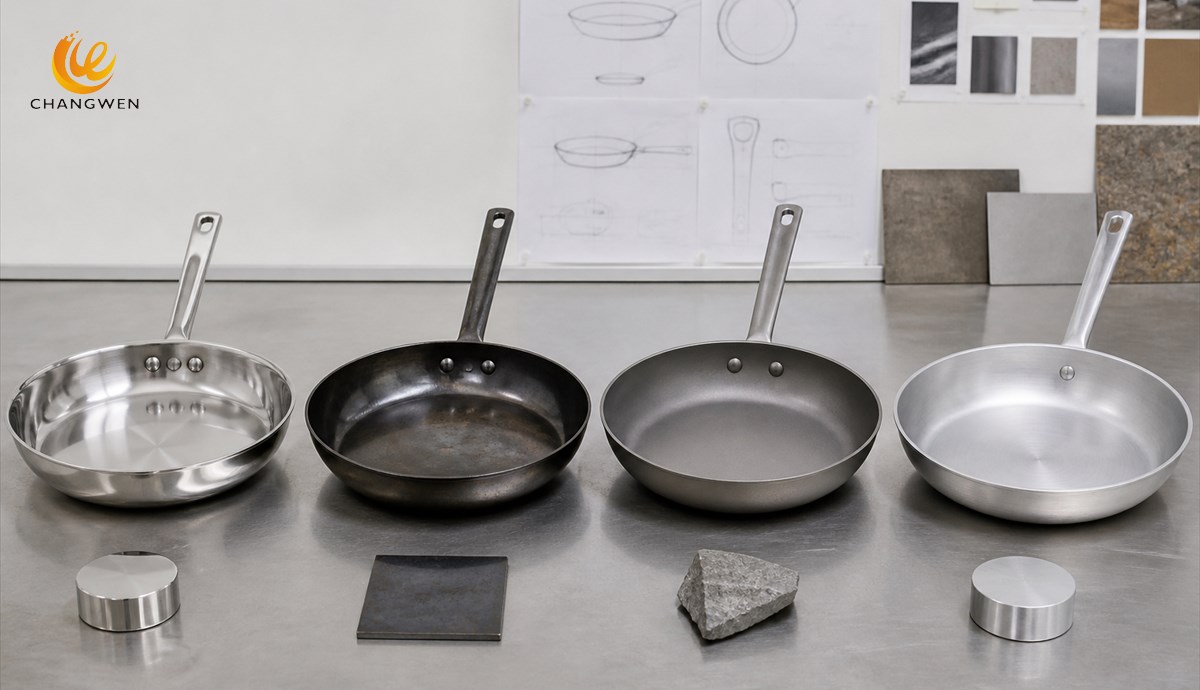
A multi-material range can look coherent when handles, lid architecture, silhouette, surface color, logo placement, packaging grid, and product photography follow a shared design system. Perfect visual identity is not always possible because carbon steel and polished stainless steel age differently. The design language should coordinate the products without hiding their real materials.
Handles are a useful unifying element, but one handle construction may not suit every vessel. A carbon steel pan may need a welded metal handle, while an aluminum pan may use a riveted or molded grip. The family resemblance can come from geometry and color while attachment methods remain optimized for each body.
Packaging should state the distinct benefit of every metal while retaining consistent hierarchy. Consumers should understand why two visually related pans require different care. The cookware packaging guide for retail brands explains shelf communication and protective structures.
What EU Compliance Work Belongs in the Project?
The compliance plan should identify the product construction, food-contact surfaces, coatings, plastics, adhesives, colorants, markets, claims, and intended conditions of use. The brand and importer should determine which EU-wide and national requirements apply. A generic certificate supplied for another product does not automatically cover the finished SKU.
Testing should use representative finished products and describe materials accurately. Migration conditions, simulants, temperatures, durations, and repeated-use cycles should match foreseeable use and the applicable test plan. Technical files should connect purchase specifications, bills of materials, declarations, reports, labels, and traceability records.
REACH-related substance obligations, packaging requirements, consumer information, and country-specific food-contact expectations may also affect the launch. The project team should review requirements early because changing coatings, plastics, inks, or packaging after testing can invalidate evidence or require an assessment update.
How Should the Product Brief Be Written?
The product brief should assign a unique code to each SKU and list dimensions, capacity, weight, materials, construction, finish, color, handles, lids, cooktop compatibility, oven limits, care, packaging, tests, and tolerances. Reference images can communicate intent, but controlled drawings and written specifications determine acceptance.
The brief should define claims before the laboratory plan. Claims such as induction-compatible, dishwasher-safe, oven-safe, recycled content, PFAS-free, or metal-utensil-safe require different evidence. Removing unsupported claims is usually less costly than defending them after packaging and stock reach the market.
A revision table should record every change, approver, date, and affected document. Verbal approvals should be converted to controlled records. This discipline prevents a handle, coating, or carton update from appearing in one document while older specifications remain active elsewhere.
What Should Happen During Supplier Qualification?
Supplier qualification should confirm that the factory can manufacture every selected material or manage approved specialist processes transparently. Multi-material capability should be demonstrated through equipment, process records, sample history, material controls, and quality staff, not a broad catalog alone.
The retailer should review incoming material control, batch traceability, calibration, coating or heat-treatment control, nonconformance handling, corrective actions, and final inspection. A strong quality system identifies process drift before finished cartons accumulate. The bulk cookware purchasing checklist provides additional supplier-review criteria.
Subcontracted operations should be named and controlled. Coating, composite sheet bonding, glass-lid production, packaging printing, or laboratory testing may occur outside the main facility. The OEM remains responsible for coordinating approved specifications and traceability across that network.
How Does Sample Development Work?
Sample development should begin with appearance and construction prototypes, then progress to functionally representative samples. A color sample can approve tone but cannot validate thermal performance. A machined or hand-finished prototype may show shape but may not represent mass-production surface consistency.
The brand should evaluate dimensions, weight, balance, handle comfort, lid fit, base contact, heat distribution, release, cleaning, corrosion behavior, packaging fit, and claim-specific performance. Results should be recorded against pass criteria. Preference comments such as “feels premium” should be translated into measurable changes where possible.
A golden sample should represent the approved product, but it must be supported by specifications and tolerances. One physical sample cannot define hidden material composition or acceptable variation. Signed samples, drawings, bills of materials, colors, and test records together form the approval package.

What Quality Tests Should Be Planned?
All materials need dimensional checks, base flatness, handle torque and fatigue, loaded-lift testing, lid security, thermal cycling, and visual inspection. Test severity should reflect product size and intended use. A large casserole creates different handle loads from a small saucepan.
304 stainless steel products may need grade verification, corrosion-related evaluation, bonding checks, and heat-distribution tests. Carbon steel needs surface-condition, corrosion, deformation, and seasoning-related evaluation. Titanium constructions need material identity and joint or layer verification. Aluminum products need alloy or construction control, base stability, and coating tests where applicable.
Coated products need adhesion, thickness, abrasion, release, staining, and chemical-resistance tests defined by an agreed method. Dishwasher testing should use repeated cycles when the claim is made. Results must be interpreted with the full construction because a handle or exposed edge can fail even when the cooking surface remains intact.
How Should Packaging Be Developed?
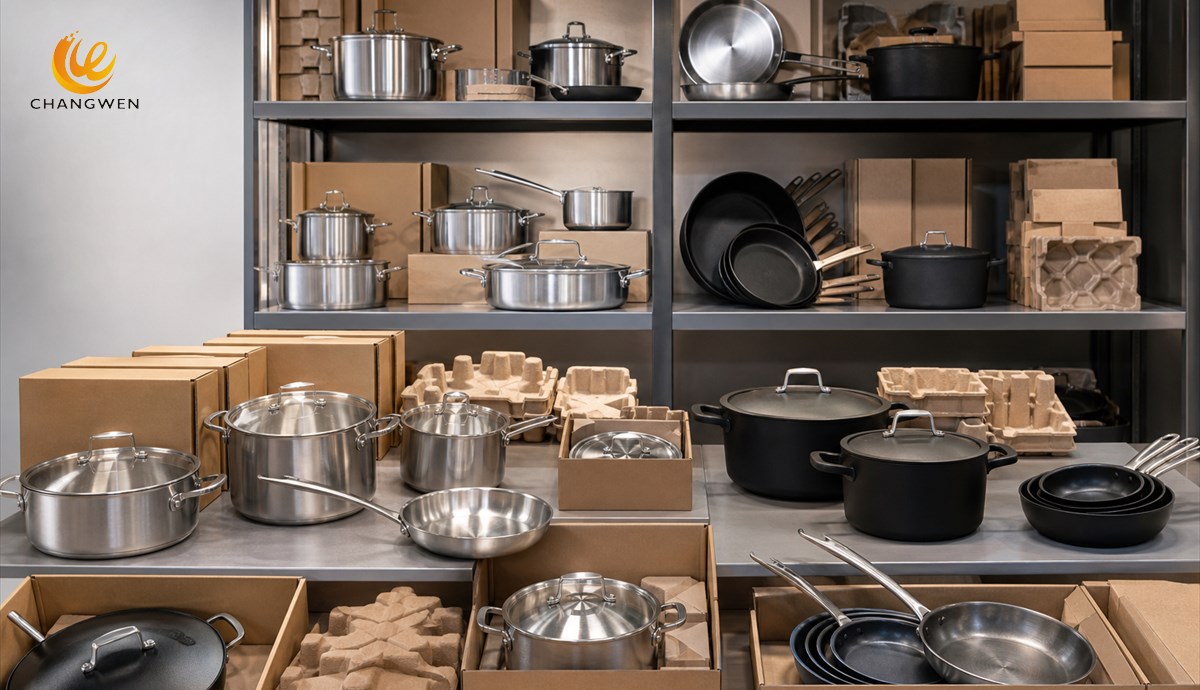
Packaging development should start before the final sample because carton dimensions affect pallet and container efficiency, shelf fit, photography, inserts, and cost. The structure should protect rims, coated surfaces, glass lids, long handles, and polished finishes. Mixed-material products may require different protectors within one visual system.
Consumer-facing packaging should use accurate material names, care instructions, compatibility icons, warnings, responsible-party information, and traceability elements as required. Multilingual content needs controlled translation and enough physical space. Very small type can turn technically complete information into unusable communication.
Transit validation should represent the actual packed configuration and distribution route. A beautiful retail box can fail when handles move, lids strike rims, or nested products abrade each other. Master-carton strength and internal protection should be confirmed before the full packaging order.
What Does a Practical Project Timeline Look Like?
| Stage | Main output | Release decision |
|---|---|---|
| Market and range definition | Customer, price, channels, core SKUs | Approve commercial brief |
| Technical definition | Materials, drawings, claims, tests | Approve request for quotation |
| Supplier and quotation review | Capability, cost, MOQ, lead time | Select development source |
| Sample development | Appearance and functional samples | Approve or revise each SKU |
| Compliance and validation | Reports, declarations, performance data | Release claims and technical file |
| Pre-production | Golden samples, packaging, inspection plan | Authorize mass production |
| Production and inspection | Controlled lots and shipment evidence | Release shipment |
| Launch and replenishment | Sales, returns, corrective actions | Approve reorder changes |
The timeline should be built backward from the required shelf date and include decision time, laboratory queues, artwork translation, packaging tooling, production, inspection, transport, customs, and distribution. A project can have a short factory lead time and still miss launch because approvals or packaging were not on the critical path.
How Should Cost and MOQ Be Managed?
Cost should be compared at equivalent specification and quality risk. A quotation can fall when thickness, material grade, coating, handle construction, inspection, packaging, or documentation changes. The cost breakdown should identify tooling, samples, testing, packaging setup, unit cost, inspection, freight, and expected replacement or spare-part provisions.
MOQ should be assessed by SKU, color, material, packaging version, and production process. Combining quantities across unrelated metals may not reduce the true minimum because each material uses different inputs and production lines. A smaller launch can use standard tooling and focused colors to reduce risk.
The article on OEM cookware container cost helps explain why landed economics involve product mix, packaging, freight, and utilization rather than unit price alone.
What Common Mistakes Should the Project Avoid?
The first mistake is choosing all four materials without a role for each. More materials increase testing, care language, supplier coordination, and inventory complexity. A metal belongs in the launch only when it serves a distinct customer need that cannot be met more simply.
The second mistake is allowing design approval to precede compliance and engineering review. A handle color may require a plastic or coating change, while a decorative finish can alter testing scope. Cross-functional approval should occur before packaging artwork and production tooling are locked.
The third mistake is treating the sample as the specification. Production acceptance requires tolerances, defect definitions, sampling plans, and controlled documents. The article on common importer specification mistakes explains why a premium steel label cannot compensate for weak construction control.
The fourth mistake is launching too many SKUs. A focused range produces clearer sales data and reduces slow inventory. Expansion should follow sell-through, return reasons, customer reviews, and retailer feedback rather than the factory’s full catalog.
How Should Reorders Be Controlled?
A reorder should reference the latest approved specification, golden sample, artwork, packaging structure, color standard, test requirements, and inspection plan. The purchase order should not rely on “same as last time” because personnel, suppliers, and processes can change.
Change control should require notification before any material, coating, component, subcontractor, process, or packaging change. The project team should assess whether a change requires new samples, tests, declarations, or labels. Silent substitution is particularly risky in a multi-material range.
Post-launch data should improve the second production run. Returns can reveal handle discomfort, confusing care instructions, coating misuse, carton damage, or size expectations. A good OEM relationship uses field evidence to refine the product without changing its core promise unpredictably.
Frequently Asked Questions
Which material should lead a European cookware range?
304 stainless steel is a strong core material when durability and broad cooking use lead the proposition. Coated aluminum may be better for an easy-release value range, carbon steel for high-heat enthusiasts, and titanium for a clearly defined lightweight or premium niche.
Can one OEM factory produce all four materials?
Some factories coordinate several materials, but capability should be verified by process and product. Specialized steps may be subcontracted. The retailer needs transparent responsibility, approved sources, traceability, and consistent quality control across the manufacturing network.
Does EU compliance require one universal cookware certificate?
No single document automatically proves every cookware construction is compliant for every EU market and use condition. The evidence package depends on materials, coatings, plastics, claims, intended use, and destination requirements. Finished-product traceability and representative testing are essential.
Should the first order include every planned SKU?
A focused first order is usually safer. A hero product and a few supporting SKUs create useful market data while limiting tooling, testing, packaging, and inventory exposure. Additional sizes and colors can follow demonstrated demand.
What is the most important sample approval?
Functional approval is more important than appearance approval alone. The brand should confirm material, dimensions, heat behavior, handles, lids, surface performance, care, packaging, and claims evidence before authorizing production.
Final Framework for a Successful European OEM Cookware Project
A successful OEM cookware project for a European retail brand begins with a narrow commercial promise and translates it into material-specific specifications. 304 stainless steel, carbon steel, titanium, and aluminum can coexist in one assortment when every metal has a clear task, target customer, price role, and care message.
The project should connect supplier qualification, controlled samples, EU-focused compliance planning, performance tests, packaging, inspection, logistics, and reorder change control. This connected approach creates a retail range that is easier to explain, verify, manufacture, and improve than a collection built from unrelated catalog items.