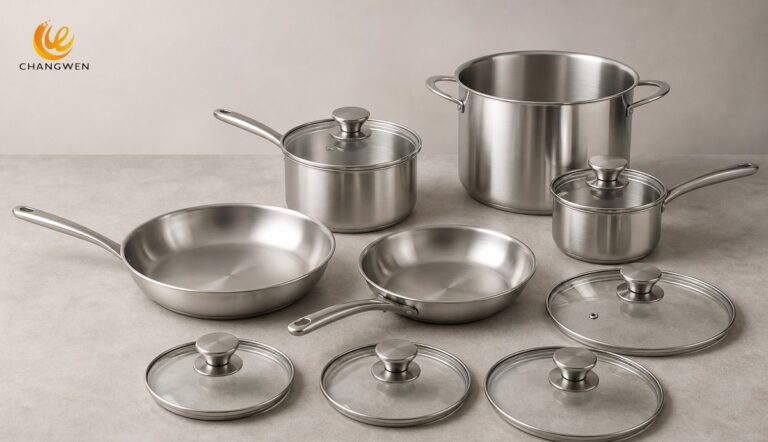
Cookware manufacturing partner since 2002 info@cwchangwen.com · +86 180 2296 3948

The Right-Sized Sear: How to Determine What Size Frying Pan You Need

Read time: 14 minutes
The right frying pan size is the smallest pan that holds the food in one uncrowded layer while still matching the burner and leaving enough room to turn, stir, or reduce a sauce. An 8-inch pan is usually best for one serving, a 10-inch pan is the most versatile choice for one or two people, and a 12-inch pan is better for family portions of three to five servings. Pan depth, cooking-surface diameter, burner size, weight, and storage space can change that recommendation, so the number printed on a product page should be treated as a starting point rather than the complete answer.
Choosing a frying pan by household size alone often produces the wrong result because two households of the same size may cook very different meals. A person who fries one egg needs less usable surface than a person who sears two steaks, even when both cook for one. The most reliable method starts with the foods cooked most often, measures the space those foods require, and then checks whether the pan fits the stove, oven, sink, and storage area.
What Frying Pan Size Do Most People Need?
A 10-inch frying pan is the strongest single-pan choice for many kitchens because it balances usable area, manageable weight, and burner compatibility. A typical 10-inch pan can cook two or three eggs, two modest protein portions, or vegetables for two without demanding the storage space of a larger pan. The same pan remains small enough for controlled tossing and responsive temperature changes on most residential cooktops.
A 12-inch frying pan becomes the better choice when a cook routinely prepares three or more portions, browns food in batches, or needs space for moisture to escape. The extra area reduces crowding, so meat browns instead of steaming and vegetables retain a firmer texture. A 12-inch pan also weighs more, occupies a wider burner zone, and becomes harder to lift when full, which means capacity must be compared with handling comfort.
An 8-inch frying pan is efficient for one egg, a small omelet, a single burger, toasted spices, or reheating one portion. The smaller surface heats quickly and uses less fat to create a continuous coating. An 8-inch pan becomes restrictive when several ingredients must remain in contact with the hot surface, so it works best as a specialist pan or as the smaller member of a two-pan set.
How Is Frying Pan Size Measured?
Frying pan size is normally the diameter measured straight across the top opening from one inside rim to the opposite inside rim. The measuring line must pass through the center of the circular opening, and the handle is not included. This convention describes the pan’s overall category, but it does not reveal the exact diameter of the flat cooking surface.
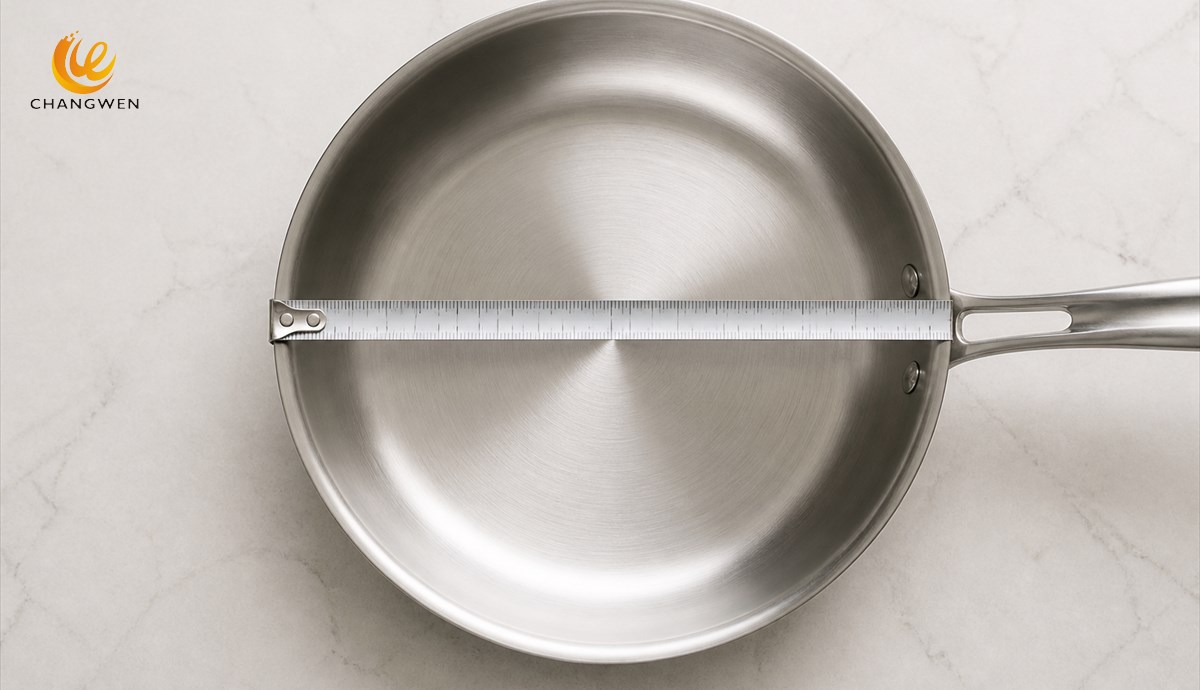
The flat cooking surface is smaller than the top diameter because frying pans have sloped sides. Two pans sold as 10-inch models can therefore hold different amounts of food when one has steep sides and the other has a broad flare. Buyers who need precise capacity should compare top diameter, bottom contact diameter, sidewall angle, and stated volume instead of assuming that equal labels mean equal usable space.
Metric and imperial labels are often rounded rather than mathematically exact. An 8-inch pan is approximately 20 centimeters, a 10-inch pan is approximately 25 centimeters, and a 12-inch pan is approximately 30 centimeters. A manufacturer may label a 24-centimeter pan as a 10-inch category for market convenience, so product drawings provide a more dependable comparison than a converted headline size.
Frying Pan Size Chart: Which Diameter Fits Each Task?
| Nominal size | Typical servings | Best uses | Main limitation |
|---|---|---|---|
| 8 inch / 20 cm | 1 | One or two eggs, one burger, a small omelet, spices | Food crowds quickly |
| 9 inch / 22-23 cm | 1-2 | Breakfast portions, one steak, small vegetable sides | Limited room for multi-part meals |
| 10 inch / 24-26 cm | 1-2 | Two protein portions, three eggs, everyday sauteing | May be small for family meals |
| 11 inch / 28 cm | 2-3 | Larger omelets, cutlets, vegetables, shallow frying | Less common lid and accessory size |
| 12 inch / 30 cm | 3-5 | Family meals, several steaks, stir-fry, pan sauces | Heavier and needs a larger burner |
| 14 inch / 35-36 cm | 5+ | Large batches and commercial-style portions | Difficult to heat evenly on many home stoves |
The chart estimates practical portions rather than fixed capacity because ingredient shape changes how much food fits. Four thin fish fillets may occupy more surface than a larger weight of diced vegetables. A good size decision therefore compares the footprint of the food, not only its weight or the number of diners.
How Much Cooking Surface Does a Larger Pan Add?
Pan capacity grows faster than diameter because cooking area depends on the radius squared. If the flat base of one pan measures 8 inches and another measures 10 inches, the larger base provides about 56 percent more surface area, not merely 25 percent more. This geometric difference explains why a modest increase in labeled diameter can make a substantial difference during searing or batch cooking.
The usable area matters most when food must brown. Meat, mushrooms, and watery vegetables release moisture, and tightly packed pieces trap that moisture as steam. A larger pan separates the pieces and exposes more liquid to evaporation, while an oversized pan used for a tiny portion can burn oil or sauce in the empty zones. The correct surface is large enough to prevent crowding but small enough to remain occupied and thermally stable.
A practical home test can estimate required area without calculations. Arrange the raw ingredients on a dinner plate in the single layer desired during cooking, then measure the width of that arrangement. Choose a pan whose flat interior can contain that footprint with small gaps between pieces. This plate-layout method is more reliable than selecting a size from serving count when meals vary in shape.
How Should Household Size Influence Frying Pan Choice?
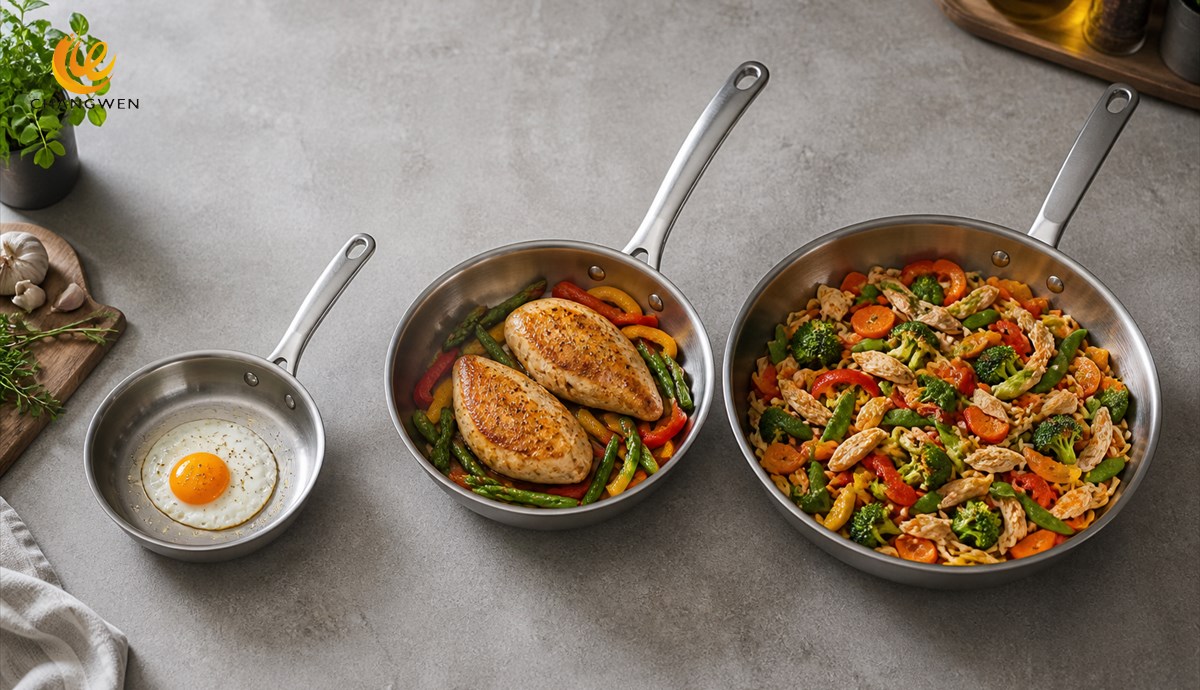
A one-person household usually benefits from an 8-inch or 10-inch pan, depending on whether meals are compact or complete. The 8-inch option minimizes cleanup for eggs and single proteins, while the 10-inch option provides enough space to cook a protein and vegetables together. A solo cook who prepares leftovers may need the same 12-inch size as a family because batch size, not occupancy, controls surface demand.
A two-person household usually finds a 10-inch pan suitable for breakfast and light dinners, but a 12-inch pan is more efficient for two large steaks, fish fillets, or meal preparation. The larger pan keeps portions separated and reduces sequential batches. The smaller pan is easier to handle and wastes less energy for modest servings, so the decision should follow the household’s most space-intensive weekly meal.
A household of three to five people generally needs a 12-inch frying pan for main dishes. A second 8-inch or 10-inch pan adds flexibility for sauces, eggs, garnishes, or dietary separation without forcing every task into the large vessel. This two-pan strategy usually covers more real cooking situations than buying one extremely large pan that performs poorly on a standard burner.
The site’s guide on matching stainless steel pan capacity to family size provides additional household planning considerations. Family size remains useful when it is combined with portion style, batch cooking habits, and stove limitations.
Which Frying Pan Size Fits Eggs, Steak, Fish, and Vegetables?
Eggs need enough room to spread without merging. An 8-inch pan handles one or two fried eggs or a compact two-egg omelet, while a 10-inch pan handles two to three fried eggs or a broader omelet that folds easily. A 12-inch pan can prepare a family breakfast, but the extra open metal may overheat if only one egg is present.
Steak requires clearance around each piece because moisture must escape for browning. One average steak generally fits an 8-inch or 10-inch pan, while two steaks usually need a 12-inch pan. Thick sidewalls and a heavy base help retain temperature, but surface area remains essential because even a heat-stable pan will steam crowded meat.
Fish fillets often need more length than their weight suggests. A 10-inch pan may hold one medium fillet, whereas two fillets or one long whole fish portion can require a 12-inch oval or round pan. Buyers should compare the flat base measurement with the actual fillet length because the sloped wall cannot provide the same searing contact as the base.
Vegetables require space according to water content and desired texture. A 10-inch pan works for a side dish for two, while a 12-inch pan better supports a family-size saute because it accelerates evaporation. The stainless steel frying pan guide explains broader construction and use factors that influence how the selected size performs.
How Should Burner Size Affect the Decision?
The pan’s flat base should align reasonably closely with the active burner zone. A base much wider than the burner develops a hot center and cooler perimeter, which produces uneven browning and longer cooking times. A base much smaller than a powerful burner allows flame or radiant heat to climb the sides, wasting energy and potentially overheating the handle area.
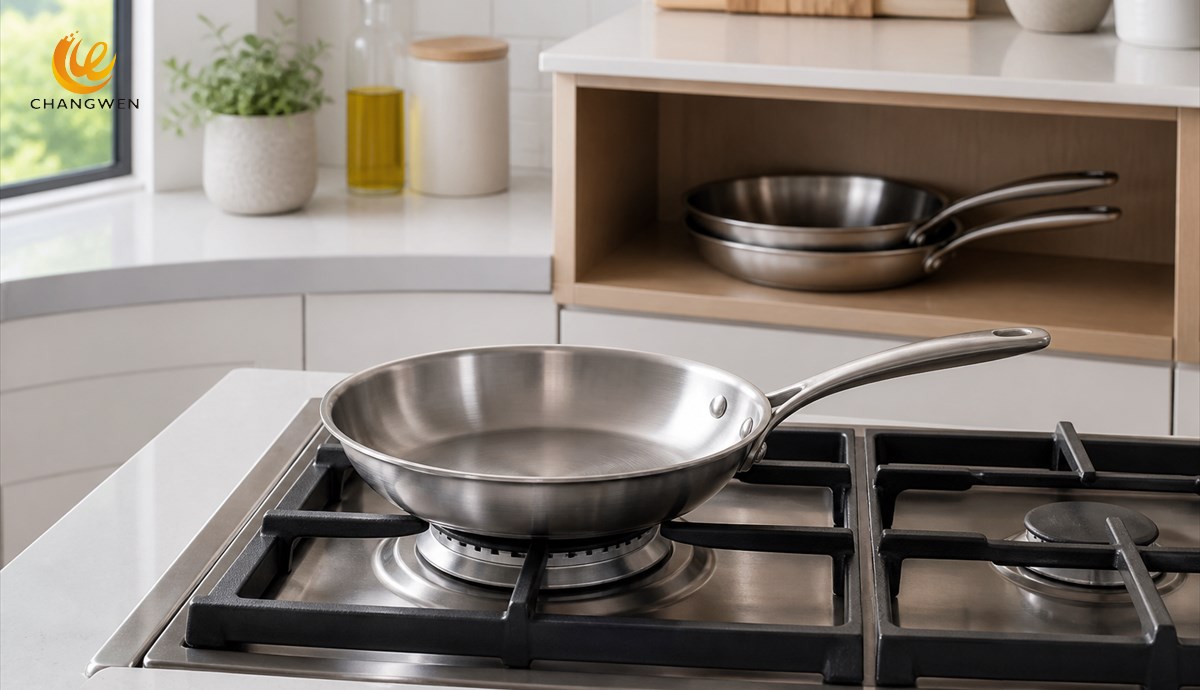
Gas burners tolerate a moderate size mismatch because flames spread outward, but flames should remain beneath the base instead of wrapping around the walls. Electric coil and radiant glass cooktops work best when the base closely matches the marked element. Induction cooktops also require magnetic compatibility and may have minimum or maximum vessel dimensions defined by the appliance manufacturer.
A 12-inch pan can have a base closer to 9 or 10 inches because its walls flare outward. Measuring the bottom contact diameter therefore gives a better burner comparison than using the top diameter. The article about cookware for gas stoves explains how base design and flame control affect cooking performance.
Does Pan Shape Change the Size You Need?
A frying pan with low, flared sides maximizes access for a spatula and releases steam quickly, so it excels at searing and tossing. A skillet with steeper sides may hold more liquid at the same top diameter but can offer a smaller flat base. The frying pan and skillet comparison clarifies how terminology, geometry, and intended cooking methods overlap.
Sidewall height changes effective volume without changing nominal diameter. A shallow 12-inch pan offers excellent evaporation but may spill a large saucy meal, while a deeper 12-inch pan contains more food and reduces splatter. Buyers who cook pan sauces or braised dishes should compare depth and capacity alongside diameter.
Rounded corners make whisking and stirring easier, while sharp interior corners can trap food. A broad flat base improves contact area, whereas dramatic wall flare creates easier tossing and plating. The frying pan design and engineering guide explains how shape, material, and construction interact with usable size.
How Do Material and Construction Affect Size Choice?
Material changes the weight and heat behavior of a given diameter. A large pan with a thick multi-layer body can distribute heat effectively but may become tiring to lift with one hand. A thinner pan is lighter but can develop stronger hot spots, especially when its base extends beyond the burner. The best size is therefore a pan that the user can safely control when it contains food, oil, and liquid.
Fully clad or multi-layer stainless steel construction helps a wider pan spread heat toward its edges. More layers do not automatically make every pan better because layer materials, thickness, bonding quality, and total mass also matter. This tri-ply and five-ply cookware comparison provides a structured explanation of those tradeoffs.
Handle design becomes increasingly important as pan size rises. A long handle provides leverage, but a 12-inch or 14-inch pan may also benefit from a helper handle when it is lifted full. Rivet placement, balance, handle temperature, and grip clearance determine whether nominal capacity can be used safely in everyday cooking.
Should You Buy One Frying Pan or a Two-Pan Set?
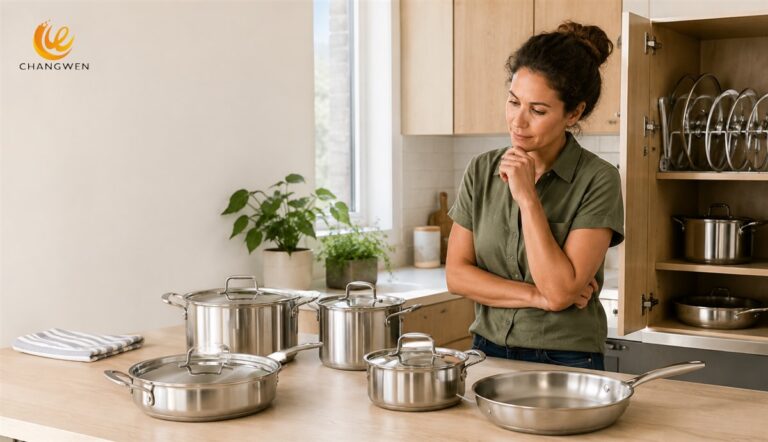
A single 10-inch frying pan is the most efficient starting point for a small household with limited storage. It handles a broad range of breakfasts, proteins, vegetables, and reheating tasks without creating excessive empty surface. A single-pan strategy becomes inefficient when meals repeatedly require either one tiny portion or several separated portions.
An 8-inch and 12-inch combination covers more extremes than owning only a 10-inch pan. The small pan handles eggs, garnishes, and individual meals with minimal fat, while the large pan handles family dishes and high-moisture ingredients. The tradeoff is that neither pan is the exact middle size for routine two-person cooking.
A 10-inch and 12-inch combination suits cooks who prepare full meals and entertain. The 10-inch pan remains manageable for daily use, while the 12-inch pan supports batch browning and side-by-side portions. Buyers should choose a set only when each diameter has a defined weekly job; unused sizes consume budget and cabinet space without improving performance.
What Mistakes Lead to the Wrong Frying Pan Size?
Choosing by top diameter alone is the most common measurement error because the flat cooking base may be substantially smaller. Product specifications should be checked for bottom diameter, depth, capacity, and overall length. A pan that fits the food but blocks an adjacent burner can still be too large for the kitchen.
Buying the largest available pan as a universal solution creates uneven heating when the burner cannot support the base. Large empty regions can also scorch oil, make sauce reduction unpredictable, and increase wrist strain. Extra capacity is valuable only when the stove and cooking volume can use it.
Choosing a pan solely from diner count ignores the physical footprint of food. Three servings of diced vegetables may fit where three fish fillets do not, and two steaks may need more area than a four-portion sauce. The correct comparison uses the largest food arrangement cooked regularly.
Ignoring storage and cleaning space creates a practical mismatch. A 12-inch pan may measure much longer when its handle is included, and a 14-inch pan may not sit flat in a small sink. Buyers should measure cabinet width, shelf depth, oven clearance, dishwasher rack spacing, and sink dimensions before choosing an unusually large model.
How Can You Test Pan Size Before Buying?
A paper template provides a simple size test. Cut or draw circles measuring 8, 10, and 12 inches, place each circle on the intended burner, and check adjacent controls, walls, and cookware. Then place the template in the cabinet and sink to reveal limitations that are not obvious from online product photos.
A food-footprint test makes the template more useful. Place representative ingredients on the paper circle with the gaps needed for browning, then allow a small border so food does not sit against the sloped wall. If the ingredients overlap or touch continuously, move to the next size; if most of the template remains empty, choose the smaller option.
A handling test should account for loaded weight rather than empty weight. Add the listed pan weight to the expected food and liquid weight, then consider whether the cook can tilt, transfer, and wash that total safely. A helper handle can improve control, but it does not reduce the lifting force required.
What Size Frying Pan Is Best for Commercial Buyers?
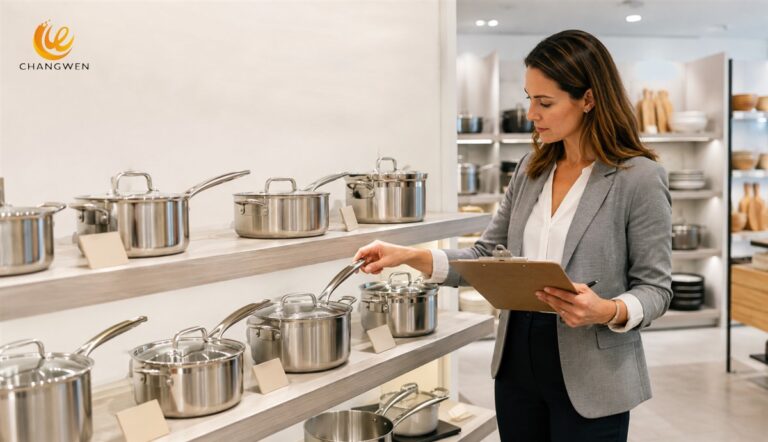
Commercial buyers should select a size range from customer use cases rather than offering every diameter without a merchandising plan. An 8-inch entry supports single servings, a 10-inch model covers general-purpose cooking, and a 12-inch model serves families and batch cooking. This three-size ladder communicates a clear good-better-capacity progression without overwhelming shoppers.
Retail assortment planning should compare regional stove dimensions, household sizes, cabinet standards, and preferred recipes. A diameter that sells well in one market may feel oversized where burners and kitchens are compact. Packaging must also account for the handle’s full length, carton efficiency, shelf depth, and nested-set protection.
Product specifications should state both top diameter and flat-base diameter so buyers can evaluate food capacity and burner fit. Depth, volume, body thickness, total weight, handle length, oven limit, lid compatibility, and induction compatibility make the specification complete. The site’s stainless steel frying pan sourcing guide adds manufacturing and procurement criteria for importers.
Quick Decision Checklist
- Choose 8 inches when the pan will mainly cook one serving, eggs, garnishes, or small reheating portions.
- Choose 10 inches when one or two people need a versatile daily pan that fits most residential burners.
- Choose 12 inches when three to five servings, two large proteins, or moisture-heavy vegetables must cook in one layer.
- Choose 14 inches only after measuring when large batches justify the weight and the stove can heat the base evenly.
- Check the flat-base diameter because nominal size measures the top opening, not the actual burner contact area.
- Measure overall length and storage because a suitable cooking diameter can still be impractical in the kitchen.
Frequently Asked Questions
Is a 10-inch or 12-inch frying pan better?
A 10-inch frying pan is better for one or two servings, lighter handling, and typical medium burners. A 12-inch frying pan is better for family portions, two large proteins, and vegetables that need evaporation space. The better choice is the smallest diameter that prevents crowding during the largest meal cooked regularly.
What size frying pan is best for two people?
A 10-inch frying pan is usually sufficient for two moderate portions, while a 12-inch pan is preferable for two steaks, long fish fillets, batch cooking, or meals that combine protein and vegetables. Two people who cook compact breakfasts need less area than two people who prepare complete dinners in one pan.
What size frying pan is best for a family of four?
A 12-inch frying pan is the most practical starting size for a family of four because it holds several portions in one layer. A 10-inch pan can serve as a second pan for sauces or side dishes, while a 14-inch model should be considered only when burner coverage, storage, and handling strength are adequate.
Does a 12-inch pan have a 12-inch cooking surface?
No. A 12-inch label normally describes the top opening, while the flat cooking surface is smaller because the sides slope inward toward the base. The product drawing or bottom-diameter specification is required to determine actual cooking and burner-contact area.
Can a frying pan be too large for a burner?
Yes. A base that extends far beyond the active burner can develop a hot center and cool edges, causing uneven browning and slow evaporation. A modest overhang is common, but the bottom contact diameter should remain reasonably close to the burner’s heated zone.
Is an 8-inch pan too small?
An 8-inch pan is not too small for one or two eggs, one burger, a small omelet, or toasted ingredients. It becomes too small when multiple proteins or watery vegetables must remain separated. The pan is a useful specialist size even when a larger everyday pan is also owned.
Final Recommendation: Match the Pan to the Food, Burner, and Kitchen
The most dependable frying pan size is determined by three checks: the food must fit in one uncrowded layer, the flat base must match the burner, and the complete pan must remain easy to lift, clean, and store. For most buyers, 10 inches offers the best everyday balance, 12 inches serves families and large portions, and 8 inches handles individual tasks efficiently.
A pan-size label cannot describe usable surface, sidewall geometry, or real kitchen fit by itself. Measuring the food footprint, bottom diameter, overall length, and storage space turns a general size recommendation into a defensible purchase decision. That method reduces crowding, supports even heating, and avoids paying for capacity that the kitchen cannot use.