Cookware manufacturing partner since 2002 info@cwchangwen.com · +86 180 2296 3948

OEM/ODM Tri Ply Stainless Steel Cookware Manufacturer

⏱ Read Time: 11 minutes
Let’s Start with the Uncomfortable Truth About Most Cookware
Here it is: the majority of stainless steel cookware sold today is single-ply.
One layer of steel. Thin base. Hot spots the size of a dinner plate. And a performance gap that any halfway serious cook notices within the first five minutes of use.
Retailers stock it. Wholesalers move it. Buyers order it. And then they wonder why their customers keep coming back to complain about uneven browning, scorched centres, and handles that get uncomfortably hot faster than the food cooks.
Meanwhile — the category that actually solves this problem, the one that professional chefs have trusted for decades, the one that’s now driving the premium end of retail, e-commerce, and hospitality procurement worldwide — is tri-ply stainless steel cookware.
If you’re a brand, wholesaler, importer, or Amazon seller and you’re not yet running a tri-ply stainless steel cookware program, this guide is your briefing.
By the end of it, you’ll understand exactly what tri-ply is, why it outperforms, what an OEM program looks like, and how to find a stainless steel cookware manufacturer capable of delivering the real thing.
Let’s get into it.
What Is Tri-Ply Stainless Steel Cookware?
Tri-ply stainless steel cookware is cookware built from three bonded layers of metal — hence “tri” (three) and “ply” (layer). The layers are permanently fused together through a process called roll-bonding, creating a single composite material that behaves differently from any of its individual components.
Here’s what those three layers are and what each one does:
| Layer | Material | Function |
|---|---|---|
| Inner layer | 18/8 (304) stainless steel | Food-safe cooking surface — non-reactive, easy to clean, durable |
| Core layer | Pure aluminum (or aluminum alloy) | Heat conductor — spreads heat rapidly and evenly across the entire surface |
| Outer layer | Magnetic stainless steel (430) | Structural durability + induction compatibility |
The magic happens because of the aluminum core. Aluminum conducts heat approximately 13× better than stainless steel. By sandwiching it between two stainless layers, tri-ply construction gets the best of both worlds: the food-safety and durability of stainless steel on the surfaces, and the rapid, even heat distribution of aluminum throughout the body.
In full-clad tri-ply construction — the proper version — these three layers run the entire height of the pan, not just the base. Heat travels up the sides of a full-clad pan with the same speed and evenness as across the base. That’s why sauces reduce evenly, why fond develops uniformly, and why tri-ply pans are trusted in professional kitchens where performance is non-negotiable.
What Is Tri-Ply Stainless Steel Cookware — Common Search Questions Answered
Before we go further, let’s answer the questions that bring most buyers to this page in the first place.
What does “tri-clad” or “tri-ply clad” mean?
Tri clad stainless steel cookware, tri-ply clad stainless steel cookware, and tri-ply stainless cookware all refer to the same construction: three bonded metal layers with an aluminum core. The terms are used interchangeably in the market. “Clad” simply emphasizes that the layers are bonded (cladded) rather than just stacked.
Is tri-ply stainless steel cookware safe?
Is tri-ply stainless steel cookware safe? — short answer: yes, it’s one of the safest cookware constructions available.
The cooking surface is 18/8 (304) food-grade stainless steel — non-reactive, free from PTFE, PFOA, and coating chemicals. It doesn’t leach into food at normal cooking temperatures, it doesn’t degrade with use, and it doesn’t require any special care to maintain its safety properties. The aluminum core layer is fully encapsulated between the stainless steel layers — it never contacts food. For buyers sourcing for EU markets, tri-ply stainless steel cookware with a verified 304 interior passes LFGB food contact requirements without the complication of non-stick coating compliance.
What is the difference between tri-ply and regular stainless steel?
Tri-ply stainless steel vs stainless steel (single-ply) is the most important performance question in this category. Here’s the direct comparison:
| Feature | Single-Ply Stainless | Tri-Ply Stainless |
|---|---|---|
| Heat distribution | Poor — concentrated at heat source | Excellent — even across entire surface |
| Hot spots | Frequent and significant | Minimal to none |
| Heat-up time | Slow | Faster due to aluminum core |
| Heat retention | Low | High |
| Induction compatible | Only with magnetic grade exterior | ✅ Yes (430 exterior) |
| Weight | Light (sometimes too light) | Heavier — premium feel |
| Price | Low | Mid to premium |
| Professional use | Not recommended | Industry standard |
| Ideal for | Budget retail, institutional volume | Premium retail, professional kitchen, OEM |
The verdict? Tri-ply is not a luxury upgrade — it’s the correct specification for any cookware product that will be used seriously. Single-ply has its place in volume institutional programs where budget is the constraint. For anything else, tri-ply is the answer.
The Full Tri-Ply Cookware Product Range — What OEM Buyers Can Source
A capable stainless steel cookware manufacturer for tri-ply programs produces the complete cookware category, not just a few flagship items. Here’s the full OEM product scope:
Tri-Ply Frying Pans & Skillets
The highest-volume SKU in any tri-ply program. Available in 8-inch (20cm), 10-inch (24cm), 12-inch (28–30cm), and 14-inch (35cm) diameters. The 12-inch is the most-searched, highest-converting size for retail and e-commerce programs.
Full-clad tri-ply construction ensures the flared sides — not just the base — heat evenly. This matters specifically for the way a skillet is actually used: food travels up the sides during tossing, sautéing, and sauce reduction, and those areas need to perform as well as the base.
Tri-Ply Saucepans
Straight-sided, single long-handle saucepans in 1Qt, 2Qt, 3Qt, and 4Qt capacities. The full-clad tri-ply construction makes a real difference in saucepan performance — liquid heats evenly from sides and base, reducing scorching on delicate sauces and precise-temperature applications like custards, caramel, and reductions.
Tri-Ply Stock Pots
Available from 6Qt to 20Qt+ for retail and commercial programs. Stock pots benefit from tri-ply construction differently than smaller vessels — the even heat from the sides reduces the need for constant stirring on long-cook stocks, soups, and braises.
Tri-Ply Cookware Sets — The OEM Hero Product
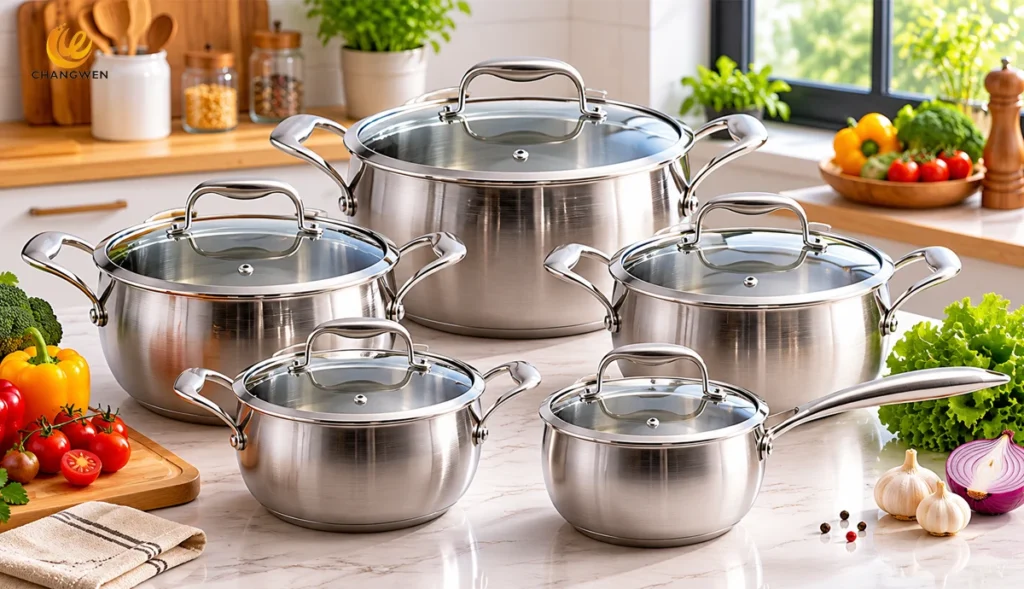
Tri-ply clad stainless steel cookware sets are the highest-value OEM SKU in this category. The most common configurations:
| Set Size | Typical Contents | Market |
|---|---|---|
| 5-piece | 8″ skillet, 10″ skillet, 2Qt saucepan, 3Qt saucepan, 8Qt stock pot | Core retail, e-commerce starter |
| 7-piece | Above + 5Qt sauté pan + 10″ lid | Mid-market retail |
| 10-piece | Comprehensive home kitchen set | Premium retail, gift, private label |
| 12-piece | Full kitchen complement | Premium / department store |
The 12 piece tri-ply clad stainless steel cookware set and the 12 pc tri-ply clad stainless steel cookware set are among the most-searched product configurations in this category — buyers know what they want, and a well-specified 12-piece program with clear materials disclosure converts reliably.
Tri-Ply Cookware Sets with Glass Lids
The tri-ply clad stainless steel cookware set with glass lids configuration is a strong retail variant — tempered glass lids allow users to monitor cooking without lifting the lid and are consistently preferred in consumer surveys over stainless steel lids for home cooking use. From an OEM perspective, glass lids add a modest cost premium with a significant retail appeal advantage.
Tri-Ply Sauté Pans & Braisers
Wide-base, straight-sided sauté pans in 3Qt and 5Qt configurations — the workhorses of professional kitchens and serious home cooking. Deep enough to hold liquid for braising, wide enough to sear and sauté at volume, and with tri-ply construction, capable of going from stovetop sear to oven braise without losing performance.
Tri-Ply Woks
The tri-ply wok is a modern adaptation of the traditional carbon steel design — offering the rapid heat response required for high-temperature wok cooking, but in an easier-to-maintain, induction-compatible format. Growing demand category for Asian market retail programs and international restaurants.
OEM Tri-Ply Stainless Steel Cookware: The Manufacturing Specifications That Matter
Here’s where most buyers get into trouble: they ask for “tri-ply” and assume that covers everything. It doesn’t. The term describes a construction type — the specific implementation varies enormously between manufacturers, and those variations directly affect performance.
Layer Thickness Specification
Tri-ply construction quality is determined by the thickness of each layer. The total wall thickness of a quality tri-ply pan is typically 2.6mm–3.0mm, distributed approximately as follows:
| Layer | Quality Standard | Economy Grade |
|---|---|---|
| Inner 304 stainless | 0.4mm–0.5mm | 0.2mm–0.3mm |
| Aluminum core | 1.8mm–2.2mm | 1.0mm–1.4mm |
| Outer 430 stainless | 0.4mm–0.5mm | 0.2mm–0.3mm |
| Total | 2.6mm–3.2mm | 1.4mm–2.0mm |
The aluminum core is where most cost-cutting happens. Thinner aluminum means reduced heat conductivity — which means the main performance benefit of tri-ply construction is compromised. Always specify total wall thickness in your product brief, and request confirmation of the layer breakdown.
Full-Clad vs. Capsule Bottom — The Critical Distinction
Full-clad tri-ply means all three layers run the complete height of the pan body — base and sides. This is genuine tri-ply construction.
Capsule bottom with tri-ply labeling is a product with a single-ply stainless body and a multi-layer disc bonded only to the base. The sides heat from a single-ply layer. Some manufacturers label these products as “tri-ply” — technically they have three layers, but only on the base.
For buyers sourcing premium products: always specify full-clad tri-ply construction explicitly. For budget programs where the price difference matters: capsule-bottom construction is acceptable, but should not be marketed as “full-clad.”
Steel Grade Verification
- Interior cooking surface: Must be 18/8 (304) stainless steel minimum. Verify with mill certificate.
- Outer layer: 430 magnetic stainless steel for induction compatibility.
- Never accept 201 on the interior. 201 stainless has significantly lower nickel content, reduced corrosion resistance, and is not appropriate for premium or certified-market programs.
Handle Construction
Tri-ply pans can be undermined by poor handle design. Quality specifications:
- Stay-cool handle geometry — hollow stainless steel handle with air gap provides natural insulation
- Ergonomic angle — handle axis at 15–20° from horizontal for comfortable pouring
- Attachment method — riveted for commercial programs; welded acceptable for consumer retail if weld quality is confirmed
- Length — long enough to keep hand away from heat (minimum 18cm for 10-inch pan)
The OEM Program: How to Source Tri-Ply Cookware Under Your Brand
Sourcing a tri-ply clad stainless steel cookware set under your own brand is one of the highest-value OEM programs available in the cookware category. Here’s the process.
Define Your Program Architecture
Before approaching any factory, map your product line:
- Core SKUs: Which pan sizes and set configurations will anchor your program?
- Price tier: Economy (capsule bottom), mid-range (full-clad 2.6mm), or premium (full-clad 3.0mm+)?
- Lid specification: Stainless steel lids for a clean professional look, or tempered glass for consumer visibility preference?
- Set configurations: What set sizes do you need? 5-piece, 7-piece, 10-piece, 12-piece?
- Target market: US, EU, AU? Each has specific certification implications.
Specify Your OEM Customization Requirements
A complete OEM brief for a tri-ply stainless steel cookware set includes:
Branding Options
- Laser-engraved logo on handle or base — permanent, dishwasher-proof, no added lead time
- Embossed brand mark on handle or pan base — tactile premium branding
- Custom handle shape — requires mold development (4–6 weeks, one-time tooling cost)
- Lid knob with brand mark — small mold, reasonable tooling cost
Packaging Configuration
- Individual box per item for set assembly on arrival, or pre-boxed set
- Retail color box — full-color branded packaging with product imagery
- Gift box with insert — premium configuration for department store and gifting programs
- FBA-ready packaging — poly bag, barcode label, suffocation warning, FBA-compliant dimensions
Surface Finish
- Mirror polish (8K) — classic premium stainless aesthetic
- Brushed / satin finish — contemporary, fingerprint-resistant, preferred in North American and Northern European markets
- Mixed — polished interior, brushed exterior — the most common premium retail configuration
Sample Development & Approval
The sample approval stage is where OEM programs either get locked in properly or start accumulating problems.
Request a complete pre-production sample set — one unit from each SKU in your program. Evaluate:
- Wall thickness (measure with a digital caliper — don’t eyeball it)
- Layer structure confirmation (ask for a cut section photograph showing the three layers)
- Logo placement accuracy and application quality
- Lid fit — should close smoothly with slight resistance, not rattle
- Handle balance — hold the pan at fill capacity; it should feel controlled, not front-heavy
- Packaging fit and print quality
Approve everything in writing before production begins. Changes made post-production-start are expensive for everyone.
Certifications for Tri-Ply Stainless Steel Cookware OEM Programs
Tri-ply stainless steel cookware — because it’s a bare metal product without coating chemistry — has a simpler certification landscape than non-stick cookware. But it still requires attention, especially for premium market programs:
| Certification | Market | What It Confirms |
|---|---|---|
| FDA food contact | USA | 304 stainless steel food-contact safety |
| LFGB | Germany / EU | Food contact migration standards |
| REACH | EU | Chemical substance compliance |
| CA Proposition 65 | California | Heavy metals disclosure |
| NSF | US foodservice | Commercial kitchen equipment approval |
| BSCI / Sedex | Global retail | Factory social compliance |
For tri-ply stainless cookware specifically: the main certification focus is on stainless steel grade verification (304 interior) and handle material compliance (bakelite or silicone handle components require their own food-safe test reports in EU programs).
The Honest Guide to Choosing a Tri-Ply Stainless Steel Cookware Manufacturer
The cookware market has a supply chain problem that’s worth being direct about: a meaningful number of products marketed as “tri-ply” are not genuine full-clad construction. Some have undersized aluminum cores. Some use capsule-bottom construction with full-clad labeling. Some use 201 interior steel instead of 304.
None of these misrepresentations are obvious in a catalog photograph. They become obvious when your customers start complaining about hotspots on their “professional-grade” pans.
Here’s the test that separates genuine tri-ply manufacturers from those selling the name without the substance:
Ask for a cross-section photograph of the wall. A factory that produces genuine full-clad tri-ply has no reason to refuse this. The cut section shows all three layers clearly — their relative thickness, their bonding quality, and whether the layers extend the full height of the pan. If a supplier can’t produce this, or deflects the request, you have your answer.
Specify total wall thickness in millimeters in your purchase order. “Tri-ply construction” without a dimensional spec is an invitation for ambiguity. “Full-clad tri-ply, total wall thickness 2.8mm minimum, with 304 interior confirmed by mill certificate” is a contract term that protects you.
Request the mill certificate for the stainless steel. Genuine 304 has a predictable chromium/nickel ratio that’s easy to verify. Suppliers using 201 know this — which is why mills certs aren’t always offered proactively. Ask for them.
Why Changwen for OEM Tri-Ply Stainless Steel Cookware
If you’ve read this far, you now know more about tri-ply cookware specifications than the majority of people placing OEM orders. That knowledge is only useful if you put it to work with the right manufacturing partner.
Changwen Cookware and Kitchenware Co., Ltd. is a professional stainless steel cookware manufacturer with over 20 years of OEM/ODM experience, exporting tri-ply and full-range stainless steel cookware to buyers in 80+ countries worldwide.
The Changwen Tri-Ply Program at a Glance
| Specification | Changwen Standard |
|---|---|
| Construction | Full-clad tri-ply (layers run full pan height) |
| Interior grade | 18/8 (304) stainless steel — mill certificate available |
| Core | Pure aluminum (high-conductivity grade) |
| Exterior | 430 magnetic stainless steel — induction compatible |
| Total wall thickness | 2.6mm–3.0mm (confirmed per order) |
| Handle | Hollow stainless, stay-cool, riveted or welded |
| Lid options | Stainless steel or tempered glass |
| Available sets | 5-piece, 7-piece, 10-piece, 12-piece |
| Surface finish | Mirror, satin, brushed, mixed |
| Certifications | FDA, LFGB, REACH, CA Prop 65 |
| MOQ | standard 1,000 |
| OEM capability | Logo, packaging, custom handle, custom finish |
| Lead time (production) | 30–45 days from order confirmation |
What Makes Changwen Different
Factory direct. You talk to the people who make the product. Not a sales agent, not a trading company, not an intermediary who’s going to relay your spec to a factory they’ve never visited. Direct communication means faster sample cycles, accurate specifications, and someone who’s actually accountable when something needs correcting.
Transparent specifications. We provide mill certificates, layer thickness confirmation, and cross-section samples on request. If you’ve been burned by vague “tri-ply” claims before, you’ll appreciate the difference.
20+ years of export experience. We know what LFGB compliance looks like for European buyers, what FBA packaging requires for Amazon sellers, and what commercial kitchen buyers mean when they say “riveted handles only.” We’ve had those conversations thousands of times.
Full range — one relationship. Beyond tri-ply, Changwen manufactures the full kitchenware spectrum: non-stick cookware, cast iron, carbon steel, dinnerware, knives, and kitchen tools. Build your entire catalog with one trusted supplier.
Frequently Asked Questions
What is the difference between tri-ply and 5-ply stainless steel cookware?
Tri-ply stainless steel cookware has three bonded layers: stainless interior, aluminum core, stainless exterior. 5-ply adds two more layers — typically an additional aluminum layer and a second stainless layer — for greater total thickness and marginally superior heat retention. For most retail and professional programs, tri-ply delivers excellent performance at a significantly better price-to-performance ratio than 5-ply. 5-ply is appropriate for explicitly ultra-premium positioning.
Is a 12-piece tri-ply set worth the investment over a smaller set?
The 12 piece tri-ply clad stainless steel cookware set and the 12 pc tri-ply clad stainless steel cookware set make sense for buyers targeting comprehensive home kitchen programs, premium gifting, or professional home cook segments. For entry-level retail or e-commerce testing, a 5-piece or 7-piece set has lower inventory risk with strong conversion. For hospitality procurement, individual pieces are often more practical than set purchasing.
Can I get a tri-ply set with glass lids?
Yes. The tri-ply clad stainless steel cookware set with glass lids is a standard variant — tempered glass lids are available across all set configurations. Glass lids are preferred by home cooks for their visibility advantage and add modest cost versus stainless lids.
What’s the minimum order for a custom-branded tri-ply cookware set?
Changwen’s standard OEM minimum for a branded tri-ply program starts from 300 pieces per SKU for trial orders — or a minimum combined order value for multi-SKU programs. Volume pricing tiers improve significantly at 500, 1,000, and 3,000+ units.
How do I verify that I’m getting genuine full-clad tri-ply and not a capsule-bottom product?
Request a cross-section photograph of the pan wall showing all three layers at mid-height (not just the base). Specify “full-clad tri-ply, layers extend full pan height” in your purchase order. Ask for the mill certificate confirming 304 interior. These three steps together provide strong verification — and a factory that resists them is telling you something important.
Request Your Tri-Ply Cookware OEM Quote
Ready to build a tri-ply stainless steel cookware program that’s actually made to the specification you’re paying for?
Tell us:
- 🍳 Products required (set sizes, individual pans, set configurations)
- 📐 Specification preference (wall thickness, lid type, handle finish)
- 🎨 OEM requirements (logo, packaging, finish)
- 📊 Target order quantity per SKU
- 🌍 Destination market and certifications needed
We respond within 24 hours with a complete factory-direct quotation.