Cookware manufacturing partner since 2002 info@cwchangwen.com · +86 180 2296 3948

The Clock Starts at Approval: How Long Does OEM Cookware Production Take?

Changwen typically needs about two weeks to prepare an OEM cookware sample and 45-60 days to manufacture the cookware after the sample, specification, packaging, and commercial terms are confirmed. These periods describe factory execution under an approved project scope. Buyer review, sample revisions, new tooling, third-party testing, holidays, shipment booking, and international transit can extend the total calendar from initial inquiry to warehouse delivery.
Read time: 14 minutes
The most accurate answer to “How long does OEM cookware production take?” begins by defining which clock is being measured. Sample lead time, buyer approval time, production lead time, and logistics time are separate intervals with different owners and risks. Combining them into one number makes a schedule look simple, but it hides the dependencies that usually determine whether a launch arrives on time.
Changwen planning baseline: Allow approximately 2 weeks for sample preparation. After the final sample and all production inputs are approved, allow 45-60 days for cookware production. Ask for a project-specific schedule because tooling, product complexity, order mix, packaging, testing, and factory capacity can change the critical path.
What Is the Typical OEM Cookware Timeline at Changwen?
| Timeline segment | Typical Changwen baseline | When the clock starts | What may extend it |
|---|---|---|---|
| Sample preparation | About 2 weeks | Complete sample brief, feasible materials, components, artwork, and sample terms are confirmed | New tooling, uncommon components, special finish trials, incomplete files, or design changes |
| Buyer review and revision | Buyer-controlled | Buyer receives the sample and inspection information | Slow feedback, subjective comments, multiple reviewers, retesting, or additional sample rounds |
| Cookware production | 45-60 days | Final sample, specification, order, packaging, artwork, payment conditions, and schedule are released | Complex construction, many SKUs, special components, high quantity, testing holds, change requests, or capacity constraints |
| Inspection and shipment | Quoted separately | Goods are finished and ready for release | Inspection booking, corrective work, documentation, carrier space, port conditions, customs, or destination transit |
The table is a planning model, not a guaranteed date for an undefined product. A standard cookware item using existing tooling can follow a cleaner path than a proprietary multi-SKU range with new handles, special finishes, printed gift boxes, and market-specific validation. Changwen confirms the binding schedule after reviewing the complete project.
Does Two Weeks Mean the Sample Will Be Delivered in Two Weeks?
The two-week sample baseline refers to sample preparation, not necessarily arrival at the buyer’s office. Courier booking, export handling, transit, customs, weekends, and the destination address add time after the sample is ready. A project schedule should therefore separate “sample ready date” from “sample delivered date” and “sample approved date.”
The sample clock should begin only when the factory has enough information to make the intended sample. A complete request identifies the cookware type, dimensions, material, construction, thickness, base, handle, lid, finish, logo, packaging concept, destination market, and required checks. If key decisions remain open, the factory may be waiting for information rather than actively producing the sample.
A two-week sample can also mean different things depending on the sample type. An existing-tool sample with selected components demonstrates a practical catalog-based configuration. A hand-finished appearance sample can show shape or surface intent. A production-representative sample uses the intended materials, tooling, and process as closely as possible. Buyers should identify which sample is promised because each type supports a different approval decision.
What Happens During the Two-Week Sampling Period?
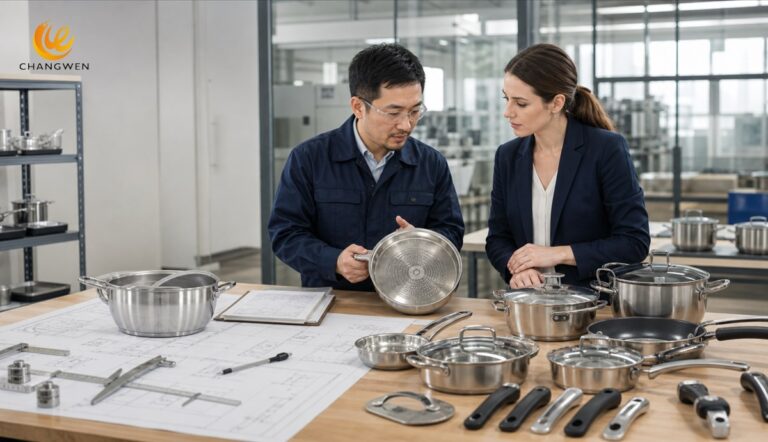
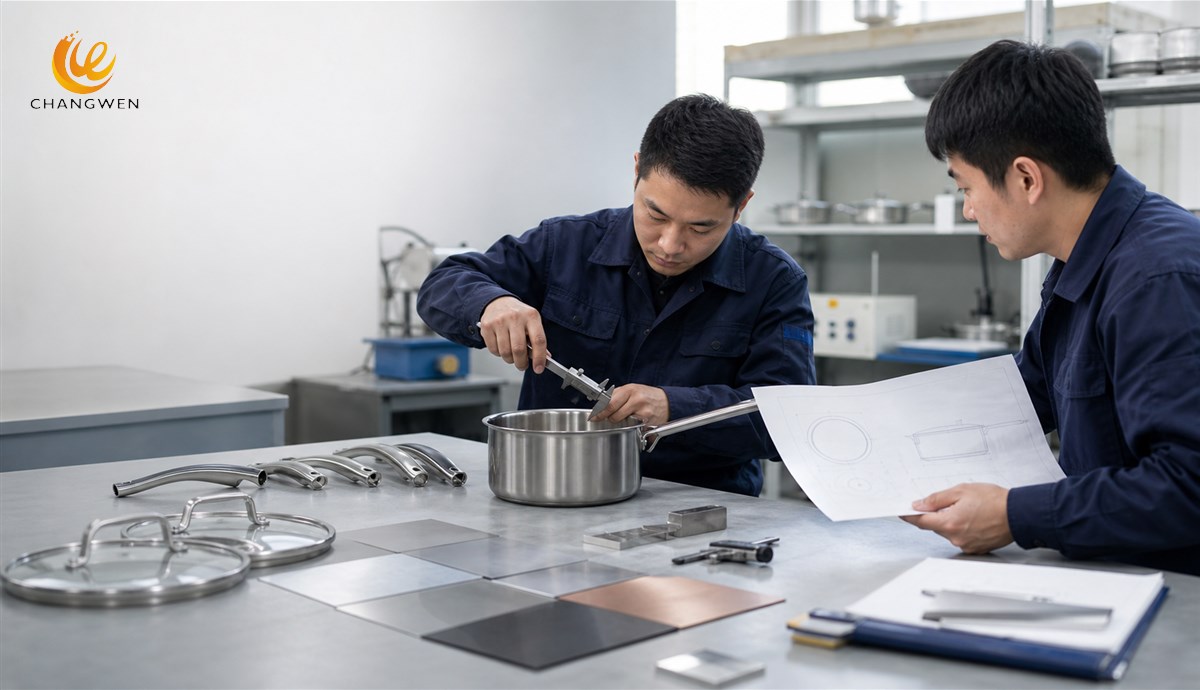
Sample preparation typically coordinates material availability, cookware body selection or forming, base construction, surface treatment, handle and lid fitting, logo method, cleaning, assembly, and sample inspection. The exact sequence depends on the product. Stainless steel, aluminum, carbon steel, coated cookware, and multi-layer constructions do not share one universal sampling route.
The sample period should end with evidence rather than only a parcel. Useful sample records can include confirmed dimensions, weight, material references, appearance photographs, component details, packaging notes, and results from the checks agreed for that development stage. The sample and its records together give the buyer a clearer basis for approval.
Sample preparation does not automatically include every compliance test or destructive performance test. Third-party laboratories have their own submission, testing, and reporting schedules. If a test result is required before production release, the project manager should place that test on the critical path instead of assuming it fits invisibly inside the two-week sample period.
Why Can Sample Approval Take Longer Than Sample Making?
Sample approval can exceed the factory’s preparation time when the buyer has several reviewers, unclear acceptance criteria, slow courier transit, or incomplete feedback. The factory may prepare a sample in about two weeks, but the project cannot advance while product, sourcing, quality, packaging, and management teams are still deciding whether the sample is acceptable.
Buyer feedback should describe the requirement, observed difference, measurement or comparison method, and requested decision. Comments such as “make it more premium” do not tell an engineer whether to change the gauge, finish, handle, weight, geometry, or packaging. Precise feedback reduces unnecessary revision loops and protects the target production date.
Every revision should be linked to a drawing, specification, artwork, or sample version. Approving a new handle through one message while using an older specification in the purchase order creates conflicting production instructions. A single controlled approval package is faster than searching across scattered conversations after production planning has begun.
When Does the 45-60 Day Production Clock Start?
The 45-60 day production clock starts after the final production inputs are approved and Changwen releases the order into the agreed schedule. The release package normally includes the approved sample, current product specification, bill of materials, order quantity by SKU, packaging and artwork, inspection requirements, commercial confirmation, and any required payment milestone.
A purchase order alone may not start production when technical or packaging decisions remain incomplete. Raw materials and printed cartons cannot be purchased accurately when product revisions are still changing. Treating an incomplete order as “in production” creates a false start date and makes later schedule discussions unreliable.
The release date should be recorded in writing with the planned completion window. If the buyer changes quantity, color, component, finish, packaging, artwork, or test scope after release, the factory should evaluate the schedule impact before accepting the change. The original completion date cannot be assumed to survive a material scope change.
What Happens During the 45-60 Day Production Window?
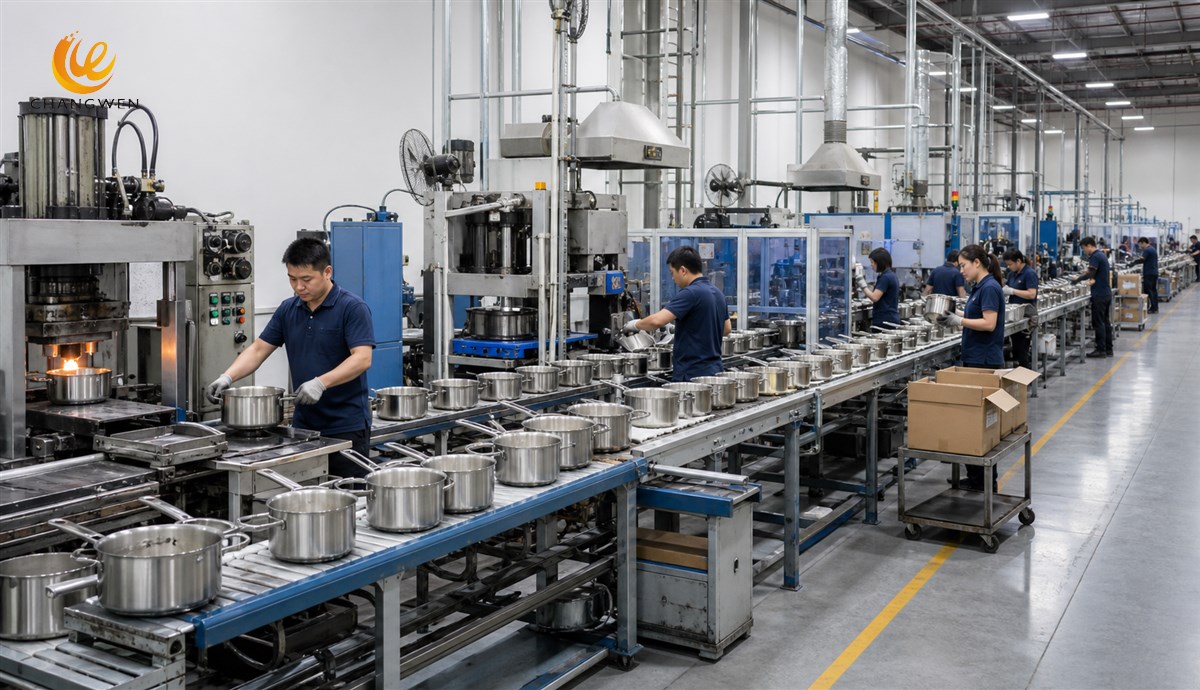
The production window covers more than the time a pan spends on a machine. Production planning must allocate capacity, purchase or release materials and components, prepare tooling, arrange the line, manufacture bodies, complete surface and base processes, assemble components, perform in-process inspection, clean products, pack finished units, and prepare them for final release.
Cookware body manufacturing may include blank preparation, drawing or forming, trimming, base bonding, welding or riveting, grinding, polishing, coating or other surface treatment, marking, cleaning, and assembly. The applicable steps depend on the cookware construction. A simple stock pot, an impact-bonded saucepan, and full-clad cookware require different operations and scheduling dependencies.
Quality control is part of production lead time rather than work added only after the batch is complete. Incoming material checks, dimensional checks, base flatness, handle alignment, surface inspection, assembly verification, and packaging checks are most effective near the operation that creates the characteristic. Removing these checks may shorten a calendar on paper while increasing rework and shipment risk.
Why Does Changwen Quote a 45-60 Day Range Instead of One Date?
A range is more accurate than one fixed duration because cookware orders use different products, quantities, components, processes, and packaging. The shorter end may fit a well-defined program using available tooling, common components, one finish, and straightforward packaging. The longer end may be required when the order has more SKUs, specialized processes, larger volume, or constrained components.
Factory capacity is also time-specific. Two identical orders placed in different production periods may receive different schedules because confirmed work already occupies machines, finishing lines, assembly stations, or packing capacity. A lead time quoted during an inquiry should therefore be reconfirmed when the order is ready for release.
The 45-60 day window protects process sequence and inspection discipline. Compressing one operation can create congestion at the next operation, while rushing finishing or packaging may increase defects. A credible schedule balances throughput across the entire route rather than accelerating one visible step.
Which Product Decisions Have the Greatest Effect on Lead Time?
Existing Tooling Versus New Tooling
Existing tooling generally removes a major development dependency because the body or component geometry has already been produced. New tooling adds design review, fabrication, trial parts, corrections, and approval before production. The OEM versus ODM cookware comparison explains why development ownership and tooling choices affect time, cost, control, and differentiation.
Standard Components Versus Exclusive Components
Standard handles, lids, knobs, and fittings can use established purchasing and assembly routes. Exclusive components require their own drawing, tooling, sample, supplier capacity, finish, minimum order, and inspection. The slowest required component can control the entire cookware completion date even when the body is already finished.
One SKU Versus a Large Assortment
One SKU creates one primary combination of body, finish, components, artwork, and packaging. A collection with many sizes or colors creates multiple material allocations, changeovers, inspections, labels, and carton files. The guide to typical OEM cookware MOQ explains why each SKU can have its own production and component minimum, which also affects scheduling.
Simple Packaging Versus Retail-Ready Packaging
Plain protective packaging can be prepared more simply than printed retail packaging with inserts, manuals, labels, and channel-specific presentation. Printed packaging should run in parallel only after the product dimensions, artwork, barcode data, statements, and quantity are stable. The cookware packaging planning guide shows how protection, presentation, and distribution requirements shape the pack.
What Is the Critical Path in an OEM Cookware Project?
The critical path is the longest chain of dependent activities that determines the earliest possible completion date. Work outside the critical path may have scheduling flexibility, but a delay in a critical activity moves the final date unless later work can be safely compressed. The critical path can change as the project develops.
For one cookware project, new handle tooling may control the schedule; for another, printed packaging, laboratory testing, or buyer approval may be slower than body production. A useful project plan shows dependencies rather than placing every task in a simple list. Production cannot consume an unapproved component, and packing cannot use artwork that has not been released.
Parallel work can shorten the schedule only when its input is stable. A packaging supplier can develop structure while the product is being sampled, but printing final boxes before the product and artwork are frozen creates obsolescence risk. Safe parallelization advances work that is unlikely to change and postpones irreversible commitments until evidence is approved.

Which Delays Are Controlled by the Buyer and Which by the Factory?
| Schedule responsibility | Typical activities | Best control |
|---|---|---|
| Buyer-controlled | Complete brief, sample feedback, artwork approval, test decisions, purchase order, payment milestone, and change authorization | One decision owner, measurable criteria, and fixed review deadlines |
| Factory-controlled | DFM review, sourcing, tooling, line planning, production, process inspection, packing, records, and readiness reporting | Milestone plan, named owners, capacity confirmation, and early exception reporting |
| Shared or external | Courier transit, laboratory work, third-party inspection, carrier booking, customs, and international freight | Book early, define document inputs, and maintain realistic buffers |
The purpose of assigning responsibility is not to transfer blame. Clear ownership tells the project team where an unanswered decision or late task will affect the completion date. A shared schedule should distinguish factory work from waiting time so both parties can improve the next order.
How Much Time Should Be Added for Tooling and Testing?
Tooling and testing should be quoted as project-specific schedule lines because their duration depends on the actual design and test scope. A standard product using existing tools may not need a new-tool phase, while proprietary geometry or exclusive components require fabrication, trials, correction, and approval. It would be misleading to hide those activities inside the standard sample or production baseline.
Testing schedules depend on specimen readiness, laboratory availability, method, number of variants, failures, and report review. A project that requires test evidence before production must wait for the required decision. A project that permits certain non-critical testing to run in parallel needs a written risk and release rule.
Buyers should identify development and recurring cost together with schedule. The stainless steel cookware OEM price guide explains how tooling, materials, construction, finish, certification, MOQ, packaging, and quality control influence the commercial model. A faster option is not equivalent if it changes the specification or validation scope.
Is Shipping Included in the 45-60 Day Production Time?
International shipping is not included in the 45-60 day cookware production baseline. Production time ends when the order reaches the agreed factory completion or shipment-readiness milestone. Inspection booking, balance payment when applicable, export documentation, container loading, carrier departure, sea or air transit, customs, and inland delivery belong to the logistics schedule.
The buyer should plan backward from the required warehouse date, not from the preferred factory start date. The backward plan should include destination delivery, customs buffer, freight transit, departure availability, inspection and correction allowance, 45-60 days of production, approval time, courier time, and the two-week sample baseline. Launch inventory needs an additional business buffer when missing the date would stop sales.
How Can Buyers Shorten the Timeline Without Increasing Quality Risk?
The safest way to shorten the timeline is to remove waiting and ambiguity before compressing manufacturing. A complete specification, existing tooling, proven components, one finish, limited SKU count, stable packaging, fast sample feedback, and one authorized buyer contact reduce dependencies. These choices make the normal process easier to schedule and repeat.
Buyers can prepare packaging structure, compliance questions, barcodes, and inspection criteria while the sample is being developed, provided final commitments wait for confirmed dimensions and artwork. This controlled parallel work saves time without assuming that an unfinished design will not change.
Skipping sample approval, incoming checks, process inspection, or final inspection is not a reliable time-saving strategy. A defect found after production or arrival consumes more time than an early control point. The bulk cookware purchasing checklist helps buyers preserve material, quality, compliance, packaging, and delivery controls while planning speed.
What Common Problems Push an OEM Cookware Order Past Its Planned Date?
- Incomplete sample brief: the sample room waits for dimensions, materials, components, or artwork.
- Subjective sample comments: the factory cannot translate preferences into measurable corrections.
- Multiple uncoordinated approvers: product, quality, and management teams send conflicting decisions.
- Late SKU additions: new sizes or colors introduce components, packaging, and process changeovers.
- Unreleased packaging: finished cookware waits for boxes, inserts, labels, or manuals.
- Post-approval design changes: purchasing, tooling, samples, tests, and documents may need revision.
- Unplanned testing: laboratory submission and reporting become a new critical-path activity.
- Late inspection booking: completed goods wait for an inspector or release decision.
- Assuming production equals delivery: freight, customs, and inland transport were omitted from the launch plan.
What Should a Lead-Time Quotation Include?
A useful lead-time quotation should identify the product and revision, sample type, sample-ready baseline, tooling activities, approval dependencies, production-start trigger, 45-60 day production window when applicable, inspection point, shipment-readiness definition, exclusions, and quotation validity. A number without a start trigger cannot be measured fairly.
The quotation should also state whether days are calendar days or working days and how factory holidays are handled. The buyer should ask which materials or components have been assumed available, whether the quoted capacity is reserved, and when the schedule must be reconfirmed. These details prevent an inquiry-stage estimate from being mistaken for a booked production slot.
A project-specific timeline can then convert the quotation into dated milestones. The OEM cookware project planning example shows how product positioning, materials, compliance, sampling, packaging, quality, cost, and replenishment interact. A schedule becomes reliable when every milestone has an input, output, owner, and approval rule.
How Should Production Progress Be Reported?
Production reporting should compare actual progress with agreed milestones rather than repeat a general statement that production is ongoing. Useful updates identify completed materials, active process, inspected quantity, open issue, responsible party, next milestone, and any effect on the planned completion window.
Exception reporting should begin when risk appears, not after the delivery date is missed. If a component is late, a finish trial fails, or packaging artwork changes, the report should identify the affected SKU, recovery action, decision needed, and revised risk. Early visibility gives the buyer choices that disappear near shipment.
Are Repeat Orders Faster Than First OEM Orders?
Repeat orders can remove design, tooling, and sample-development work when the product, components, packaging, and requirements remain unchanged. However, repeat production still needs confirmed capacity, materials, components, line scheduling, inspection, and packing. Buyers should not assume that existing tooling guarantees immediate production.
A repeat order should reference the approved product revision and record any requested changes separately. Forecasts and early purchase planning help reserve components and capacity, but the factory must confirm the actual schedule for each order. Stable specifications and accurate forecasts create more dependable replenishment than last-minute urgency.
FAQ About OEM Cookware Production Time
How long does Changwen need to make an OEM cookware sample?
Changwen typically needs about two weeks to prepare an OEM cookware sample after the sample brief, materials, components, artwork, and sample terms are complete. Courier delivery, buyer review, revisions, new tooling, and third-party testing are additional schedule items.
How long does Changwen need for cookware mass production?
Changwen typically needs 45-60 days for cookware production after the final sample, specification, packaging, commercial terms, and schedule are confirmed. The exact duration depends on product construction, order quantity, SKU mix, components, finish, packaging, testing, and factory capacity.
Does the 45-60 day timeline include shipping?
No. The 45-60 day baseline covers cookware production, not international freight or destination delivery. Inspection, shipment booking, export handling, transit, customs, and inland transport require separate planning.
What date officially starts OEM cookware production?
The official production start should be the documented release date after the approved sample, current specification, bill of materials, SKU quantities, packaging, artwork, inspection scope, commercial terms, and required payment milestone are complete.
Will a custom handle or new pan shape extend the timeline?
A custom handle or new pan shape can extend the project because new tooling, trial parts, corrections, sample approval, component sourcing, and validation may be required before the standard production window begins. The additional work should be shown separately in the project schedule.
Can several cookware sizes be produced within the same 45-60 day window?
Several sizes may fit the same overall window when their materials, tooling, components, quantities, and packaging can be scheduled together. A large assortment can require more changeovers and dependencies, so Changwen must confirm the SKU-level production plan.
How early should an importer start an OEM cookware project?
An importer should work backward from the required warehouse date and include sample preparation, courier time, buyer approval, possible revision, tooling and testing when required, 45-60 days of production, inspection, freight, customs, inland delivery, and a launch-risk buffer.
What Is the Final Lead-Time Planning Rule?
The final rule is to plan four clocks separately: sampling, approval, production, and logistics. Changwen’s typical factory baselines are about two weeks for sample preparation and 45-60 days for cookware production after confirmation. Those figures become dependable only when the project defines exactly what starts and finishes each clock.
A reliable OEM cookware schedule is not the shortest verbal promise. A reliable schedule connects scope, approvals, tooling, components, testing, capacity, inspection, packaging, and shipping through dated dependencies. When buyer waiting time and factory execution time are visible, both parties can protect the launch date without sacrificing product quality or creating avoidable rush costs.