Cookware manufacturing partner since 2002 info@cwchangwen.com · +86 180 2296 3948

3-Piece vs 5-Piece vs 7-Piece Cookware Sets: Who Is Each Set For?

Estimated reading time: 13 minutes.
A 3-piece cookware set suits focused cooking or a small gap in an existing kitchen; a 5-piece set suits regular meals that need frying, simmering, and a larger pot; a 7-piece set suits cooks who genuinely use another vessel for a different task. These recommendations depend on the contents, sizes, and lids supplied. The number on the box alone cannot identify the right household.
The most useful question is not how many people live in the home, but how many cooking jobs must happen before dinner is ready. Two people preparing several dishes may need more vessels than four people sharing a single stew. Capacity determines how much food fits, while the mix of cookware determines which tasks can run together.
This guide compares three explicitly defined example sets through meal routines, storage, existing cookware, and purchasing priorities. The examples are planning models, not universal package definitions or confirmed Changwen catalog SKUs. Retailers and private-label buyers can use the same comparison to develop clear assortments for different customers.
What do the 3-piece, 5-piece, and 7-piece examples include?
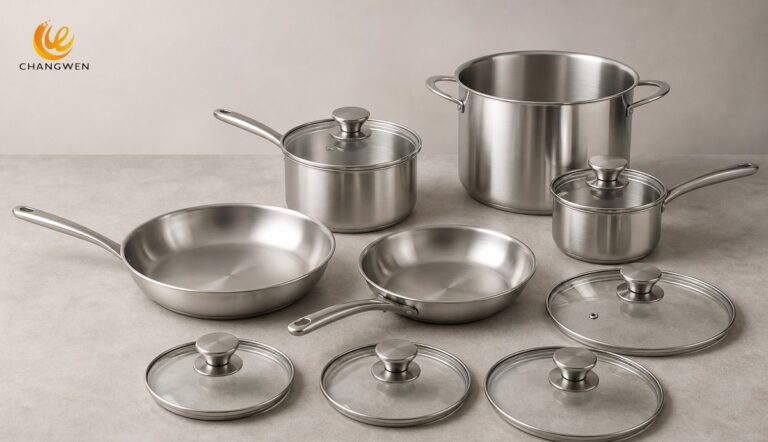
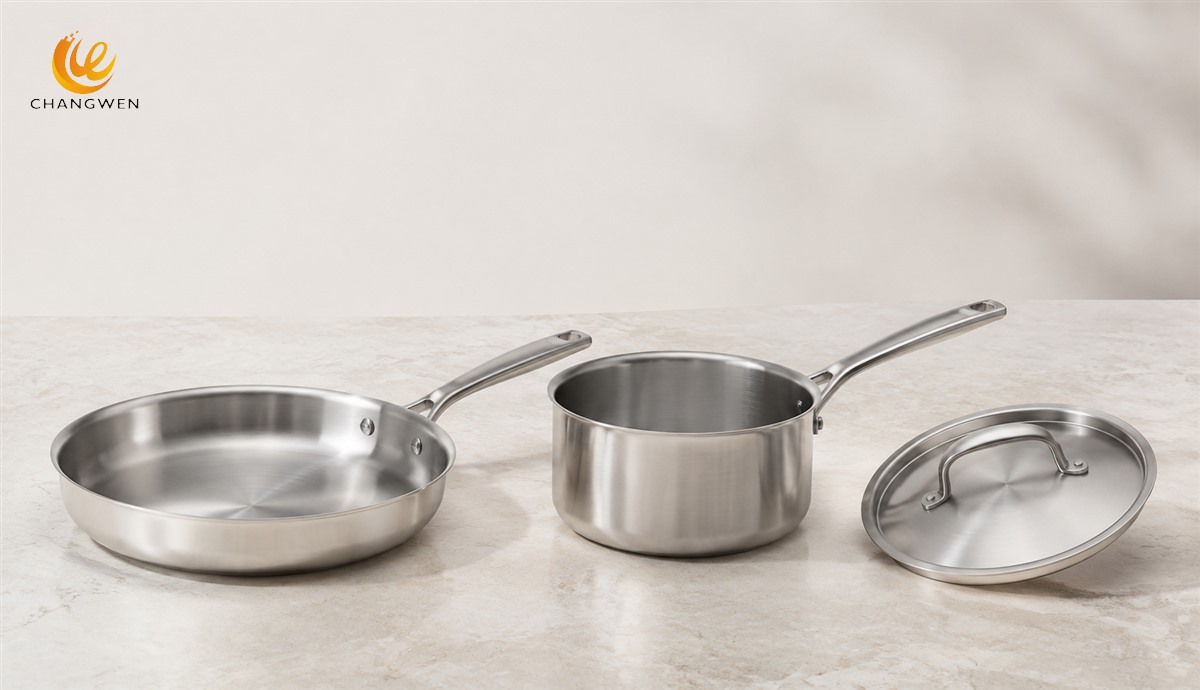
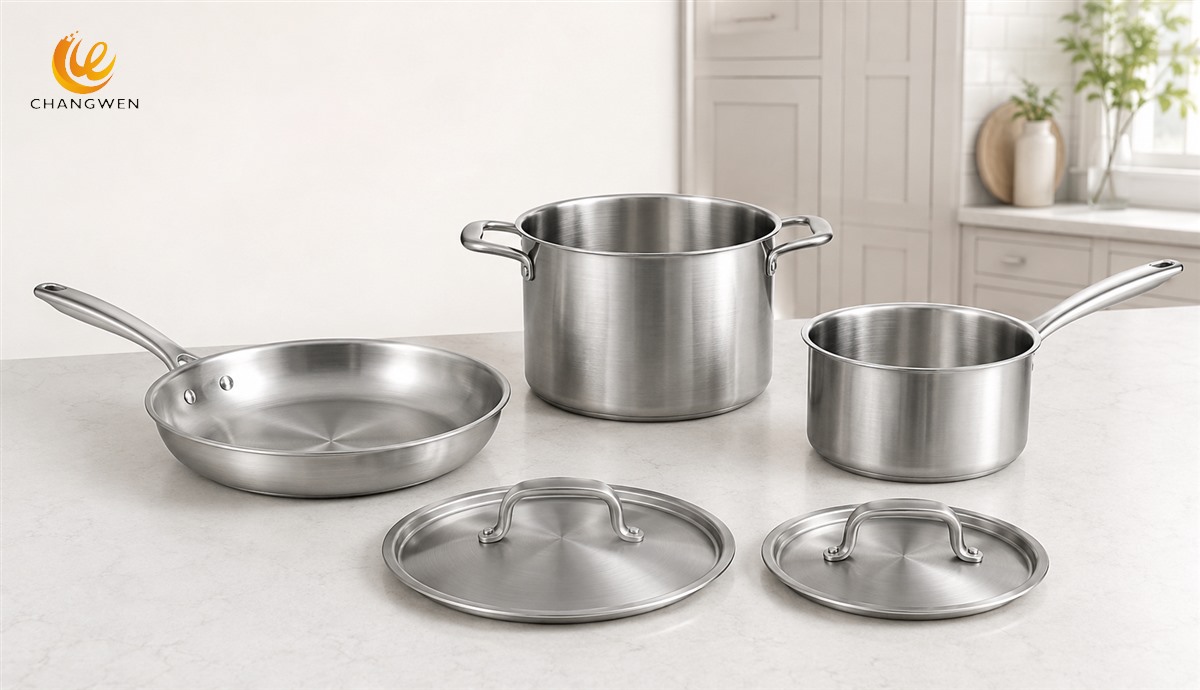
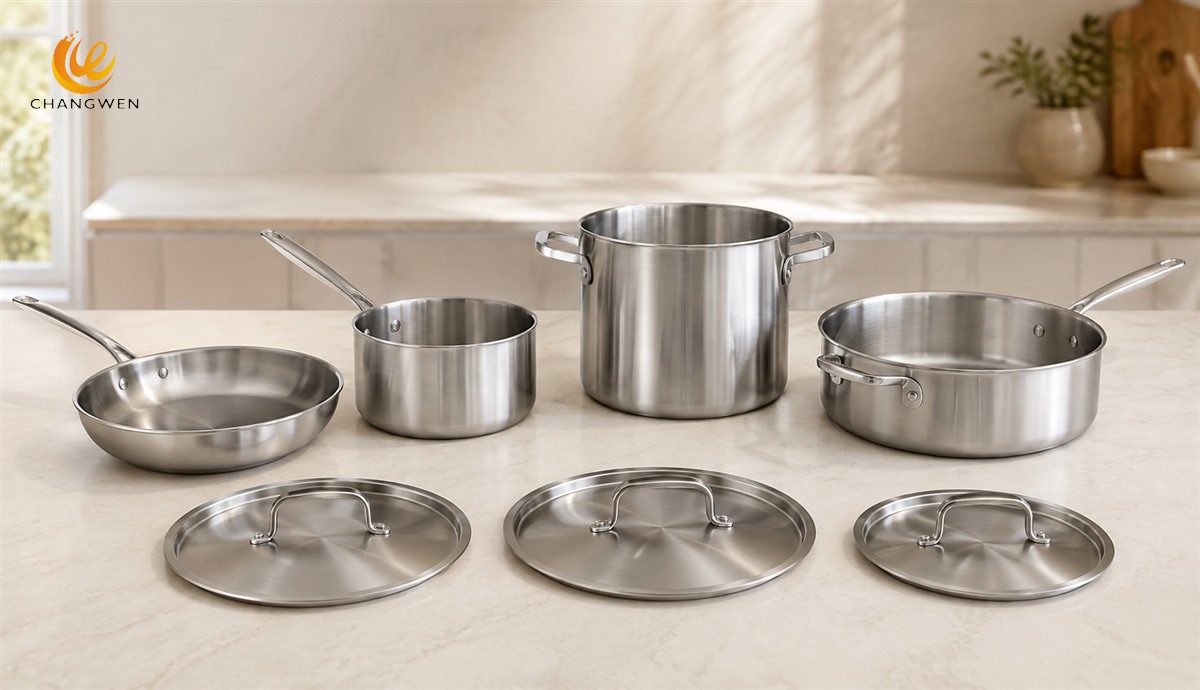
For this comparison, the 3-piece example contains a frying pan, a saucepan, and its lid. The 5-piece example adds a stockpot and a second lid. The 7-piece example adds a straight-sided saute pan and a third lid. Each step therefore introduces one additional cooking vessel and one matching cover, rather than increasing the count with unrelated accessories.
| Example set | Cooking vessels | Separate lids | Main reason to choose it |
|---|---|---|---|
| 3 pieces | Frying pan and saucepan | One saucepan lid | A compact frying-and-simmering combination |
| 5 pieces | Frying pan, saucepan, and stockpot | Two matching lids | Everyday cooking plus a larger-volume vessel |
| 7 pieces | Frying pan, saucepan, stockpot, and saute pan | Three matching lids | More flexibility for covered shallow cooking and separate dishes |
Another supplier may use the same numbers for entirely different combinations, including three uncovered pans or sets with removable handles. Compare the contents list before applying any recommendation below. The separate guide to what cookware set piece count actually means explains counting conventions in detail; this article concentrates on deciding who benefits from each composition.
Who is the 3-piece cookware set best suited to?
The illustrative 3-piece cookware set is a strong starting point for someone whose regular meals need one shallow cooking surface and one vessel for liquids. A frying pan can prepare eggs, vegetables, or a protein, while the saucepan handles a grain, sauce, or modest batch of soup. The combination supports two separate tasks without filling a cabinet with rarely used shapes.
A person furnishing a first apartment may value the 3-piece combination because the two vessels have clearly different roles. The buyer can learn which tasks recur before adding specialty cookware. This approach is more deliberate than purchasing a broad collection immediately, although the saucepan must still be large enough for the intended meals.
A 3-piece set can also suit an experienced cook replacing worn essentials rather than building an entire kitchen. If a useful stockpot and casserole are already available, another large pot would duplicate existing capacity. A small supplementary set may deliver more practical improvement than a larger box, provided the new pan and saucepan solve actual weaknesses in the current collection.
The main limitation of the 3-piece example is that the saucepan becomes a scheduling bottleneck when several liquid-based dishes are needed together. Cooking rice, making a separate sauce, and boiling vegetables may require sequential work or another vessel. The set is less suitable when the cook repeatedly transfers food or interrupts preparation just to free the saucepan.
A 3-piece label does not make cookware suitable for every compact living arrangement. Confirm that cooking appliances are permitted in the accommodation and that the vessels fit the available hob and storage. The useful advantage is a small number of purposeful items, not an automatic promise of portability or suitability for restricted spaces.
Who benefits most from the 5-piece cookware set?
The illustrative 5-piece cookware set suits a household that regularly needs both a small liquid-cooking vessel and a larger pot. The saucepan can prepare a sauce or grain while the stockpot handles pasta, soup, or a larger batch. The frying pan remains available for browning, so the added pieces remove a specific workflow constraint rather than merely increasing variety.
A couple cooking most evenings may find the 5-piece example a practical core collection when the menu alternates between quick pan meals and larger preparations. The stockpot adds batch capacity without requiring a second frying pan that may serve the same role as the first. The strongest case for upgrading from three to five pieces is a recurring need for that larger vessel.
A household with children can also use a 5-piece set effectively when vessel dimensions match its portions and the menu is relatively straightforward. Piece count does not determine serving capacity: three suitably sized vessels may serve a family better than four undersized ones. Review the usable pan surface and pot volume before assigning any set to a household-size category.
The 5-piece example can support planned leftovers because the stockpot provides a different volume range from the saucepan. However, extra batch capacity is useful only when the cook can handle the filled pot and has an appropriate food-storage plan. Do not choose the tallest pot simply to make the collection appear more substantial.
The main limitation of the 5-piece example is the absence of a dedicated wide covered pan. A frying pan and a tall stockpot can perform many tasks, but neither necessarily matches the shape needed for shallow braising or a broad sauce-based main dish. Cooks who frequently prepare those meals should compare adding a saute pan with replacing the entire set.
Who should consider the 7-piece cookware set?
The illustrative 7-piece cookware set suits a cook who will use the saute pan as a distinct tool rather than as a spare frying pan. Its broad base and taller straight sides can accommodate covered shallow cooking, sauce-based dishes, and meals that need room for turning ingredients. The additional vessel expands shape choice, not just total capacity.
A household preparing several separate components may benefit from the 7-piece example because another vessel can remain dedicated to a main dish while the saucepan and stockpot serve other jobs. The extra lid also matters when those dishes need covered cooking together. This advantage depends on the actual lid assignments and available working space, not on the package number alone.
A keen home cook who alternates between frying, simmering, boiling, and shallow braising may make frequent use of all four vessels. A household that mainly repeats one-pot meals may not. The 7-piece set is therefore better described as a more varied cooking system than as an automatic family upgrade or a marker of advanced cooking ability.
The 7-piece example can help during occasional entertaining when the extra vessel supports a known preparation step. It is harder to justify when the fourth vessel exists only for a hypothetical dinner party. Compare the frequency of that event with the storage and purchase cost, and consider buying a specialist pan separately if the need is narrow.
The main limitation of the 7-piece example is the space and handling burden of an additional wide vessel and lid. Four cooking vessels cannot necessarily sit on a small hob at once, and long handles may compete for clearance. Check the real kitchen layout before treating extra inventory as extra simultaneous cooking capacity.
How do the three sets compare through a week of meals?
A weekly meal check makes the set choice more concrete than a broad label such as starter or family. Write down several meals actually prepared at home, then identify which components need separate vessels and which steps overlap. A set that handles the usual week comfortably is generally easier to justify than one optimized for a rare elaborate occasion.
| Meal pattern | 3-piece example | 5-piece example | 7-piece example |
|---|---|---|---|
| Pan-cooked main with one simmered side | Often sufficient if sizes fit | Stockpot may be unnecessary for this meal | Additional shapes are optional |
| Pasta, separate sauce, and browned vegetables | May require sequential cooking | Three vessels provide distinct jobs | Fourth vessel helps only if another task exists |
| Soup prepared alongside a smaller grain dish | One saucepan may create a conflict | Stockpot and saucepan can work separately | Extra pan may not improve this workflow |
| Shallow-braised main with separate accompaniments | May lack the preferred covered shape | Depends on the available pan and lid | Saute pan offers a more direct match |
Meal timing can make a smaller set entirely workable when the cook already prefers sequential preparation. Finishing a sauce before frying a main dish may be comfortable for one routine and frustrating for another. The comparison should reflect how dinner is actually prepared, rather than treating every task as if it must run at the same moment.
Existing appliances can change the recommendation substantially. A household using a separate rice cooker or an oven for a frequent component may need fewer stovetop vessels. Those appliances do not make a larger set wrong, but they reduce the value of cookware purchased solely to duplicate an established cooking method.
Should household size determine the set size?
Household size should influence vessel capacity, but it should not determine piece count by itself. A larger family may need a wider frying surface and a larger pot without needing additional vessel types. A smaller household preparing several separate dishes may benefit from more shapes even when each vessel has modest capacity.
Frying-pan selection should begin with the food footprint: ingredients need the surface area required by the intended cooking method. The nominal rim diameter does not tell the whole story because wall slope and usable base area vary. The guide to choosing the right frying pan size provides a more detailed sizing method after the set composition has been selected.
Pot selection should distinguish stated volume from a practical working fill. Stirring, ingredient movement, and the specific recipe can require clearance below the rim. A stockpot that is technically large enough when filled to the top may still be inconvenient for the intended task, so assess the normal batch rather than comparing capacity labels alone.
Handling ability should be considered alongside portion size. Compare the weight and grip of the cookware when realistically loaded, and check whether a helper handle improves control. A large set that is difficult to lift or drain can be less usable than fewer vessels selected around the abilities and habits of the actual cook.
How should storage and hob space influence the decision?
Storage assessment should include every lid, handle, and protective separator, not just the footprint of nested pot bodies. Measure cabinet openings, shelf height, and drawer depth, then consider how frequently the bottom vessel must be retrieved. A compact stack loses much of its advantage if daily cooking requires unpacking the entire collection.
A 3-piece set generally involves fewer objects to organize under the example definition, but actual geometry still controls storage. A very wide frying pan can be harder to store than several smaller pots. Similarly, a 7-piece set with thoughtful nesting may fit better than a poorly matched 5-piece combination; verify the actual arrangement rather than inferring it from count.
Hob fit should be tested with the combinations likely to be used together. Check base placement, neighboring vessel clearance, handle orientation, and access to controls. Owning four vessels does not mean a four-zone hob can comfortably accommodate all of them, especially when the stockpot and saute pan have large footprints.
Cleaning space can also limit the useful set size. Confirm whether large vessels fit the sink and whether any dishwasher claim applies to the complete product, including lids and handles. A broader collection can reduce mid-meal washing, but it also creates more items to clean and store after cooking.
Is a smaller high-quality set better than a larger basic set?
A smaller set can be the better purchase when its frequently used vessels offer the construction, stability, handling, and finish the buyer needs. A larger set can be the better purchase when the additional shapes remove genuine workflow problems. The correct comparison separates build requirements from assortment requirements rather than assuming that one automatically compensates for the other.
Material, base or clad construction, dimensions, and handle design should be checked vessel by vessel. A shared exterior style does not establish identical construction throughout the set. Buyers should also verify cooktop compatibility and care limitations for the complete configuration, because one lid or handle component can change how an otherwise similar vessel may be used.
Quality expectations should match the planned workload without relying on unsupported labels such as professional or premium. Ask what the cookware must do, what evidence supports relevant claims, and whether the sample performs appropriately for those tasks. Increasing the piece count cannot correct an uncomfortable grip, a poorly fitting lid, or an unsuitable pan size.
When is adding one vessel better than buying a larger set?
Adding one vessel is often the clearer option when the existing collection already covers most regular meals. A cook who owns the 3-piece example and needs only a stockpot should compare the cost and specifications of that addition with the 5-piece bundle. Rebuying an adequate frying pan and saucepan may create duplication rather than meaningful improvement.
Upgrading from the 5-piece example to seven pieces is most useful when the saute pan solves a repeated problem and the new collection offers a coherent reason to replace existing cookware. If the current three vessels remain suitable, purchasing a matching or compatible saute pan separately may be more practical. Matching appearance should not outweigh the functional benefit and total expenditure.
A bundle discount should be evaluated against the pieces the household will actually use, not against a theoretical total of individual retail prices. Include any immediate extra purchases needed to make the set workable. A low-priced set missing the necessary size can cost more overall once the buyer adds the vessel that should have driven the original choice.
How can retailers and private-label brands position these sets clearly?
Retailers can position the example 3-piece set around focused essentials, the 5-piece set around everyday versatility, and the 7-piece set around broader meal preparation. These are proposed merchandising roles, not market-demand statistics. Validate the roles with the intended audience before committing to a large assortment or treating all three tiers as necessary.
Each tier should have a concrete step-up benefit that customers can explain. In this model, the first upgrade adds larger-volume cooking, while the second adds a wide covered vessel. If the actual product combinations differ, rewrite the benefit around those contents. The private-label cookware launch guide explains how customer validation can precede a broader product rollout.
Retail communication should show the complete configuration, the dimensions of its important vessels, and a recognizable cooking scenario. A simple meal illustration can make the difference between the tiers easier to understand without exaggerating serving capacity. The site guide to cookware packaging for retail channels offers additional presentation options after the assortment has a clear purpose.
Wholesale planning should distinguish an order quantity of complete sets from an order quantity of individual components. Different materials, handles, finishes, and packaging versions can affect feasibility and minimums. The guide to OEM cookware minimum order quantities provides context, but the final quotation should identify the exact composition and quantity basis rather than relying on the headline set count.
What is the simplest final decision rule?
Choose the smallest configuration that handles the recurring menu without awkward workarounds, at capacities that fit the people and kitchen involved. For the examples here, choose three pieces for focused frying and simmering, five when a larger pot creates recurring value, and seven when a wide covered pan adds a genuinely different job.
Before paying, identify one expected use for every vessel, one storage location for every component, and the meal that most strongly justifies the upgrade. If those answers are unclear, a smaller set or a targeted addition deserves another look. If the larger collection solves several repeated constraints, its extra pieces may be worth the space.
Frequently asked questions
Is a 3-piece cookware set enough for two people?
A 3-piece set can be enough for two people when the included vessels fit their portions and meal routine. In the example here, two vessels support frying and simmering together, but additional separate dishes may require sequential cooking or cookware already owned.
Is a 7-piece set automatically better for a family?
A 7-piece set is not automatically better for a family. Capacity, useful shapes, handling, and storage matter more than the number alone. Four small or overlapping vessels can be less helpful than three appropriately sized vessels with distinct jobs.
Can the same lid serve more than one pan?
A shared lid can serve more than one pan only when the manufacturer confirms the intended fit. Matching nominal diameter is not sufficient evidence. Also check whether both vessels need a cover at the same time, because physical compatibility does not remove that scheduling conflict.
How can Changwen help build the right cookware set?
Changwen provides cookware wholesale, private-label, OEM, and ODM services for brands, retailers, and distributors. Buyers can explore the Changwen stainless steel cookware set range as a starting point, then discuss which available or customized configuration best matches the target customer. The 3-piece, 5-piece, and 7-piece examples in this article remain illustrative until a specific product proposal is confirmed.
Changwen lists customization options covering material, shape, size, style, coatings where applicable, body and base construction, lids, handles, labels, and packaging. The custom stainless steel cookware service also describes manufacturing capabilities from forming and finishing through assembly and packing. Confirm the feasible combination, sample requirements, and performance claims for the actual project rather than assuming every option applies to every product.
For a useful quotation, prepare the destination market, target household, recurring meal types, vessel list, capacities or dimensions, lid allocation, preferred construction, branding, packaging format, and estimated quantity of complete sets. Include the intended retail position and any required testing. Then contact Changwen for a wholesale or private-label OEM set proposal that connects the advertised piece count to cookware customers will actually use.