Cookware manufacturing partner since 2002 info@cwchangwen.com · +86 180 2296 3948

Stockpot Capacity Guide: Match Quarts and Liters to Meals and Kitchens

Short answer: Choose a stockpot by the largest batch you actually cook, then add enough empty space for boiling, stirring, and moving the pot safely. For most home kitchens, a 6 to 8 US qt (5.7 to 7.6 L) stockpot covers routine soup, beans, pasta, and meal prep. A 10 to 12 qt (9.5 to 11.4 L) pot suits larger families and planned batch cooking. Capacities of 16 qt (15.1 L) and above become more useful for events, catering, and commercial preparation, but only when the burner, sink, storage area, and staff can handle the loaded pot.
Estimated reading time: 14 minutes. This stockpot capacity guide compares US quarts and liters by usable batch volume, meal type, and kitchen workflow. It does not repeat our existing guide to a 12 qt stainless steel stockpot. Instead, it gives buyers a repeatable sizing method that works across several capacities.
Which stockpot capacity is the best starting point?
An 8 qt (about 7.6 L) stockpot is a flexible starting point for many households because it holds a useful soup batch yet remains manageable on a home burner. A 6 qt (about 5.7 L) pot is easier to wash and store for smaller meals. A 12 qt (about 11.4 L) pot offers more batch capacity, but occupies more burner, sink, and cabinet space and becomes heavier when full.
| Nominal capacity | Approximate liters | Practical batch context | Typical kitchen fit |
|---|---|---|---|
| 4 to 6 US qt | 3.8 to 5.7 L | Small soup, grains, beans, sauces, or compact pasta batches | Small household, limited storage, secondary pot |
| 8 to 12 US qt | 7.6 to 11.4 L | Family soup, stock, meal prep, pasta, or entertaining | General home use and light professional prep |
| 16 to 20 US qt | 15.1 to 18.9 L | Large batch cooking, event preparation, or repeated menu prep | Large home range, catering, or small commercial kitchen |
| 24 to 32 US qt | 22.7 to 30.3 L | High-volume stock, soup, blanching, or production batches | Commercial range with planned lifting and washing |
| 40 US qt and above | 37.9 L and above | Dedicated high-volume production rather than occasional overflow | Commercial workflow designed for the vessel |
These bands are planning guides, not guaranteed serving counts. Stew, foaming pasta, stock, and sauce require different free space. The correct capacity is the smallest pot that holds the process volume without crowding the rim or creating a handling problem.
How do you convert stockpot quarts to liters?
For cookware sold in the United States, one US liquid quart equals approximately 0.946 L, while one liter equals approximately 1.057 US liquid qt. The practical shortcut is to multiply quarts by 0.946 to estimate liters or multiply liters by 1.057 to estimate US quarts. The NIST household volume table supports the 0.946 L conversion for one US liquid quart.
| US liquid quarts | Liters, rounded | US liquid quarts | Liters, rounded |
|---|---|---|---|
| 4 qt | 3.8 L | 16 qt | 15.1 L |
| 6 qt | 5.7 L | 20 qt | 18.9 L |
| 8 qt | 7.6 L | 24 qt | 22.7 L |
| 10 qt | 9.5 L | 32 qt | 30.3 L |
| 12 qt | 11.4 L | 40 qt | 37.9 L |
A specification should always identify US liquid qt or L because the word quart is not globally unambiguous. An Imperial quart is larger than a US liquid quart, and a US dry quart is a different measure again. Clear unit labels prevent packaging, catalog, and purchasing teams from describing the same pot with conflicting numbers.
What is the difference between nominal and usable capacity?
Nominal capacity describes the measured volume of the vessel under a defined test condition, often close to the rim, while usable capacity describes how much a cook can process with appropriate room for the task. A nominal 12 qt pot should not automatically be treated as a 12 qt soup batch. Ingredients displace liquid, boiling creates movement, starch can foam, and a ladle needs space to work.
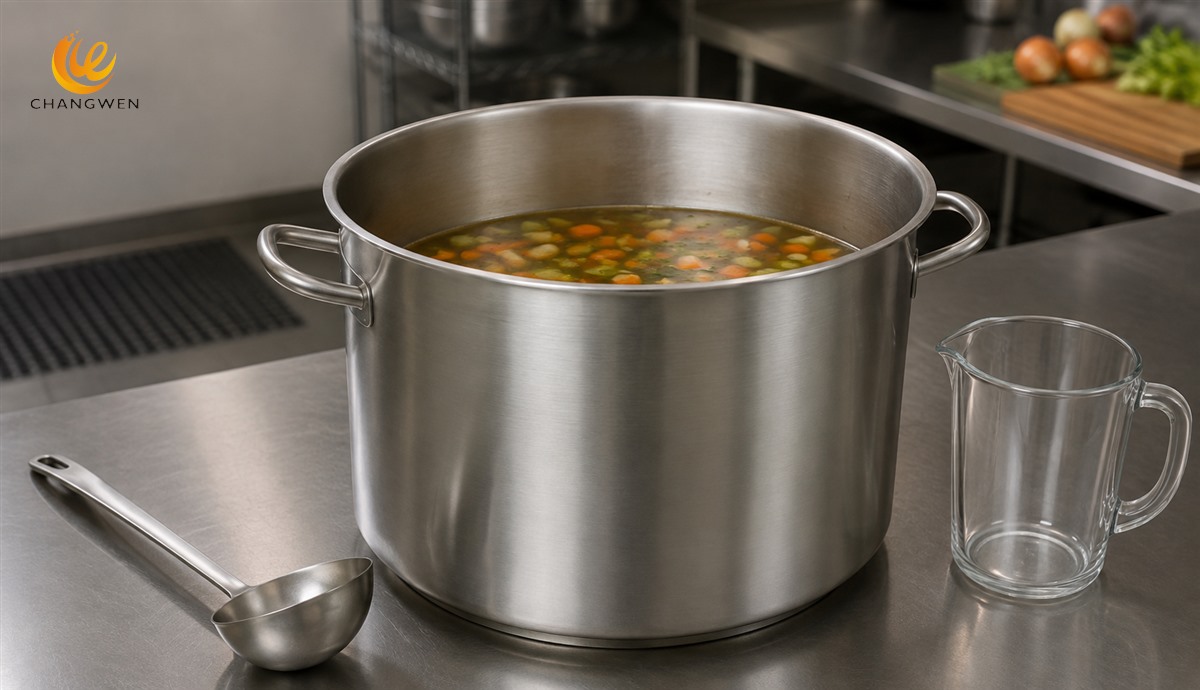
No single fill percentage is correct for every recipe. Quietly simmered stock may use more of the vessel than pasta that foams, while thick soup may need extra stirring clearance. The reliable method is to define the expected ingredient volume and process behavior first, then test the proposed pot with the real recipe or a controlled water-volume trial.
How can you calculate the stockpot size a recipe needs?
Start with the largest volume that will exist at any moment, not only the finished yield. Add the liquid, solid ingredients, expected expansion, and any water that will later be drained. Then add process headspace. The simple purchasing rule is: required nominal capacity must be greater than the maximum in-process volume plus the empty space required for boiling and stirring.
- Measure the finished batch. Record the actual liters or quarts produced by the standard recipe.
- Find the peak process volume. Include bones, vegetables, pasta water, foam, or other material present before reduction or draining.
- Allow recipe-specific headspace. Use more room for vigorous boiling, foaming starches, or frequent stirring.
- Round up to a commercially available size. A calculated need of 7.1 L does not belong in a nominal 7.1 L vessel with no working room.
- Run a kitchen trial. Confirm burner fit, heat-up time, stirring access, lifting, pouring, cleaning, and storage before standardizing the size.
This method is more dependable than assigning a pot by household size or restaurant seat count. Two four-person households may need different stockpots because one cooks fresh portions and the other prepares a week of meals. Two 60-seat restaurants may need different capacities because menu mix and batch schedule determine production volume.
What stockpot size works for soup and stew?
A 6 to 8 qt pot is usually suitable for a normal household soup batch, while 10 to 12 qt supports larger family portions, leftovers, or freezer meal preparation. A 16 qt or larger vessel makes sense when soup is produced for events or as a repeated menu item. Thick stew needs enough diameter and stirring clearance to move dense ingredients from the bottom, so extra height alone does not guarantee a better result.
Serving count should be calculated from the actual portion standard. If one portion is 350 mL and the target is 20 portions, the finished yield is 7 L before production loss or hold-back. The stockpot must still accommodate the higher in-process volume and headspace, so a nominal 8 L pot would be too close to the required finished yield.
What stockpot size works for pasta and blanching?
Pasta and blanching require a capacity chosen around water movement rather than finished food volume. The water, product displacement, boil recovery, foam, and stirring motion all consume space. A household cooking one package of pasta may find 6 to 8 qt practical, while larger batches often benefit from 10 to 12 qt. A commercial kitchen should validate batch weight and recovery time on the intended burner instead of extrapolating from a home serving rule.
A larger pot does not automatically cook pasta faster. If the burner is undersized, more water takes longer to heat and may recover slowly after cold food is added. Matching the base diameter to the heat source can improve workflow more than adding several unused quarts of nominal capacity.
What stockpot size works for stock and broth?
Stock production is governed by the combined volume of water and solid ingredients at the start of the cook. Bones and vegetables occupy significant space even when the finished liquid yield is modest. A 10 to 12 qt pot can handle many household stock sessions, whereas recurring restaurant production often moves into 16, 20, 24, or 32 qt sizes after the recipe is standardized.
Tall, relatively narrow stockpots can reduce exposed surface area and use floor space efficiently, but a very tall vessel may be harder to stir, lift, and clean. A wider body improves access and may match a powerful burner better. The useful shape is therefore the one that balances evaporation, base coverage, access, and storage for the target kitchen.
How should household size affect stockpot capacity?
Household size is a starting clue, not a final specification. A one- or two-person home may prefer 4 to 6 qt when storage is tight and leftovers are limited. A three- to five-person household often gains more flexibility from 8 qt. A larger household or a cook who freezes meals may value 10 to 12 qt, provided the pot remains comfortable to lift and clean.
The same decision logic applies across cookware categories: capacity, cooking surface, and workflow matter more than a headline number. Our guide to frying pan size likewise uses food load and burner fit rather than family count alone.
How should a commercial kitchen choose stockpot capacity?
A commercial kitchen should size a stockpot from the menu, recipe yield, production schedule, and holding plan. Seat count is insufficient because a popular soup may sell to only part of the room, a sauce may be produced every second day, and prep may be divided between shifts. The best capacity supports one controlled batch that staff can heat, move, cool, clean, and store within established procedures.
Material and construction also affect commercial use, but they answer a different question from volume. Our guide to the best material for commercial cookware explains durability and service considerations. Capacity selection should remain a separate calculation so a good material choice does not hide a vessel that is too large or too small for the batch.
Why can two smaller stockpots outperform one large stockpot?
Two smaller pots can improve flexibility when a kitchen needs parallel flavors, staggered service, allergen separation, faster cooling, or easier lifting. One larger stockpot can reduce vessel count and simplify a standardized high-volume batch. The better arrangement depends on whether the operation values maximum single-batch volume or the ability to divide production.
For example, two 12 qt pots do not behave exactly like one 24 qt pot. The two-pot arrangement needs two burners and more washing space, but each vessel is easier to handle and can finish at a different time. The 24 qt pot uses one burner and one recipe vessel, but it concentrates more weight and creates a larger cooling and transfer task.
How heavy is a filled stockpot?
Water contributes approximately 1 kg per liter near normal kitchen temperatures, so liquid weight rises quickly before the pot and solid ingredients are counted. An 11.4 L pot containing 9 L of soup already holds roughly 9 kg of water-based liquid, plus the vessel, lid, and dense ingredients. A 30 L commercial batch can become a major handling load even when the pot looks manageable while empty.
Loaded weight should influence handle design, rivet or weld requirements, pouring method, trolley access, and whether staff lift the pot at all. The safest workflow may use smaller batches, a transfer tool, a drain, or a fixed kettle rather than asking one person to carry a nearly full stockpot. Capacity is therefore an ergonomic and process decision, not merely a recipe decision.
How do burner size and heat output limit capacity?
The stockpot base should sit stably on the grate or cooking zone and receive useful heat across an appropriate area. A very wide base on a small burner may heat unevenly, while a tall high-volume pot on a weak burner may take too long to reach a boil. Induction users must also confirm that the base construction is compatible and that the appliance accepts the vessel diameter and loaded weight.
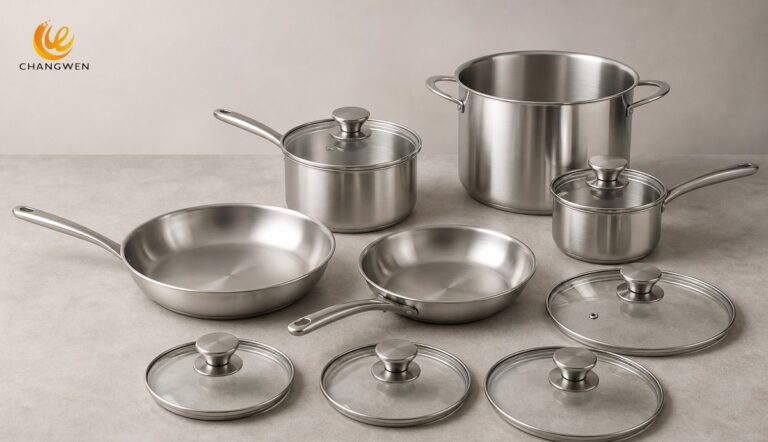
Capacity comparisons should include base diameter, body diameter, total height, and contact surface, not just quarts or liters. A procurement sheet that lists only capacity cannot establish whether a pot fits the intended range. In cookware sets, actual vessel types and sizes matter more than package count.
How do sink, storage, and doorway clearance affect the choice?
A stockpot that fits the burner can still fail if it cannot sit flat in the sink, clear the faucet, enter the dishwasher, or fit on its shelf. Measure the exterior width across the handles and the complete height with the lid because body diameter understates required space.
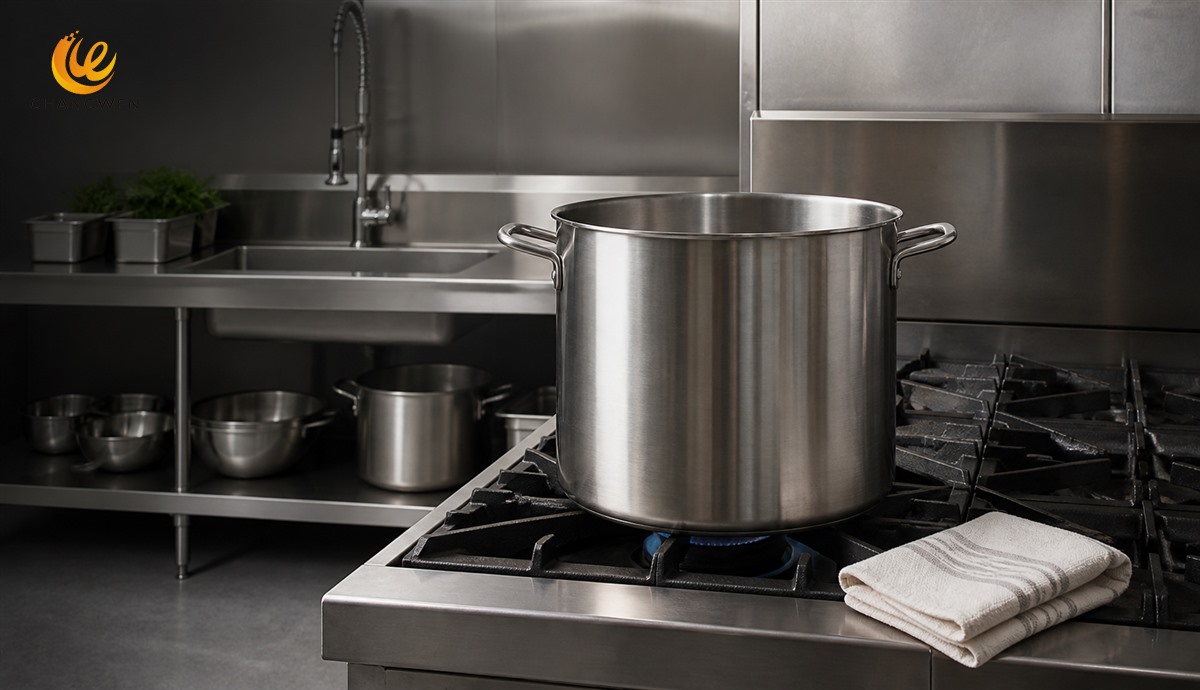
Commercial buyers should also trace the pot route from dry storage to prep, range, pass, cooling area, washing station, and return storage. Tight corners, shelf lips, cart dimensions, and low faucets can turn a technically suitable capacity into an operational problem. A simple cardboard footprint or sample pot can reveal these conflicts before a bulk order.
Does stockpot material change the capacity needed?
Material does not change the liters required by a recipe, but construction changes weight, heat response, durability, induction compatibility, and price. A heavy base may improve stability and heat distribution while increasing lifting effort. Thin construction may reduce empty weight but requires evaluation for deformation and the intended service environment.
Buyers who have already calculated volume can review our comparison of stockpot materials and cost factors. Keeping the decisions separate makes the specification clearer: capacity defines how much the pot must process, while material and construction define how it should perform.
How can retailers build a useful stockpot size assortment?
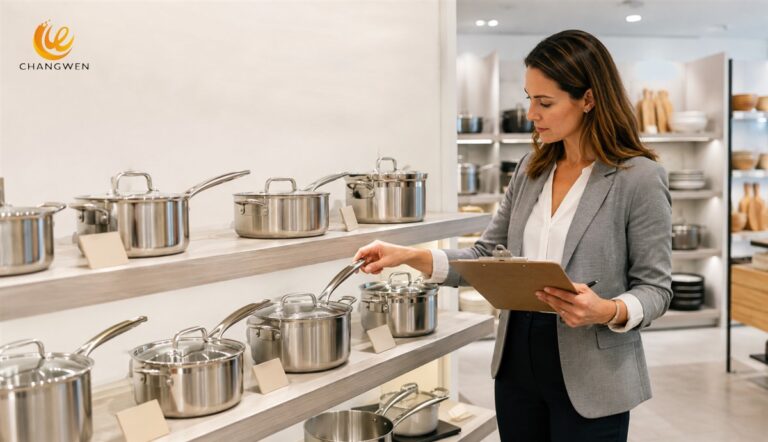
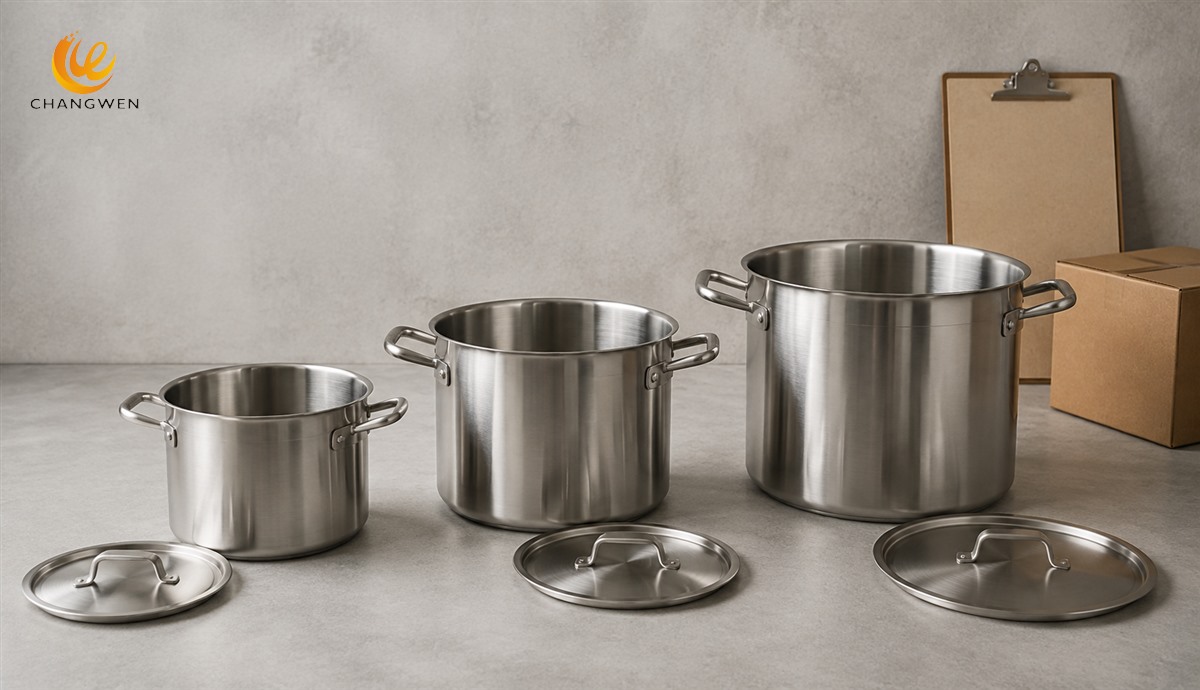
A retail assortment should cover distinct jobs rather than repeat nearly identical capacities. A compact option can serve small households and secondary-pot use; an 8 qt core size can address broad home demand; a 12 qt step-up can support batch cooking; and one or more 16 qt-plus products can target entertaining or professional use. The exact ladder should reflect local units, shelf space, price architecture, and customer cooking habits.
Each step should offer a visible reason to trade up. If two adjacent stockpots have similar usable volume, exterior dimensions, and target meals, one may create inventory complexity without adding customer value. A capacity family is stronger when every SKU has a defined user, recipe range, and kitchen environment.
What should an OEM stockpot capacity specification include?
An OEM or private-label specification should state the nominal capacity, capacity tolerance, measurement method, internal and external dimensions, base diameter, handle span, lid height, empty weight, construction, finish, and intended cooktop. It should also identify whether the marketed quart value means US liquid quarts and provide the rounded liter equivalent used on packaging.
The buyer should request a sample and verify capacity with an agreed test method before approving packaging claims. The sample review should also cover handle clearance, lid fit, balance, pouring behavior, surface finish, carton protection, barcode position, and nested packing if multiple sizes ship together. Capacity is only one controlled characteristic in a saleable product.
For a broader sourcing checklist, see the factors to consider when buying stockpots wholesale. Buyers planning customization can also review the Changwen custom stainless steel cookware services for product, logo, finish, handle, lid, and packaging options.
What mistakes cause buyers to choose the wrong stockpot size?
- Using serving count without a portion standard: A claim of ten servings does not define volume unless the recipe specifies milliliters or fluid ounces per portion.
- Treating rim capacity as working capacity: A full-to-the-top vessel leaves no practical space for boiling or stirring.
- Ignoring peak process volume: Finished stock may be smaller than the bones, vegetables, and water present at the beginning.
- Choosing the largest option by default: Unused capacity increases heat-up time, storage demand, and handling burden.
- Comparing units without naming the system: US liquid quarts, Imperial quarts, and liters should never be mixed without conversion.
- Skipping an exterior-dimension check: Handles, lid, burner contact, sink clearance, and shelf height determine physical fit.
- Approving labels before testing a sample: Packaging capacity claims should match the agreed physical measurement method.
Frequently asked questions about stockpot capacity
Is an 8 qt stockpot big enough for a family?
An 8 qt stockpot is big enough for many families because it can hold a practical soup or pasta batch while remaining manageable in a home kitchen. A family that freezes large batches or entertains frequently may prefer 10 to 12 qt, while a household with limited storage may use 6 qt more often.
Is a 12 qt stockpot too large for home use?
A 12 qt stockpot is not inherently too large for home use, but it should earn its storage space. It is useful for large soup batches, stock, pasta, and entertaining. It is less convenient when the burner is small, the sink is shallow, or the cook usually prepares only two portions.
How many liters are in a 20 qt stockpot?
A 20 US liquid qt stockpot has a nominal capacity of approximately 18.9 L. That conversion does not mean 18.9 L is the correct working fill for every recipe; boiling and stirring may require substantial empty space below the rim.
Should a restaurant buy 24 qt or 32 qt?
A restaurant should choose between 24 qt and 32 qt by measuring peak recipe volume and validating the loaded workflow. The 32 qt pot provides more batch room, while the 24 qt pot may heat, move, cool, clean, and store more easily. If the recipe fits the smaller pot with proper headspace, the operational advantage may outweigh unused nominal capacity.
Can capacity be calculated from pot dimensions?
Cylindrical volume can be estimated from internal diameter and internal height, but a stockpot may have curved walls, a rolled rim, a shaped base, or a capacity line below the top. Buyers should treat geometry as a cross-check and use an agreed measured-volume test for final approval.
How can Changwen support a stockpot capacity project?
Changwen supports cookware wholesalers, retailers, distributors, and foodservice buyers with stainless steel cookware manufacturing, private-label programs, and OEM or ODM development. A project can be scoped around the target capacity ladder, construction, handles, lids, finish, logo application, packaging, and market-specific unit labeling. The practical starting point is a clear brief that connects each SKU to a meal, batch volume, and kitchen environment.
Send Changwen your target US qt and liter capacities, expected order quantity, destination market, cooktop requirements, material preference, packaging plan, and reference dimensions. Minimum order quantity depends on the confirmed product and customization; our guide to typical OEM cookware MOQ explains why size mixes, finishes, and packaging affect the final threshold. Contact Changwen to review your stockpot range and request a project-specific quotation.