Cookware manufacturing partner since 2002 info@cwchangwen.com · +86 180 2296 3948

The Six Gates That Stop Expensive OEM Cookware Mistakes Before They Scale

Quick answer: The most damaging OEM cookware mistakes occur when an importer releases money, tooling, production, packaging, or shipment without objective evidence that the project is ready. A reliable importer does not manage risk with one final inspection. A reliable importer uses six release gates: commercial feasibility, specification freeze, sample validation, production readiness, in-process control, and shipment release. Each gate names the decision owner, required evidence, acceptance criteria, and corrective action before the project can advance.
Read time: 14 minutes
This guide takes a different approach from a conventional list of sourcing warnings. Each common OEM cookware mistake is connected to the moment when the mistake can still be prevented. The result is a practical control system for importers, wholesalers, retailers, restaurant suppliers, and private label brands that need repeatable quality rather than a one-time successful order.
Why do OEM cookware projects fail even when the sample looks good?
An attractive cookware sample proves only that one unit can be made. An OEM program succeeds only when the approved materials, dimensions, components, finish, logo, packaging, test requirements, quantity, and delivery plan can be repeated across mass production. The gap between one acceptable sample and thousands of acceptable units is where most sourcing risk develops.
Many failures are transfer failures rather than isolated factory errors. Information is lost when a sales quotation becomes a purchase order, when a sample becomes a production specification, when artwork becomes printed packaging, or when an approved component is replaced during purchasing. A control gate protects each transfer by requiring the next team to work from the same approved revision.
The six-gate method also separates prevention from detection. Prevention defines the correct product and process before production. Detection checks whether production followed those controls. Final inspection is useful for detection, but final inspection cannot cheaply correct an unsuitable design, an unsupported claim, a missing component test, or packaging that was approved too late.
What are the six release gates for an OEM cookware order?
| Release gate | Question the importer must answer | Minimum evidence | Decision if evidence is missing |
|---|---|---|---|
| 1. Commercial feasibility | Does the product work for the market and business model? | Target cost, quantity, market, channel, margin, and timing assumptions | Revise the concept before sampling |
| 2. Specification freeze | Can every supplier quote and build the same product? | Controlled specification, drawings, bill of materials, and artwork list | Do not compare prices or authorize tooling |
| 3. Sample validation | Does a production-representative sample meet measurable requirements? | Approved sample, test results, deviation log, and signed approval record | Correct and resample |
| 4. Production readiness | Are materials, components, packaging, capacity, and changes controlled? | Approved inputs, production plan, quality plan, and revision confirmation | Do not release mass production |
| 5. In-process control | Is the factory detecting variation before the entire order is complete? | Incoming, first-piece, process, and corrective-action records | Contain affected units and correct the process |
| 6. Shipment release | Are product, packaging, quantity, documents, and shipment terms acceptable? | Final inspection, packing verification, test documents, and shipping file | Hold shipment until disposition is approved |
Mistake 1: Choosing the lowest unit price before equalizing the quote
The lowest quoted price is not necessarily the lowest comparable price. Two cookware offers may differ in steel grade, body thickness, conductive layer, base diameter, handle weight, lid construction, finish standard, inspection scope, packaging, tooling ownership, payment terms, or trade term. A price comparison is invalid when the product and commercial boundary are not equal.
The preventive control is a normalized quotation sheet. Every supplier should price the same specification revision, SKU quantity, packaging format, testing responsibility, delivery term, and currency basis. Alternatives should appear as separate options rather than silent substitutions. The importer can then compare unit cost, one-time cost, expected landed cost, and risk exposure on a common basis.
The release evidence is not a low number; the release evidence is an explained number. An unusually low offer should identify which construction, component, process, or commercial assumption creates the difference. Importers who still need a broader purchasing checklist can use the site’s 12 factors for purchasing cookware in bulk alongside this gate-based workflow.
Mistake 2: Treating a product name as a manufacturing specification
Descriptions such as “304 frying pan,” “tri-ply saucepan,” or “premium nonstick set” are categories, not build instructions. A factory cannot infer the importer’s intended diameter, capacity, layer thickness, base flatness, rim geometry, handle attachment, lid fit, finish boundary, coating system, logo position, or packaging protection from a category name.
A quote-ready specification should define the cookware body and every functional component. The specification should state materials by component, finished dimensions, thickness or weight controls, construction, usable cooking surface, induction requirement, handle and lid system, surface finish, color reference, branding method, tolerances, performance tests, cosmetic zones, packaging, and approved deviations.
The specification gate closes only when open fields are visible. Mark each requirement as fixed, preferred, factory-proposed, or to be decided. This classification prevents a buyer preference from being mistaken for a mandatory requirement, while preventing a critical requirement from being treated as optional. Revision number and issue date should appear on the specification, drawings, artwork, and purchase order.
Mistake 3: Approving a showroom sample instead of a production reference
A showroom sample may come from existing stock, another customer’s configuration, a different production batch, or a specially prepared development process. The sample can demonstrate appearance and general construction, but it cannot control mass production unless its exact materials, components, process, and deviations are documented.
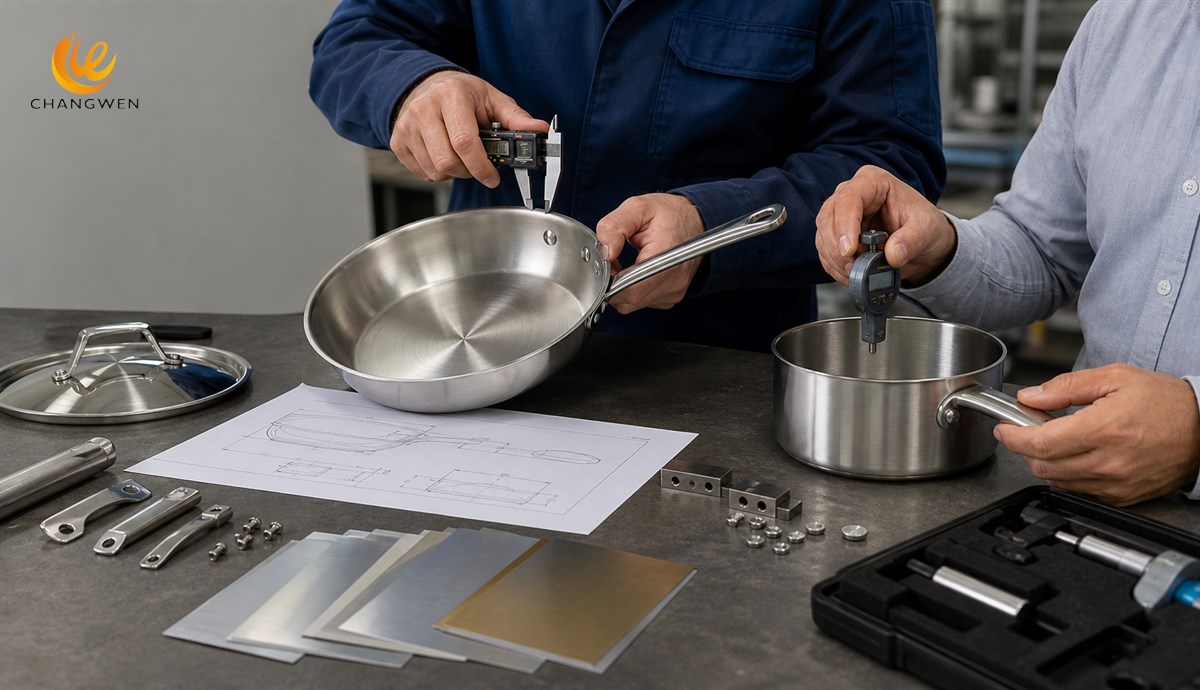
A golden sample should be production-representative and connected to the controlled specification. The buyer and factory should identify the sample version, record every accepted deviation, photograph critical details, and seal or retain matching reference units. If the physical sample conflicts with the written specification, the agreement should state which reference controls the decision.
Functional validation must reflect intended use. Depending on the product, validation may include base flatness, induction response, thermal distribution, handle load and torque, lid fit, pouring, stability, capacity, coating performance, dishwasher exposure, corrosion resistance, thermal cycling, impact, and packaging transit checks. Applicable tests depend on construction, claims, market, and channel; one generic test list is not suitable for every cookware SKU.
The sample gate should end with an approval record, not an informal email saying “looks good.” The approval record should list sample ID, specification revision, test status, open issues, approved deviations, responsible approvers, and the exact meaning of approval. A visual approval should never be interpreted as approval of untested performance or compliance.
Mistake 4: Confirming compliance after materials and claims are fixed
Food-contact compliance is a design input, not a certificate collected at the end. The target market, product construction, food-contact surfaces, handles, lids, coatings, silicone parts, adhesives, packaging, warnings, and marketing claims determine which evidence may be needed. A report that covers a different material, color, coating, factory, or product configuration may not support the imported item.
The importer should define the compliance matrix before sample approval. The matrix should connect each applicable requirement to the tested component, test method, report owner, laboratory, report date, sample identity, and required renewal or verification point. Regulatory requirements can change, so importers should confirm the current obligations with qualified laboratories, customs professionals, or legal advisers for the destination market.
Claims require the same discipline as materials. Statements about induction compatibility, oven temperature, dishwasher use, recycled content, coating chemistry, food safety, durability, or environmental performance should match evidence and user instructions. Unsupported claims can create risk even when the physical cookware is otherwise acceptable.
Mistake 5: Allowing the purchase order to contain less detail than the approval package
A detailed sample process loses value when the purchase order says only model, quantity, unit price, and delivery date. The purchase order should incorporate the approved specification revision, golden sample ID, artwork versions, packaging file, quality plan, test responsibilities, inspection rights, approved subcontracting, change-control procedure, and rules for nonconforming goods.
Commercial documents should also distinguish forecast from commitment. MOQ, order quantity, quantity tolerance, spare parts, overrun policy, tooling charges, sample charges, payment milestones, trade term, delivery location, and lead-time starting point should be explicit. The site’s guide to the typical MOQ for OEM cookware explains why product quantity, packaging quantity, component purchasing, and customization can create different minimums.
The safest approval hierarchy is simple: controlled written requirements govern; the approved sample confirms appearance and workmanship; later changes require written authorization. When the hierarchy is undefined, buyer and factory may each rely on the reference that supports their own interpretation.
Mistake 6: Accepting unrecorded changes after sample approval
OEM cookware projects often change after approval because a component becomes unavailable, artwork is revised, a coating color needs adjustment, the order mix changes, or production engineering identifies a manufacturability issue. Change itself is normal. Uncontrolled change is the mistake.
A change request should describe the current requirement, proposed replacement, reason, affected SKUs, cost impact, timing impact, compliance impact, required retesting, inventory disposition, and effective production batch. The buyer should approve, reject, or request evidence before the factory implements the change. Verbal approval should be converted into the controlled project record.
The production team should receive only released files. A shared folder containing several files called “final” encourages mistakes because operators, purchasing staff, packaging suppliers, and inspectors may use different versions. A master revision index should identify the only valid specification, drawing, bill of materials, artwork, packaging, and inspection plan.
OEM and ODM projects assign control differently, so change authority should match the development model. The OEM versus ODM cookware framework compares design authority, tooling, intellectual property, and change control in more detail.
Mistake 7: Waiting for final inspection to discover process defects
Final inspection evaluates completed goods, but many cookware defects originate much earlier. Incorrect metal, unstable forming, weak bonding, coating preparation, poor curing, handle assembly, polishing variation, or contaminated cleaning can affect an entire batch before packed units are available for inspection.
In-process control should focus on characteristics that become expensive or impossible to correct later. Incoming material identity should be checked before forming. First-piece dimensions should be confirmed before continuous production. Bonded bases, coatings, handles, lids, finishes, logos, and packaging should have process-specific checks at the point where correction remains practical.
The importer does not need to operate the factory’s quality system, but the importer should approve a project quality plan. The plan should state critical-to-quality characteristics, test or inspection method, frequency, sample size, acceptance rule, record owner, reaction plan, and evidence available to the buyer. Critical safety or compliance characteristics deserve tighter controls than minor cosmetic variation.

Mistake 8: Using vague acceptance language without defect rules
Words such as “high quality,” “good polishing,” “strong handle,” and “no obvious defect” depend on personal interpretation. A measurable acceptance rule defines what is checked, how it is checked, where it applies, how many defects are allowed, and what happens when the sample fails.
Cosmetic criteria should define viewing conditions, inspection distance, appearance zones, defect categories, and approved references. Dimensional criteria should define target, tolerance, tool, and measurement location. Functional criteria should define load, duration, cycles, temperature, sequence, and pass condition. Packaging criteria should define product orientation, protective material, label position, carton construction, quantity, and drop or transit expectations where required.
Not every characteristic needs an extremely tight tolerance. Unnecessarily strict controls can increase cost without improving consumer value, while loose controls on base stability, handle security, food-contact materials, or critical fit can create serious risk. The importer and factory should use product risk and customer use to decide which features are critical, major, or minor.
Mistake 9: Treating packaging as decoration instead of a product system
Cookware packaging must protect heavy, hard, and sometimes sharp-edged components through handling, stacking, vibration, drops, storage, and retail presentation. Attractive graphics cannot compensate for movement inside the box, metal-to-metal contact, lid impact, handle pressure, moisture exposure, weak cartons, or an inefficient master-carton arrangement.
Packaging development should begin before mass production because package dimensions affect cost, palletization, container utilization, fulfillment, labeling, and delivery planning. The buyer should approve dielines, artwork, barcode data, product claims, warnings, country-of-origin marking, inserts, protective structure, retail pack, master carton, and packing method. The site’s guide to cookware packaging for retailers and supermarkets provides additional format and merchandising considerations.
A packaging sample should be tested with the actual cookware configuration. An empty box or digital rendering cannot prove protection. Packaging release evidence can include a packed sample, gross and net weights, carton dimensions, packing photographs, barcode verification, agreed transit tests, and confirmed shipping marks.
Mistake 10: Planning the launch from the factory lead time alone
Factory production time is only one segment of the import schedule. Product definition, quotation, tooling, sample development, buyer review, artwork, compliance testing, component procurement, inspection, corrective action, booking, export documents, international transit, customs clearance, and local delivery can each control the final launch date.
A realistic schedule should identify dependencies and owners. Production should not be shown as starting before the specification, sample, packaging, commercial terms, and required inputs are approved. The OEM cookware production timeline separates sample preparation, buyer-controlled approval time, 45-60 days of typical Changwen production after confirmation, and the additional logistics path.
Schedule protection comes from decision deadlines and buffers, not optimistic dates. The buyer should set deadlines for artwork, sample feedback, test approval, deposit, inspection booking, and shipping instructions. A launch with no allowance for correction assumes that every first result will pass, which is not a responsible planning basis.
Mistake 11: Releasing shipment without a complete decision file
A passed final inspection does not automatically mean the order is ready to ship. Shipment release should also confirm order quantity, approved deviations, packaging, markings, documents, test evidence, spare parts, carton data, trade term, booking information, balance payment conditions, and treatment of any nonconforming units.
When an inspection finds a problem, the decision should separate containment, cause, correction, and prevention. Containment identifies affected inventory. Cause analysis explains why the process failed. Correction repairs, replaces, sorts, or accepts defined units. Prevention changes the process or control so the defect is less likely to recur. A discount alone does not prevent the same problem on a reorder.

Mistake 12: Starting a reorder from memory instead of the approved baseline
A successful first order can create false confidence. Reorders may use a different material batch, component supplier, production line, operator team, packaging printer, season, or freight arrangement. The correct baseline is the released specification and approved evidence, not the assumption that the factory remembers the previous order.
Every reorder should confirm the current revision, approved changes, golden sample condition, component availability, compliance status, quantity mix, packaging files, quality plan, and production schedule. Repeat orders can use a shorter review when nothing has changed, but the no-change decision should still be recorded.
Performance data should improve the next order. Importers should feed inspection findings, warehouse damage, customer returns, warranty claims, review themes, and sales-channel feedback into the specification and quality plan. A repeatable OEM program becomes stronger when field evidence changes prevention controls instead of remaining in customer-service records.
How should an importer operate the six-gate system?
Each gate needs one accountable buyer-side owner, even when several people contribute. Product, sourcing, quality, compliance, packaging, logistics, and finance can review their areas, but one person should confirm that required evidence exists and unresolved risks are visible before release.
A gate decision should be one of four outcomes: release, conditional release, revise, or stop. Conditional release is appropriate only when the open item has an owner, deadline, risk assessment, and defined condition that must be completed before the affected activity. Conditional release should not become a convenient label for unresolved critical requirements.
A simple project register can track requirement, evidence, owner, status, due date, revision, and decision. The control system does not need complex software. It needs controlled information, disciplined decisions, and a rule that commercial urgency does not silently override quality or compliance requirements.
Which OEM cookware mistakes deserve the highest priority?
Importers should prioritize mistakes by severity, likelihood, and detectability. A hidden food-contact material change can have high severity and low detectability, so it deserves material traceability and testing controls. A minor carton color variation may be visible and commercially manageable, so it can receive a different response.
| Risk type | Typical example | Best prevention point | Why final inspection may be insufficient |
|---|---|---|---|
| Safety or compliance | Unsupported material, coating, or claim | Design and compliance matrix | Visual inspection cannot prove chemical compliance |
| Functional | Loose handle, unstable base, poor lid fit | Specification, validation, and process control | A small sample may miss variable process output |
| Cosmetic | Finish, logo, color, or polishing variation | Approved references and appearance rules | Vague standards create subjective disputes |
| Packaging | Transit damage or wrong retail information | Packed-sample and artwork approval | Correction after packing is slow and expensive |
| Commercial | Unexpected tooling, MOQ, freight, or delay | Normalized quote and purchase order | Product inspection does not validate contract scope |
Frequently asked questions about OEM cookware mistakes
Is a golden sample enough to control cookware quality?
A golden sample is necessary for appearance and workmanship reference, but it is not enough by itself. A physical sample cannot reveal every internal material, tolerance, test method, packaging requirement, or compliance obligation. The strongest baseline combines the sample with a controlled specification, test evidence, artwork, quality plan, and change record.
Should importers always hire a third-party inspector?
A third-party inspection can add independent evidence, especially for new suppliers, high-risk products, large orders, or distant markets. The decision should reflect order value, product risk, supplier history, and the buyer’s own quality resources. An inspector still needs a clear specification and acceptance plan; independence cannot compensate for vague criteria.
Can an importer change packaging after production starts?
An importer can request a packaging change, but the change may affect printed inventory, lead time, cost, product protection, labeling, carton dimensions, and shipment booking. The factory should evaluate the impact through formal change control before implementing the revision.
What should happen when the factory proposes a substitute component?
The factory should identify the proposed component, reason, specification difference, supplier, cost and timing impact, compliance effect, and validation required. The importer should approve the change in writing only after the replacement provides sufficient evidence for the intended use and market.
What is the safest first step for a new OEM cookware importer?
The safest first step is to define the target customer, sales market, product configuration, expected quantity, target cost, required customization, compliance needs, and launch timing before requesting a final quote. Clear inputs allow the factory to identify feasibility, risks, alternatives, MOQ, sampling work, and the information still missing.
Build the control system before the order becomes expensive
The central lesson is straightforward: do not wait for a finished container to discover that an earlier decision was unclear. Commercial feasibility should be proven before development cost grows. Specifications should be frozen before quotes and tooling are approved. Production-representative samples should pass defined tests before mass production. Materials, changes, and process controls should be verified before output scales. Product, packaging, documents, and commercial conditions should pass before shipment.
Changwen supports cookware wholesale, private label programs, and OEM/ODM development for global buyers. The factory’s services include stainless steel cookware production, product and component customization, logo application, custom finishes, packaging development, sampling, and high-volume supply. Changwen’s website describes more than 20 years of manufacturing experience, an 80,000-square-meter facility, automated production lines, and quality controls from incoming materials through final packing.
Ready to reduce risk in your next cookware program? Send Changwen the cookware category, sizes, construction or material preference, quantity by SKU, destination market, logo method, packaging needs, compliance requirements, target delivery date, and any reference files. The team can review manufacturability, customization options, wholesale supply, sample requirements, and a project-specific quotation. Contact Changwen to discuss your OEM cookware project.