Cookware manufacturing partner since 2002 info@cwchangwen.com · +86 180 2296 3948

Frying Pan vs Skillet: The Complete Buyer’s Guide for Choosing the Right Cookware for Your Market

⏱ Read Time: 12 minutes
The short answer: In most modern kitchens and retail markets, “frying pan” and “skillet” refer to the same cooking vessel — a shallow pan with sloped sides and a long handle designed for high-heat stovetop cooking. The terms are used interchangeably across North America, Europe, and Asia-Pacific markets.
The longer answer — and the one that matters for buyers: While end-users experience frying pans and skillets as equivalent products, there are meaningful differences in material associations, design conventions, market positioning, price tier, and OEM sourcing strategy that affect how kitchenware brands, wholesale buyers, and importers should think about, specify, and sell each product type.
This guide covers both answers — so you can have an informed conversation with consumers and make smarter decisions as a buyer.
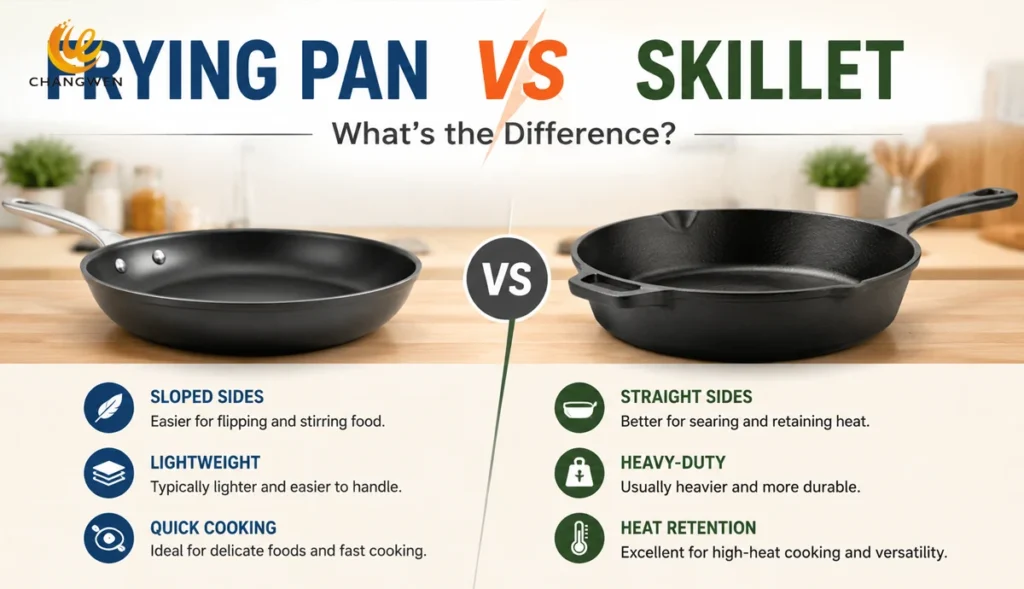
Are Frying Pans and Skillets the Same Thing?
Functionally, yes. Both frying pans and skillets share the same fundamental design: a flat cooking base, low sidewalls that flare outward, and a long handle for single-hand control. Both are used for high-heat tasks — searing, sautéing, frying, browning — and both are available in every material from stainless steel to cast iron.
The terminological distinction is primarily regional and material-associated:
- “Frying pan“ is the dominant term in everyday consumer vocabulary across most English-speaking markets. It is the default label in product listings, recipe instructions, and kitchenware retail.
- “Skillet” is more commonly used in North America (particularly the US) and is strongly associated with cast iron cookware. In professional kitchen contexts, “skillet” often implies heavier construction and higher heat tolerance than the lightest consumer frying pans.
Neither term is technically wrong when applied to either product. The market uses both, often without distinction.
For kitchenware buyers, the practical question is not “are they the same?” but rather “which positioning should my product program use, and which design and material specifications support that positioning?”
Frying Pan vs Skillet: Key Differences at a Glance
While the terms overlap significantly, meaningful distinctions emerge when you compare them across positioning, material, and target market:
| Feature | Frying Pan | Skillet |
|---|---|---|
| Side wall angle | Gently sloped outward | Slightly higher, more vertical |
| Typical weight | Lighter | Heavier (especially cast iron) |
| Heat retention | Fast response, quick cool-down | Holds heat longer |
| Primary material association | Stainless steel, non-stick aluminum | Cast iron, carbon steel, stainless steel |
| Best cooking applications | Everyday sautéing, eggs, vegetables, fish | High-heat searing, one-pan meals, oven finishing |
| Target user | Home cook, everyday use | Serious home cook, professional kitchen |
| Market positioning | Accessible, high-volume | Premium, durability-focused |
| Price perception | Mid-range | Mid-to-premium |
| OEM program type | Non-stick, tri-ply sets, retail SKUs | Cast iron, heavy stainless, professional programs |
This table is not a claim that frying pans and skillets are categorically different products — they are not. It is a positioning and market intelligence framework that helps buyers understand how each term functions in retail and wholesale markets.
Design Differences: Shape, Depth, and Cooking Performance
Side Wall Design — Where Performance Diverges
The most consistent physical difference between a “frying pan” and a “skillet” as sold in the market is the degree of sidewall slope.
Frying pans typically feature more aggressively flared sides — angled outward at 30–45 degrees from the base. This geometry offers several cooking advantages: food can be flipped easily with a wrist flip or spatula, moisture evaporates rapidly from the cooking surface (promoting browning rather than steaming), and the wide-open profile makes access easy for multiple utensils.
Skillets — particularly cast iron and professional-grade stainless skillets — often feature sides that are less dramatically flared and slightly taller. This adds useful capacity (more food fits without risk of spilling during tossing), reduces splatter during high-heat searing, and improves the pan’s utility for one-pan meal applications where liquid or sauce needs to be retained alongside seared proteins.
For OEM buyers: understanding this distinction helps in product specification. A pan described as a “skillet” in your target market should typically have more substantial sidewalls and a heavier construction than a pan labeled simply as a “frying pan.”
Cooking Surface Area and Size Specifications
The cooking surface area — defined by the base diameter, not the rim diameter — is the single most useful measurement for matching a pan to its cooking task. Both frying pans and skillets are available across the same size range:
| Size | Base Diameter (Approx.) | Best For |
|---|---|---|
| 8 inch / 20cm | ~14cm base | 1–2 eggs, single portions, small sauces |
| 10 inch / 24cm | ~17cm base | 2–3 person household, everyday cooking |
| 12 inch / 28–30cm | ~22cm base | Family meals, large sears, commercial service |
| 14 inch / 35cm | ~28cm base | Commercial volume, restaurant use |
The 12-inch / 30cm size is the most searched and purchased size in both frying pan and skillet categories across US, UK, Australian, and Canadian markets. It is the anchor SKU for any OEM or private-label pan program targeting English-speaking retail.
Material Comparison: What Goes Into Each Product Type
Material selection is where “frying pan” and “skillet” begin to diverge meaningfully from a buyer and manufacturer perspective. Each material has distinct performance characteristics, certification requirements, and market positioning.
Stainless Steel Frying Pan and Stainless Steel Skillet
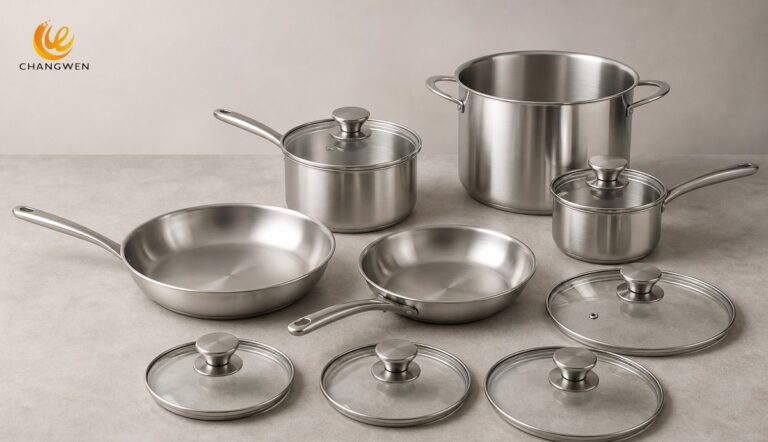
The stainless steel frying pan and stainless steel skillet are the most versatile, durable, and professionally respected product configurations in the category. Quality stainless steel pans are:
- Non-reactive with all food types — including acidic foods (tomatoes, wine, citrus) that damage cast iron and aluminum
- Dishwasher safe and oven compatible at full stainless construction (typically to 500°F / 260°C)
- Free from coatings — no PTFE, PFOA, or other chemicals that degrade over time or at high heat
- Long-life products — quality stainless steel cookware does not need to be replaced due to coating wear; it is a once-in-a-decade or lifetime purchase for most users
Stainless steel frying pans are available in three main constructions:
- Single-ply stainless — economical, lighter, heat distribution concentrated at base
- Capsule bottom — single-ply body with multi-layer bonded base disc; better heat distribution at base
- Full-clad tri-ply or 5-ply — three or five bonded layers running the full pan height; even heat distribution across base and sides; the premium tier
The stainless steel skillet label is commonly applied to the heavier-gauge, tri-ply or full-clad constructions — implying a professional-grade product for buyers who recognize the construction terminology.
For wholesale and OEM buyers: stainless steel frying pans and skillets are ideal for hotel and restaurant supply programs, premium retail brands, and any channel where product longevity and professional credentials drive purchase decisions. The absence of a degradable coating eliminates the replacement cycle that non-stick products create — but also creates a product relationship based on long-term satisfaction rather than regular repurchase.
Non-Stick Frying Pan and Non-Stick Skillet
The non-stick frying pan is the highest-volume product in the global cookware market — more units of non-stick frying pans are sold annually than any other single cookware category. The combination of easy food release, minimal fat requirement, and simple cleaning makes non-stick the default cookware choice for most home cooks in consumer markets worldwide.
Coating types available for OEM programs:
| Coating | Key Characteristics | Target Market |
|---|---|---|
| PTFE (Teflon-type) | Proven performance, cost-effective, widely understood | Mass retail, value-volume programs |
| Ceramic | PFOA-free, contemporary appeal, eco positioning | EU premium, health-conscious segments |
| Granite-effect | Aesthetic differentiation, distinctive visual | Lifestyle retail, gift sets |
| Marble-effect | Premium visual, strong shelf presence | Department stores, premium e-commerce |
| Honeycomb interior | Reduced contact non-stick, health-positioning | Chef-targeted, premium health market |
Key buying factors for non-stick programs:
- Coating thickness: A quality PTFE coating is applied in 3–4 layers; economy coatings use 1–2 layers. Thicker coatings provide better durability and scratch resistance.
- Base material and thickness: Aluminum body pans (2.0mm–4.0mm) provide fast, even heat. Thicker aluminum reduces hotspots and warping.
- Handle design and attachment: Riveted handles are stronger than welded; silicone-wrapped handles are comfortable and heat-resistant.
- Induction compatibility: A magnetic stainless steel disc bonded to the base is required for induction use. Non-stick aluminum pans without this addition are not induction compatible — verify explicitly for programs targeting EU, Scandinavian, or Japanese markets.
For wholesale and OEM buyers: non-stick frying pans offer the highest consumer demand volume, the most competitive sourcing environment, and the shortest product replacement cycle (typically 2–5 years for consumer-grade products, shorter for economy grades). Brand differentiation through coating type, handle design, and packaging matters significantly in this category.
Cast Iron Skillet vs Traditional Frying Pan
The cast iron skillet is the product that most clearly justifies the terminological distinction between “frying pan” and “skillet.” When cooking enthusiasts, chefs, and serious home cooks refer to a “skillet,” they are often picturing a cast iron vessel — and for good reason.
Why cast iron remains popular — and growing:
Cast iron offers genuinely distinctive cooking characteristics that no other material fully replicates:
- Exceptional heat retention: A preheated cast iron skillet stays hot when cold food is added better than any other cookware material. This is why steakhouse sears and professional-grade browning are so difficult to replicate without cast iron.
- Even heat across the cooking surface — once the pan is fully at temperature (which takes longer than stainless or aluminum)
- Oven-safe without temperature limit (for bare and pre-seasoned; enamel-coated variants typically rated to 500°F / 260°C)
- Natural non-stick development through seasoning — a well-used cast iron pan develops a cooking surface that rivals PTFE coatings for egg and delicate food cooking
- Exceptional durability — cast iron skillets are regularly inherited across generations; the product lifecycle is measured in decades, not years
Cast iron OEM variants:
| Variant | Description | Market Positioning |
|---|---|---|
| Plain/bare cast iron | Requires seasoning; darkens with use | Traditional, enthusiast, professional |
| Pre-seasoned cast iron | Factory-seasoned with vegetable oil for immediate use | Mass retail, convenience-focused |
| Enamel-coated cast iron | Porcelain enamel exterior and interior; no seasoning required; available in colors | Premium retail, lifestyle brands, gifting |
For OEM buyers developing a “skillet” program, cast iron with enamel coating represents the highest value-add configuration — and commands retail prices that stainless and non-stick pans in equivalent sizes typically cannot reach.
Carbon Steel Frying Pan / Skillet
Carbon steel occupies a specific and growing position in the frying pan/skillet market — lighter than cast iron, more responsive than cast iron, and favored by professional chefs who use it as a lighter-weight alternative that still develops natural non-stick seasoning through use.
Carbon steel characteristics:
- Lighter than cast iron by 30–50% in equivalent sizes
- Heats faster and responds to temperature changes more quickly
- Develops seasoning similar to cast iron with use
- Compatible with all stovetop types including induction
- High heat tolerance — restaurant kitchen standard
Carbon steel is increasingly positioned as the “chef’s choice” or “professional” variant in premium frying pan and skillet programs, commanding a meaningful price premium over stainless and aluminum alternatives while offering a compelling performance narrative.
Frying Pan vs Skillet: Which Should Kitchenware Buyers Choose?
When to Choose Frying Pans for Your Product Program
Frying pans — particularly non-stick aluminum and stainless steel variants — are the right product choice for buyers building high-volume programs in mass retail, e-commerce, or multi-SKU cookware sets.
Recommended for:
- Mass retail channels (supermarkets, discount stores, warehouse clubs)
- Amazon FBA and e-commerce programs at mid-market price points
- Entry-level to mid-range cookware sets (where the frying pan is a component alongside pots and saucepans)
- Hospitality and catering programs requiring volume at accessible price points
Why frying pans win in these contexts:
- Higher consumer awareness and demand — “frying pan” is the term most consumers search and recognize
- Easier product education — the use case is universally understood
- Higher replacement demand — non-stick frying pans are frequently repurchased as coatings degrade
- More competitive pricing — higher volume production means better factory-gate price points
- Lower barrier to private label — more existing molds and base designs available for quick OEM programs
When to Choose Skillets for Your Product Program
Skillets — particularly cast iron, carbon steel, and heavy-gauge stainless configurations — are the right product choice for buyers building premium programs, specialty brands, or chef-targeting initiatives.
Recommended for:
- Premium retail channels (specialty kitchen stores, department stores, gourmet food markets)
- Private-label programs targeting serious home cooks or culinary enthusiasts
- Professional kitchen and hospitality programs where quality and durability are paramount
- Gift programs and lifestyle brands where the “skillet” positioning carries aspirational value
- Brands building long-term customer loyalty through durable, non-degradable products
Why skillets win in these contexts:
- Higher perceived value — the “skillet” label carries professional and artisan associations
- Stronger durability narrative — cast iron and carbon steel skillets are positioned as lifetime investments
- Premium pricing opportunity — enamel cast iron skillets in particular command retail prices significantly above equivalent-size non-stick pans
- Lower return rates — durable products generate fewer quality complaints
- Chef and food culture alignment — restaurant culture, social media food content, and culinary enthusiasm all favor cast iron and heavy stainless “skillets”
How to Source Frying Pans and Skillets from a Cookware Manufacturer
Sourcing decisions for frying pan and skillet programs require evaluation across five dimensions:
1. Material Options and Factory Capability
A capable wholesale cookware supplier should manufacture across all frying pan and skillet material categories. Verify that your supplier can produce:
- Stainless steel frying pans (single-ply, capsule bottom, tri-ply, 5-ply)
- Non-stick aluminum frying pans (with PTFE, ceramic, granite, marble coatings)
- Carbon steel skillets
- Cast iron skillets (plain, pre-seasoned, enamel-coated)
A supplier limited to one or two materials cannot support your program as it evolves. A full-range cookware supplier eliminates the need to manage multiple factory relationships as your product line grows.
2. Manufacturing Quality Indicators
When evaluating a manufacturer for frying pan and skillet programs, these specifications confirm quality:
| Quality Indicator | What to Specify | Why It Matters |
|---|---|---|
| Body thickness | 0.6mm–1.0mm (stainless) | Determines heat distribution and warp resistance |
| Base construction | Capsule bottom or full-clad | Defines heat performance; specify clearly |
| Non-stick coating layers | 3+ layers (PTFE) or 2+ coats (ceramic) | Durability under daily use |
| Handle attachment | Riveted preferred; welded acceptable | Longevity, safety under load |
| Interior steel grade | 304 (18/8) minimum | Food safety and corrosion resistance |
| Weld / seam quality | No visible gaps, consistent bead | Structural integrity, cleanability |
| Surface finishing | Consistent polish; no tool marks | Retail quality perception |
3. Customization Options for Private Label Brands
A private label cookware program for frying pans and skillets should offer:
Product customization:
- Logo engraving (laser), embossing, or screen printing on handle or pan base
- Handle color customization (gold, black, chrome, rose gold via PVD or material selection)
- Surface finish selection (mirror, satin, hammered, PVD color)
- Non-stick coating color (black, grey, blue, red, marble, granite pattern)
- Base configuration (induction disc specification for non-induction base materials)
Packaging customization:
- Branded retail color box with product specifications and photography
- FBA-compliant packaging for Amazon programs
- Hang-tag design for retail hook display
- Spanish/multilingual packaging for Latin American markets
- Gift box with insert for premium programs
Set configuration:
- 2-piece pan sets (8″ + 10″ or 10″ + 12″)
- 3-piece sets including a saucepan or larger pan
- Mixed-material sets (stainless frying pan + non-stick frying pan)
Frying Pan vs Skillet: Market Potential Analysis for Buyers
Understanding the commercial opportunity in each product category helps buyers allocate sourcing investment correctly.
Frying Pan Market Advantages
Volume dominance: Non-stick frying pans represent the single highest-volume SKU in global cookware retail. Every household that cooks owns at least one; most own two or three. The replacement cycle (2–5 years for consumer-grade non-stick) generates consistent reorder demand.
Discovery-friendly: The term “frying pan” is the most commonly searched cookware term in global e-commerce. Buyers actively searching “frying pan” represent strong purchase intent and are broadly distributed across demographics.
Set component value: Every cookware set that includes a frying pan creates an additional revenue opportunity — the frying pan drives the set sale, the pot provides the volume.
Amazon / DTC advantage: Non-stick frying pans are consistently among the top-converting cookware products on Amazon in the US, UK, Canada, and Australia. Well-optimized listings with clear coating type, size, and material specifications convert at high rates.
Skillet Market Advantages
Premium pricing tolerance: The skillet category — particularly cast iron and heavy stainless — sustains significantly higher retail prices than equivalent-size non-stick frying pans. A quality enamel cast iron skillet commands 3–5× the retail price of a comparable non-stick pan. Premium pricing means healthier margins for both brand and retailer.
Chef culture alignment: The “skillet” product type benefits from sustained promotion through food media, cooking shows, restaurant culture, and social media food content. This organic marketing environment creates consumer demand that brand programs can harvest without proportional media investment.
Loyalty and LTV: Cast iron and carbon steel skillet buyers who develop skills with their pan become committed brand advocates. The product’s dependence on proper use and care creates a knowledge investment that ties users to their chosen product and its manufacturer.
Final Verdict: Frying Pan or Skillet for Your Program?
Functionally, many frying pans and skillets overlap. A tri-ply stainless steel frying pan and a tri-ply stainless steel skillet from the same factory may be the same product with different names — the label decision is a marketing choice, not an engineering one.
The buying decision framework:
- If your target customer is a value-conscious everyday home cook, your program wants a frying pan — specifically a non-stick aluminum pan at an accessible price point in a 10-inch or 12-inch size, with clear coating and cleaning benefits.
- If your target customer is a premium consumer or culinary enthusiast, your program wants a skillet — specifically a cast iron, carbon steel, or full-clad stainless steel construction with durable credentials and premium packaging that reflects the investment.
- If your target customer is a professional kitchen or hospitality operation, your program wants a commercial-grade skillet — heavy-gauge stainless or commercial cast iron with riveted handles, high heat tolerance, and NSF certification where required.
- If you are building a multi-SKU catalog for a wholesale or retail program, you want both: a frying pan line at mid-market price points to drive volume, and a skillet line at premium price points to drive margin and brand credibility.
For most wholesale buyers and brand programs: frying pans are your volume product; skillets are your margin product. Building both into your catalog covers the full market spectrum.
Why Source Your Frying Pans and Skillets from Changwen
Changwen Cookware and Kitchenware Co., Ltd. is a professional cookware supplier and kitchenware manufacturer with over 20 years of OEM/ODM manufacturing experience, supplying frying pans, skillets, and complete cookware programs to wholesale buyers, importers, and private-label brands in 80+ countries worldwide.
Whether your program requires non-stick aluminum frying pans for mass retail, tri-ply stainless skillets for premium distribution, or enamel cast iron pans for lifestyle brands — Changwen manufactures the full range under one roof.
The Changwen Frying Pan & Skillet Program
| Product Type | Materials Available | OEM Capability |
|---|---|---|
| Non-stick frying pans | PTFE, ceramic, granite, marble, honeycomb | ✅ Full customization |
| Stainless steel frying pans | Single-ply, capsule, tri-ply, 5-ply | ✅ Full customization |
| Stainless steel skillets | Heavy-gauge, tri-ply, 5-ply | ✅ Full customization |
| Cast iron skillets | Plain, pre-seasoned, enamel-coated | ✅ Full customization |
| Carbon steel skillets | Traditional and modern profiles | ✅ Full customization |
| Hammered stainless pans | Machine and hand hammered | ✅ Full customization |
Factory direct pricing. No trading company margin. No communication relay. Direct access to production, QC, and design teams.
Full private label service. Logo engraving, custom handle colors, retail packaging, FBA-compliant formatting, Spanish/multilingual packaging — complete end-to-end customization.
Verified quality. 304 stainless interior with mill certificate. Pre-shipment inspection welcomed. FDA, LFGB, REACH, and CA Prop 65 certification documentation available.
Frequently Asked Questions
Is a frying pan the same as a skillet? In most markets, yes — the terms are used interchangeably for the same cooking vessel: a shallow pan with sloped sides and a long handle. The distinction is primarily terminological: “skillet” is more commonly used in North America and is often associated with cast iron or heavier-gauge construction, while “frying pan” is the universal term across all markets and material types.
Which is better for searing steak — a frying pan or a skillet? For searing steak, a heavy skillet — particularly cast iron or a thick-gauge stainless steel skillet — outperforms a light frying pan because of its superior heat retention. When a cold steak hits a pan, it drops the pan temperature. A heavy pan with more thermal mass recovers that temperature faster and maintains the high heat needed for proper searing. A lightweight non-stick frying pan does not perform well for steak searing.
What is the difference between a frying pan and a sauté pan? A frying pan has sloped, flared sides that facilitate food tossing and moisture evaporation. A sauté pan has straight, vertical sides that are taller — providing more capacity for liquid, less risk of spilling, and a lid for moisture-controlled cooking. Both are used for stovetop cooking, but for different techniques: frying pans for searing, eggs, and quick-cook tasks; sauté pans for braising, larger-volume sautéing, and sauce-heavy cooking.
What size frying pan is most popular for retail programs? The 12-inch / 30cm frying pan is the most searched and purchased size in US, UK, Australian, and Canadian retail markets. It is the anchor SKU for most frying pan product lines. The 10-inch / 24cm is the second most popular size and is commonly sold alongside the 12-inch as a two-piece set.
What non-stick coating should I choose for an OEM frying pan program? For mass retail volume: PTFE (Teflon-type) coating remains the performance and cost-effectiveness standard. For EU-targeted or health-positioning programs: ceramic coating is the appropriate choice (PFOA-free, contemporary appeal). For lifestyle retail differentiation: granite-effect or marble-effect coatings provide visual distinction at a modest cost premium.
What certifications do I need for frying pans sold on Amazon US? FDA food contact documentation is the baseline requirement for stainless steel and food-contact surfaces. For non-stick coated pans: PTFE or ceramic coating test reports are required. For California sales: CA Proposition 65 heavy metals disclosure is required. Amazon may request these as part of the listing process — have them ready from your manufacturer before launching.
Ready to Source Frying Pans and Skillets for Your Program?
Whether you’re building a high-volume non-stick frying pan program for mass retail, a premium stainless skillet line for a private label brand, or a full cookware catalog for wholesale distribution — Changwen’s team is ready to help you specify, sample, and produce the right product.