Cookware manufacturing partner since 2002 info@cwchangwen.com · +86 180 2296 3948

Cookware Packaging Ideas for Retail Brands and Supermarkets

⏱ Read Time: 12 minutes
The Box That Sells the Pan — Before Anyone Touches It
Here’s a fact most cookware manufacturers know but not enough buyers hear early enough: the packaging is seen before the product is experienced.
In a supermarket kitchenware aisle, a consumer doesn’t pick up every pan and feel its weight. They scan the shelf. The packaging is the first — and sometimes only — element that communicates brand quality, product value, and the answer to the question every shopper is unconsciously asking: is this worth my money?
In e-commerce, the customer never sees the product before purchasing. The packaging — its photography, its copy, its presentation in the listing — is the product until the parcel arrives.
And in B2B wholesale and OEM programs, packaging determines how efficiently your products move through shipping containers, how they are received by retail partners, and what the customer’s first physical impression is when the box arrives.
Great cookware packaging does two jobs simultaneously: it protects the product (through production handling, ocean freight, warehouse storage, and last-mile delivery) and it sells the product (through brand identity, shelf visibility, feature communication, and perceived value).
Most cookware brands treat packaging as the final step — something to sort out after the product is finalized. The brands that consistently win retail programs treat it as a parallel development track, not an afterthought.
This guide covers everything you need to know about cookware packaging — from structural options and design strategy to cost impact, OEM capability, and the most common mistakes that cost brands money.
Why Cookware Packaging Matters More Than Most Buyers Realize
Packaging Creates the First Impression Before Customers Use the Product
A consumer’s first physical interaction with your cookware is not lifting the pan out of a cupboard. It is picking up the box. In that moment — which takes less than three seconds — they form an impression of your brand that affects whether they buy, what they’re willing to pay, and whether they’ll recommend it to someone else.
The packaging communicates, before any product copy is read:
- Brand quality: A high-quality printed box signals a brand that takes quality seriously at every touchpoint
- Product value: Premium packaging makes premium pricing feel justified; economy packaging undercuts positioning regardless of product quality
- Professional credibility: Clean, accurate, well-designed packaging signals that the business behind it is reliable
- Trustworthiness: Consistent, professional presentation reduces purchase hesitation — especially in e-commerce where the product cannot be handled before purchase
The same stainless steel frying pan looks like a commodity in a plain brown carton with a printed sticker, and like a premium product in a custom color box with professional photography. The pan has not changed. The buyer’s perception has.
Packaging Helps Cookware Stand Out on Competitive Supermarket Shelves
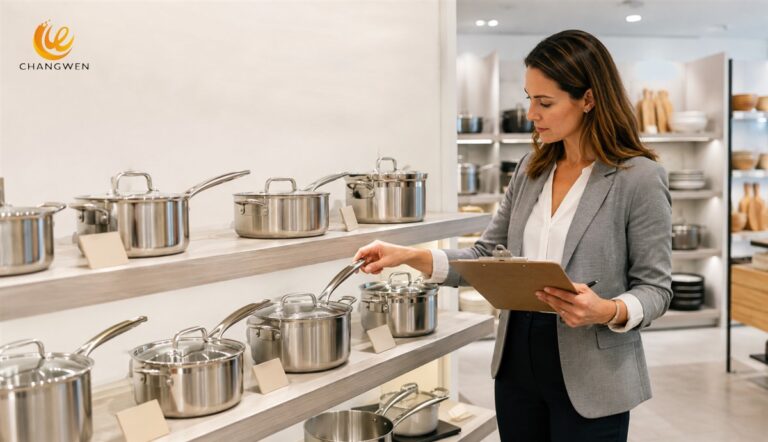
A modern supermarket kitchenware section may contain dozens of cookware products from multiple brands at similar price points. A consumer standing in that aisle has limited time and limited cognitive bandwidth. Effective packaging does not compete by overwhelming — it competes by making a single, clear, immediate case for why this product is worth choosing.
The most effective retail cookware packaging:
- Makes the material and construction visible: “18/8 Stainless Steel” and “3-Ply Construction” are specifications that matter to informed buyers; they should be large enough to read at shelf distance
- Communicates compatibility: “Induction Compatible” eliminates a purchase concern that would otherwise prevent a sale
- Uses photography to show the product in context: A pan on a stove with food is more persuasive than a pan on a white background
- Creates a visual system: A brand with a consistent visual language across multiple SKUs is easier for shoppers to identify and return to
The brands that dominate supermarket kitchenware sections are not always those with the best products. They are those with the most effective packaging communication.
Packaging Influences Perceived Product Value
The relationship between packaging quality and perceived product value is not subtle — it is measurable in retail studies and widely understood in consumer marketing. Two identical cookware products packaged differently will be perceived as different value products, even by experienced buyers who know the underlying product is the same.
This comparison makes it concrete:
| Packaging Approach | Perception | Positioning |
|---|---|---|
| Plain brown carton, black text sticker | Wholesale/commodity product | Entry-level |
| Printed single-color box, basic information | Standard retail product | Mid-market |
| Full-color box, product photography, feature icons | Quality retail product | Mid-to-premium |
| Premium custom box, photography, brand story, quality paper | Premium brand product | Premium / gift |
| Gift box with insert, brand card, recipe booklet | Luxury / occasion purchase | Ultra-premium / gift |
For OEM and private-label cookware buyers: the packaging level you choose determines the price point your product can sustain at retail — not just how it looks.
Understanding Different Cookware Packaging Requirements
Different channels, different buyers, and different use cases require fundamentally different packaging approaches. A single packaging solution does not serve all of them.
Wholesale Bulk Packaging — For Distributors, Importers, and B2B Buyers
Wholesale bulk packaging prioritizes three things: cost efficiency, container packing density, and adequate protection for transit. This is the appropriate format for distributors, restaurant equipment suppliers, hospitality procurement programs, and importers who will unpack and repackage at their destination.
Characteristics of effective wholesale packaging:
- Simple outer carton: Brown or white corrugated carton with printed specification label
- Protection without decoration: Protective wrapping, foam, or paper to prevent surface damage — without the cost of retail-quality printing
- Optimized carton dimensions: Maximum units per carton within safe weight limits; carton dimensions designed for container stacking efficiency
- Clear identification: Product specification, quantity, SKU, destination markings, country of origin
Wholesale packaging reduces per-unit packaging cost significantly and improves container utilization. For programs where the end buyer is a business rather than a consumer, this is the correct packaging investment level.
Retail Shelf Packaging — For Supermarkets and Kitchenware Stores
Retail shelf packaging is a selling tool as much as a protective container. It must simultaneously protect the product through distribution and present it compellingly to a consumer making an unassisted purchase decision.
Components of complete retail cookware packaging:
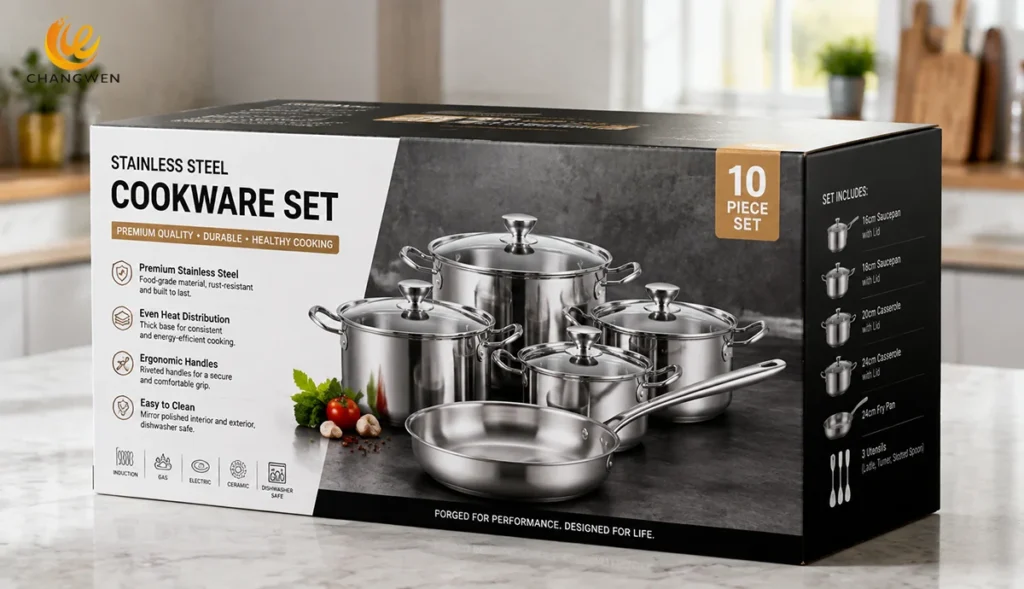
- Full-color printed outer box with brand identity, product photography, and feature communication
- Interior protection — foam, paper wrap, cardboard separators, or EVA inserts to prevent surface scratching and movement in transit
- Information hierarchy: Brand name and hero image prominent; material, size, and key features readable at shelf distance; detailed specifications and instructions accessible on sides or back
- Barcode (UPC or EAN): Required by all retail channels; location and format may be specified by the retailer
- Country of origin and legal compliance information: Required for all major markets
- User manual or care instructions: Often required by retailers and in some markets by regulation
For multi-SKU cookware lines, retail packaging should be designed as a system — consistent visual language, color coding, and structural approach across the full range, creating a recognizable brand family on shelf.
E-Commerce Packaging — For Amazon FBA, DTC, and Online Retail
E-commerce cookware packaging faces challenges that retail shelf packaging does not. A product on a supermarket shelf is handled carefully by store staff and is visually inspected by the buyer before purchase. A product in an e-commerce shipment may be handled by multiple logistics intermediaries, dropped, compressed under other packages, and arrive at a customer’s door without any prior visual inspection.
E-commerce packaging requirements:
- Structural strength: ISTA-2A or equivalent drop-testing standard for e-commerce; the box must protect from multiple drop angles
- Internal fixation: Products must not shift within the box during transit; foam inserts, molded cardboard, or EVA trays are more reliable than loose paper filling
- FBA compliance (Amazon): Specific requirements for packaging dimensions, barcode placement (FNSKU label), poly-bagging where required, suffocation warning labels for poly bags, and master carton configuration
- Photography optimization: E-commerce packaging will be photographed for the product listing; the hero side of the box should be designed to photograph well against a white background
Important: Many cookware brands use their retail shelf box as their e-commerce shipping box. This is usually inadequate — retail boxes are designed for shelf display, not repeated handling by logistics systems. Consider a secondary outer shipping box for e-commerce programs if your retail box is not drop-rated.
Cookware Packaging Ideas for Retail Brands — 6 Formats Explained
1. Premium Full-Color Box
The standard for quality retail cookware programs — a four-color printed box with high-quality photography, brand identity, feature callouts, and product information.
Best for: Cookware sets, individual premium pans, stainless steel collections, mid-to-premium frying pan programs.
Design elements that work:
- Product photograph showing the cookware in a kitchen context (not just a product-on-white shot)
- Material and construction claims in clear, visual format (icons work better than dense text)
- Brand story or positioning statement that communicates why this product exists
- Consistent typographic and color system that creates brand recognition across SKUs
Cost consideration: Full-color printing requires artwork setup and tooling (dieline) cost for the box structure, plus minimum quantity requirements. These costs are amortized over the run — for programs over 500 units, the per-unit cost impact is modest.
2. Window Packaging — Let the Product Speak
Window packaging incorporates a transparent viewing window (typically acetate or PVC film) that allows the consumer to directly see the product inside the box without opening it.
Why window packaging works for cookware:
- Stainless steel finish, handle design, and surface quality are visible before purchase — reducing the purchase risk that higher prices create
- Consumers trust what they can see more than what is described on packaging
- For hammered, polished, or distinctive-finish products, the finish is the selling point — show it
Best for: Premium stainless steel frying pans, hammered cookware, decorative cast iron, specialty products where the visual quality is the primary purchase driver.
Structural consideration: Window packaging requires more complex box construction and the addition of transparent film — slightly higher per-unit cost than a fully closed box, but often justified by the conversion benefit.
3. Minimalist Premium Packaging
Clean, minimal packaging — limited color palette, strong typography, reduced imagery — communicates premium quality through restraint rather than complexity. This approach has become the dominant aesthetic for luxury kitchenware and lifestyle-focused kitchen brands.
Design characteristics:
- Maximum two or three colors, often including white or near-white negative space
- Typography as a primary design element — not just information delivery
- Product photograph used selectively, or replaced with graphic illustration
- Material credentials communicated through copy rather than icons
Best for: Premium and lifestyle kitchen brands targeting design-conscious consumers; brands positioning as an alternative to mass-market cookware; sustainable-positioning brands where clean design reinforces environmental values.
4. Gift-Style Cookware Packaging
Gift packaging for cookware creates an occasion-appropriate presentation that justifies premium pricing, drives gift purchasing decisions, and creates an unboxing experience that customers share online.
Components of effective gift cookware packaging:
- Decorative outer box: Often rigid (not folding carton), with premium surface treatment (soft-touch lamination, embossing, foil stamping)
- Interior presentation: Products arranged visually, often in a custom foam or EVA tray, with components clearly organized
- Brand card: A printed card with brand messaging or a personal note space
- Recipe booklet or care guide: Printed material that adds value and reinforces the brand’s culinary expertise
- Ribbon or closure: Physical interaction that creates a gifting moment
Best for: Premium cookware sets sold through gift channels (department stores, specialty retailers, direct gift programs), holiday and seasonal promotions, wedding gift registry programs, premium e-commerce programs targeting the gift market.
5. Eco-Friendly Cookware Packaging
Sustainable packaging is no longer a niche preference — it is an increasingly standard requirement from retail chains, a meaningful brand differentiator for premium brands, and a growing consumer expectation across multiple markets.
Sustainable packaging options for cookware:
- Recycled cardboard: FSC-certified or post-consumer recycled content board for the box structure
- Paper-based internal protection: Molded paper pulp or paper wrap replacing polystyrene foam inserts
- Reduced plastic: Eliminating plastic windows, plastic strapping, and plastic bags where alternatives provide adequate protection
- Printable soy or water-based inks: Replacing solvent-based inks that complicate recycling
- Right-sizing: Reducing box dimensions to the minimum necessary, reducing material use and improving shipping efficiency
Important: Eco-friendly packaging must still protect the product effectively. A scratched or damaged product in sustainable packaging is not a successful eco-friendly program — it generates returns, complaints, and replacement shipments with higher total environmental impact.
6. Cookware Set Packaging — The Multi-Item Challenge
Cookware set packaging is structurally more complex than individual item packaging because it must contain multiple products of different sizes, protect all of them simultaneously, present them attractively as a set, and maintain compact dimensions for shipping efficiency.
The engineering challenge:
- A 5-piece set might include a 16cm saucepan, 18cm saucepan, 24cm frying pan, 24cm casserole, and matching lids — products of different diameters, heights, and shapes
- Lids must be protected from the pans they’re stacked with
- Handle direction must be consistent with packaging dimensions and internal layout
- Individual products must not shift or contact each other during transport
Effective set packaging solutions:
- Corrugated cardboard tray system: Each item in its own formed cardboard tray, stacked systematically within the outer box
- Foam die-cut insert: Custom-formed foam in the exact shape of each product — maximum protection; higher cost
- EVA insert tray: Thermoformed plastic or EVA in the shape of each product — good protection at moderate cost
- Printed internal organization: Printed cardboard separators that show each item’s position and help the consumer understand what they’re receiving
Cookware Packaging Structure: From Factory to Consumer
Every cookware product moves through multiple packaging layers from production to the consumer’s kitchen. Understanding the full packaging architecture helps buyers design systems that protect at every stage.
Layer 1: Primary Product Protection
The innermost layer — the protection applied directly to the product surface:
- Protective paper or film wrap: Prevents surface scratching on polished stainless or coated non-stick surfaces during handling
- Foam edge protection: Protects rim, handle, and base edges from impact damage
- Poly bag: Common for individual products before boxing; note that poly bags over a certain size require a suffocation warning in most markets
- Cardboard lid separator: Prevents glass lids from contacting pan surfaces
Primary protection must match the product surface risk. A mirror-polished stainless steel pan and a matte non-stick pan have different scratch sensitivity and require different protection approaches.
Layer 2: Individual Product Box or Retail Package
The visible retail packaging or individual product box. This is where brand communication happens.
Layer 3: Inner Pack (for multi-unit cartons)
When multiple retail boxes ship together inside a master carton, an inner pack layer may group items (e.g., 3 or 6 units) for easier retail replenishment.
Layer 4: Master Export Carton
The outer shipping carton that protects through export logistics — ocean freight, container handling, port transfer, and domestic distribution:
- Carton strength: Double-wall or triple-wall corrugated depending on weight and fragility
- Units per carton: Balanced between handling weight limit and cost efficiency
- Stacking strength: Cartons must withstand warehouse stacking without deformation
- Shipping marks: Country of origin, gross/net weight, carton dimensions, handling instructions
- Barcode: Carton-level barcode for logistics tracking
How Packaging Affects Cookware Import Costs
Packaging decisions have direct and quantifiable impact on import economics — specifically on per-unit freight cost, which is determined by the CBM (cubic meters) consumed per unit in a shipping container.
Packaging Material Cost vs. Value
| Packaging Type | Relative Material Cost | Protection Level | Retail Appeal |
|---|---|---|---|
| Plain brown carton | Lowest | Medium | Minimal |
| Single-color printed box | Low | Medium-High | Low-Medium |
| Full-color custom box | Medium | High | High |
| Window box | Medium-High | High | Very High |
| Premium rigid gift box | High | Very High | Premium |
Packaging Size and Container Efficiency
Every additional centimeter of packaging dimension that is not essential protection or presentation translates directly to reduced units per container and higher per-unit freight cost. On a 40ft container with freight costs of $2,500+, inefficient packaging can add $0.50–$2.00 per unit to landed cost — significant at scale.
The efficiency calculation:
- A 24cm frying pan in a box 28cm × 28cm × 8cm (616 cm³ net volume needed)
- A poorly designed box at 35cm × 35cm × 12cm (1,470 cm³) wastes 854 cm³ per unit
- At 5,000 units, that’s 4.27 additional CBM in the container — approximately $300+ in additional freight
Good packaging design optimizes internal protection AND external dimensions simultaneously.
Development Time for Custom Packaging
Custom OEM packaging requires:
- Artwork file preparation (typically 7–14 days)
- Dieline confirmation with the manufacturer
- Pre-production packaging sample (7–14 days)
- Physical sample approval before production run
Total packaging development timeline: 4–6 weeks minimum from brief to production approval. Initiating packaging development at the same time as product development — not after product approval — eliminates this as a cause of production delays.
How Private Label Cookware Brands Customize Packaging
Brand Identity Customization
Every element of the packaging should carry the brand’s visual identity:
- Logo: Placement on the hero face, top panel, and base label
- Brand colors: Consistent Pantone-specified colors across all packaging items
- Typography: Consistent font family and hierarchy across all text elements
- Product photography: Brand-owned photography styled to brand aesthetic guidelines
Feature Communication That Converts
The features communicated on cookware packaging should be selected based on the purchase decisions of the target consumer — not based on what the manufacturer wants to highlight.
For a stainless steel cookware set, high-converting packaging claims include:
- Grade 18/10 (316) or 18/8 (304) Stainless Steel — reassures buyers about material quality
- 3-Ply Full-Clad Construction — communicates professional-grade heat distribution
- Induction Compatible — eliminates a compatibility concern
- Oven Safe to [temperature] — expands perceived versatility
- Dishwasher Safe — reduces perceived maintenance burden
For a non-stick frying pan:
- PFOA-Free — addresses the most common health concern about non-stick coatings
- [Coating type] Non-Stick Surface — names the technology clearly
- Works on All Cooktops — confirms compatibility
- [Coating layer count]-Layer Reinforcement — communicates durability
Instruction Manuals and Consumer Education
A product care guide or instruction booklet included in packaging:
- Reduces the most common user errors (not preheating stainless steel, using abrasive cleaners on coatings)
- Reduces returns caused by user-error product damage
- Creates a positive first-use experience that drives review ratings
- Creates an additional branded touchpoint inside the box
For markets with regulatory requirements, user manuals must include specific safety information — verify requirements for each destination market.
Barcode and Retail Compliance Requirements
Every retail packaging unit must carry the appropriate barcode format for its channel:
- UPC-A: Standard for US retail
- EAN-13: Standard for European, Australian, and most international retail
- FNSKU (Amazon barcode): Required for Amazon FBA; replaces or supplements the manufacturer barcode
- QR code: Optional but increasingly used for linking to digital content
Barcode placement must be readable by scanner in its retail context — typically on a flat face of the box, not crossing a fold or corner. Confirm barcode placement and size requirements with your retail partner before finalizing artwork.
Packaging Design Tips for Supermarket Buyers
Make Product Benefits Visible in 3 Seconds
Research on retail purchasing decisions consistently shows that consumers spend 3 seconds or less evaluating a product before making a continue-or-stop decision. Packaging must communicate its core proposition in that window.
Priority information hierarchy for supermarket cookware packaging:
- Brand — top face, prominent
- Hero image — product in a desirable context
- Material or construction headline — e.g., “Tri-Ply Stainless Steel” or “Ceramic Non-Stick”
- Key compatibility — “Works on All Cooktops Including Induction”
- Size — volume or diameter, clearly marked
Everything else is secondary.
Use Professional Product Photography
Amateur or low-quality product images on retail packaging undermine any other packaging investment. A professional product photograph:
- Shows the product accurately — what it actually looks like in use
- Creates aspiration — a beautifully lit pan with food suggests a cooking experience, not just a pan
- Builds trust — professional photography signals professional product quality
For OEM programs where photography is needed for packaging, manufacturers with strong export programs often have product photography capabilities or can recommend reliable options.
Design for the Shelf System, Not Just the Individual Product
A single SKU needs good packaging. A brand with 12 SKUs on shelf needs a packaging system — a consistent visual language that allows a shopper to immediately recognize that these products belong together, navigate between options, and build brand loyalty.
Designing a packaging system involves:
- Consistent color coding or banding that identifies product families
- Consistent logo placement and typography
- Consistent photography style
- Consistent icon set and information structure
Without a system, a multi-SKU cookware line looks like a collection of unrelated products rather than a coherent brand.
Packaging Mistakes Cookware Brands Should Avoid
Treating Packaging as the Final Step
Packaging delayed to after product approval is packaging that delays production. Custom box dieline development, artwork approval, pre-production sample confirmation, and any tooling costs add 4–6 weeks to the production timeline when managed sequentially. Managed in parallel with product development, the impact is zero.
Choosing Packaging That Looks Great but Ships Poorly
Beautiful but structurally inadequate packaging generates product damage in transit, customer returns, negative reviews, and replacement shipments. Packaging must be designed for the distribution environment it will actually experience — not just for the photo shoot.
Test the packaging before committing to production:
- Drop test samples per ISTA-2A or equivalent
- Check for product movement within the box after simulated handling
- Verify carton compression strength for warehouse stacking
- Test glass lid protection specifically — glass-to-metal contact is a common source of transit damage
Oversized Packaging That Wastes Freight Budget
A box with 20mm of empty air on each dimension wastes 10–40% of container space. Identify the minimum safe packaging dimension for each product and design to that — with protection adequacy as the floor, not aesthetics or convenience.
Inconsistent Packaging Across SKU Range
For a brand building a product portfolio over time, packaging consistency is brand equity. Each new product launched in a packaging style that doesn’t match the existing range dilutes brand recognition and creates a disjointed retail presence.
Establish a packaging brief and design system before your second SKU is developed.
How Cookware Manufacturers Support Packaging Development
Packaging Structural Design Support
Experienced OEM cookware manufacturers have produced packaging for hundreds of programs and can advise on:
- Box structure appropriate for the product weight and fragility
- Internal protection options and their cost-protection trade-offs
- Carton dimensions optimized for container loading
- Internal layout for multi-item set packaging
This structural input is most valuable early in packaging development — before artwork is created for a structure that turns out to be inappropriate.
Artwork Coordination
Manufacturers with active OEM programs support:
- Dieline files for all standard box structures (ready for designer input)
- Pre-production packaging samples for physical approval
- Artwork review for print-readiness before production
- Coordination of barcode data and compliance text
Packaging Production and Quality Control
Before packing begins, a quality packaging check should confirm:
- Print color accuracy against approved standard
- Box construction quality (no delamination, correct fold lines, clean cutting)
- Internal protection components correctly installed
- Product fit and security confirmed in the actual box
A product that arrives in excellent condition in damaged or misrepresented packaging has failed the customer experience — regardless of product quality.
Sustainable Packaging Trends in the Cookware Industry
Reduced Plastic — The Direction of Travel
The trend away from plastic packaging components in cookware packaging is consistent across Europe, Australia, and increasingly in North America and East Asia. Buyers sourcing for markets with strong sustainable packaging regulations or retailer sustainability commitments should confirm:
- What plastic components are included in the current packaging
- What sustainable alternatives are available for each component
- Whether the alternative maintains adequate protection performance
Right-Sizing — The Environmental and Commercial Win
Smaller, precisely dimensioned packaging is both more sustainable (less material) and more commercially efficient (lower freight cost, better container utilization). These objectives align — optimizing packaging size for shipping efficiency produces more sustainable packaging as a byproduct.
Packaging as Brand Responsibility
Consumer evaluation of brands now extends to packaging choices. A brand that ships a premium stainless steel pan in an oversized box filled with polystyrene foam sends a signal about its values that premium positioning cannot fully overcome.
Sustainable packaging choices — FSC-certified board, paper inserts, right-sized dimensions, reduced plastic — are increasingly a baseline expectation in premium market segments, not a differentiator.
How to Choose a Cookware Manufacturer With Strong Packaging Capability
Check OEM Packaging Experience
Ask for physical packaging samples from existing retail and e-commerce programs. Review the print quality, structural integrity, internal protection, and information design. A manufacturer’s existing packaging portfolio tells you more than any claim about capability.
Confirm Custom Packaging Support
A capable OEM cookware manufacturer should confirm:
- Ability to produce custom-structure boxes (not just standard formats)
- Artwork handling process — what file formats, what review process
- Barcode support — can they apply FNSKU or EAN barcodes?
- Packaging sample lead time
- Packaging quality control process
Verify Consistent Supply at Scale
The packaging supplier matters as much as the manufacturer. Packaging produced for 500 units must be identical to packaging produced for 50,000 units three years later. Confirm:
- Packaging supplier stability
- Material consistency over time
- Color management standards for consistent print reproduction
- Capacity for your peak ordering volumes
Frequently Asked Questions
What type of packaging is best for cookware sets? For retail programs, a full-color custom color box with internal cardboard tray or EVA foam insert is the most effective combination — it protects multiple items of different sizes, presents the set attractively, and communicates product quality effectively. For e-commerce, this same box should be designed to meet drop-test standards or placed inside a secondary outer shipping carton.
How do you protect cookware during shipping? Effective transit protection requires a combination of surface wrapping (protective paper or film around each item), internal fixation (foam, EVA, or molded cardboard that prevents movement), and adequate carton strength (double-wall corrugated minimum for items over 2kg). Glass lids require specific protection to prevent contact with metal surfaces. Test the complete packaging assembly with ISTA-2A drop testing before confirming mass production.
What packaging options are available for private label cookware? Private label cookware packaging options include: full-color custom color box, window box, minimalist premium packaging, gift box with EVA insert, and eco-friendly recycled board packaging. All can be customized with your brand logo, product photography, feature icons, and multilingual text. Barcode formats (UPC, EAN, FNSKU) can be applied per channel requirements.
How does packaging affect cookware import cost? Packaging affects import cost primarily through container efficiency — the number of units that fit in a standard shipping container. Oversized or poorly dimensioned packaging reduces units per container, increasing per-unit freight cost. On a 40ft container, packaging that wastes 2–3 CBM of space can add $200–$400 to total freight cost. Custom packaging should be designed with container dimensions in mind.
What information should cookware packaging include? Required information varies by market but typically includes: brand name and logo, product name and material, capacity or size, key features (material grade, construction type, compatibility), country of origin, care instructions or reference to included user manual, barcode (UPC/EAN format), and any required safety or compliance markings. For EU markets: REACH compliance and food-contact compliance marking where applicable. For US markets: FDA food-contact compliance.
How can brands make cookware packaging stand out on supermarket shelves? Stand-out shelf packaging leads with a single, clear visual hierarchy: brand identity first, then a compelling product image, then one or two key feature statements readable at shelf distance. Color consistency across the product range creates shelf blocking that improves overall visibility. Window packaging that shows the actual product surface is particularly effective for premium stainless or decorative finishes.
How do cookware manufacturers support custom packaging development? Full-service OEM cookware manufacturers provide: dieline files for box structures, packaging structural advice based on product weight and fragility, pre-production packaging samples for physical approval, artwork coordination, barcode application, multilingual text support, and packaging quality control during production. Packaging should be discussed at the same time as product specification — not after product approval.
Conclusion: Great Cookware Needs Packaging That Protects and Sells
Successful cookware packaging is not a single decision — it is a series of decisions, made early, that align product protection, retail presentation, brand communication, shipping efficiency, and customer experience into a coherent commercial system.
For retailers and supermarket buyers: packaging is your brand’s first sales representative on the shelf. It works before your sales team, before customer reviews, and before any customer has touched the product.
For e-commerce sellers: packaging is the product until the parcel arrives. The unboxing experience — positive or negative — drives review content, social sharing, and repeat purchase decisions.
For OEM brands and private label programs: packaging is where manufacturing becomes brand equity. A product without brand packaging is a commodity. The same product in a brand-designed box that clearly communicates its quality and credentials is a brand asset.
Plan packaging in parallel with product development. Design it for the full journey from factory to consumer’s kitchen. And choose a manufacturer who treats packaging capability as seriously as production capability.