Cookware manufacturing partner since 2002 info@cwchangwen.com · +86 180 2296 3948

304 vs 201 Stainless Steel Cookware: Which One Is Better for Wholesale?

304 vs 201 Stainless Steel Cookware: Why Does Material Choice Matter for Wholesale Buyers?
Choosing between 304 and 201 stainless steel cookware is an important decision for wholesalers, importers, and private-label brands because the material directly affects product quality, customer satisfaction, pricing strategy, and long-term market reputation.
Although both 304 and 201 stainless steel belong to the stainless steel family and offer a bright, durable surface, their chemical composition creates significant differences in corrosion resistance, durability, maintenance requirements, and suitable applications.
For wholesale buyers, selecting the correct stainless steel grade is not simply about finding the lowest purchase price. The right material should match the target market, product positioning, expected lifespan, and customer requirements.
What Is the Difference Between 304 and 201 Stainless Steel Cookware?
The main difference between 304 and 201 stainless steel cookware comes from their chemical composition.
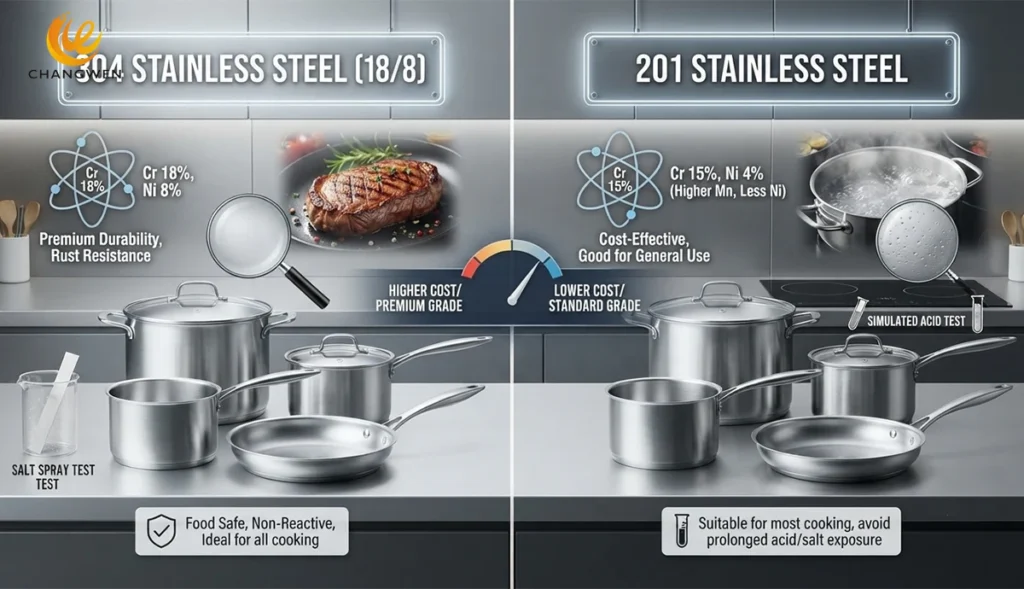
304 stainless steel is an austenitic stainless steel that contains a higher percentage of chromium and nickel. The typical composition includes approximately 18% chromium and 8% nickel, which provides excellent corrosion resistance and durability.
201 stainless steel was developed as a more economical alternative. It replaces part of the nickel content with manganese and nitrogen, reducing raw material costs while maintaining good strength and appearance.
The key differences include:
| Feature | 304 Stainless Steel | 201 Stainless Steel |
| Chromium Content | Higher | Lower |
| Nickel Content | Higher | Lower |
| Corrosion Resistance | Excellent | Moderate |
| Durability | Higher | Good |
| Price | Higher | More affordable |
| Premium Positioning | Suitable | Limited |
| Common Use | High-end cookware | Cost-effective cookware |
For cookware wholesalers, these differences determine which product category each material is best suited for.
Is 304 Stainless Steel Better for Cookware?
Yes, 304 stainless steel is generally considered a better choice for cookware because it provides superior corrosion resistance, durability, and long-term performance.
The higher nickel content improves the stability of the stainless steel structure, helping cookware resist oxidation, rust, and damage caused by frequent exposure to water, salt, and acidic ingredients.
For cookware products such as:
- Stainless steel pots
- Frying pans
- Sauce pans
- Stock pots
- Multi-layer cookware sets
304 stainless steel offers better performance for everyday cooking environments.
For wholesale buyers targeting premium customers, restaurants, hotels, or markets with strict quality expectations, 304 stainless steel cookware provides stronger product value and fewer after-sales issues.
Is 201 Stainless Steel Good for Cookware?
Yes, 201 stainless steel can be suitable for cookware when cost control is an important purchasing factor.
Because 201 stainless steel uses less nickel, manufacturers can produce cookware at a lower material cost while maintaining a stainless appearance and acceptable mechanical strength.
201 stainless steel cookware is often suitable for:
- Entry-level cookware sets
- Budget-focused markets
- Promotional kitchen products
- Large-volume wholesale orders
However, compared with 304 stainless steel, 201 stainless steel requires more attention to usage conditions. It has lower corrosion resistance, especially in environments with high humidity, salty water, or frequent exposure to acidic foods.
For wholesalers, 201 stainless steel can be a practical option when the target market prioritizes affordability over premium durability.
Which Stainless Steel Has Better Corrosion Resistance: 304 or 201?
304 stainless steel has significantly better corrosion resistance than 201 stainless steel.
The higher chromium and nickel content in 304 stainless steel creates a stronger passive oxide layer on the surface. This protective layer helps prevent corrosion when cookware contacts:
- Salt
- Water
- Acidic foods
- Cleaning chemicals
- High-temperature cooking environments
201 stainless steel also provides corrosion resistance because it contains chromium, but its lower nickel content makes it less resistant under demanding conditions.
For wholesale markets where customers expect cookware to last many years, 304 stainless steel is the safer choice.
Which Stainless Steel Cookware Is More Durable?
304 stainless steel cookware generally has better long-term durability.
The durability of cookware depends on several factors:
- Stainless steel grade
- Material thickness
- Manufacturing process
- Surface treatment
- Welding quality
- Handle and lid construction
Although 201 stainless steel has good strength and hardness, 304 stainless steel provides better resistance against corrosion-related damage over time.
For importers building a long-term cookware brand, investing in 304 stainless steel cookware can reduce customer complaints and improve repeat purchasing opportunities.
Is 201 Stainless Steel Cookware Cheaper Than 304 Stainless Steel Cookware?
Yes, 201 stainless steel cookware is usually more affordable than 304 stainless steel cookware.
The main reason is the difference in nickel content. Nickel is an important alloy element that improves corrosion resistance but also increases raw material costs.
For wholesale buyers, the cost difference can affect:
- Retail pricing
- Profit margins
- Market positioning
- Order volume
201 stainless steel may provide a lower entry price, while 304 stainless steel allows suppliers and brands to create higher-value products.
The best choice depends on whether the market competes mainly on price or product quality.
Which Stainless Steel Is Better for Wholesale Cookware Business?
The best choice depends on the target customers and sales strategy.
Choose 304 Stainless Steel Cookware When:
- Selling to premium kitchenware markets
- Building a long-term brand
- Supplying professional users
- Targeting markets with strict quality expectations
- Wanting stronger product differentiation
Choose 201 Stainless Steel Cookware When:
- Serving price-sensitive markets
- Selling high-volume products
- Need competitive entry-level pricing
- Targeting promotional or economy product lines
A professional cookware supplier should provide different material options according to customer requirements instead of offering only one stainless steel grade.
How Can Wholesale Buyers Identify 304 and 201 Stainless Steel Cookware?
Visual appearance alone cannot reliably distinguish 304 and 201 stainless steel because both materials can have a similar polished surface.
Wholesale buyers should confirm material quality through:
Material Certificate
A stainless steel material certificate can verify chemical composition and steel grade.
Professional Testing
Testing equipment can analyze the percentage of chromium, nickel, manganese, and other elements.
Supplier Transparency
Reliable cookware manufacturers should clearly provide material specifications and production information.
Before placing large wholesale orders, buyers should confirm:
- Stainless steel grade
- Thickness specification
- Manufacturing process
- Quality inspection standards
- Certification requirements
304 vs 201 Stainless Steel Cookware: Which One Should Importers Choose?
For most cookware importers and brand owners, 304 stainless steel cookware is the preferred choice for long-term business growth because of its superior corrosion resistance, durability, and customer acceptance.
However, 201 stainless steel cookware still has market value when competitive pricing is the main purchasing requirement.
The ideal product strategy is not choosing one material universally but matching stainless steel grades with market positioning:
- Premium cookware line → 304 stainless steel
- Mid-range cookware line → 304 stainless steel or optimized stainless combinations
- Budget cookware line → 201 stainless steel
Understanding the difference between 304 and 201 stainless steel helps wholesalers make better purchasing decisions and develop cookware products that meet customer expectations.
How to Choose a Reliable Stainless Steel Cookware Manufacturer?
A professional stainless steel cookware manufacturer should provide more than competitive pricing. Wholesale buyers should evaluate:
- Manufacturing experience
- Production capacity
- Quality control system
- Material verification
- OEM/ODM capability
- Export experience
- Certification support
Working with an experienced factory allows importers to customize cookware designs, select suitable stainless steel materials, and develop products that match their target market.
A reliable supplier can help wholesale buyers balance product quality, cost efficiency, and market competitiveness.
Conclusion: 304 or 201 Stainless Steel Cookware for Wholesale?
The comparison between 304 vs 201 stainless steel cookware shows that both materials have their own advantages.
304 stainless steel offers better corrosion resistance, durability, and premium value, making it suitable for quality-focused cookware brands and professional markets.
201 stainless steel provides a cost-effective solution for buyers who need affordable cookware with acceptable performance.
For wholesale buyers, the right choice depends on your target customers, pricing strategy, and product positioning. Selecting the correct stainless steel grade is one of the most important decisions when developing a successful cookware product line.