Cookware manufacturing partner since 2002 info@cwchangwen.com · +86 180 2296 3948

MOQ Is a System: What Is the Typical MOQ for OEM Cookware?

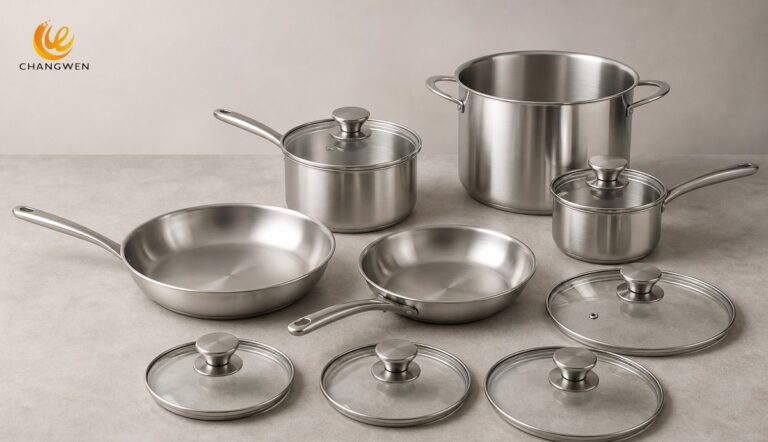
Short answer: Changwen’s typical minimum order quantity is 100 pieces for eligible large commercial stock pots and 1,000 pieces for standard cookware. These figures are starting points for one confirmed product specification, not a promise that every mixture of sizes, colors, handles, finishes, and boxes can be combined into the same minimum. The final MOQ is confirmed after the factory reviews the product, customization, packaging, testing, and delivery requirements.
Read time: 14 minutes
A cookware MOQ is best understood as a production system rather than a sales number. A finished pan depends on a metal body, base, handle, lid, finish, logo, packaging, inspection plan, and scheduled factory capacity. The practical minimum is therefore controlled by the layer with the highest workable batch requirement. This systems view explains why an oversized stock pot may begin at 100 pieces while a standard retail cookware program begins at 1,000 pieces.
Changwen MOQ baseline: Large stock pots: 100 pieces for eligible specifications. Standard cookware: 1,000 pieces for a confirmed item or SKU. Custom tooling, special materials, exclusive components, complex finishes, printed packaging, and market-specific testing can change the required quantity.
What Does MOQ Mean in OEM Cookware Manufacturing?
MOQ means the smallest production quantity that a manufacturer can accept for a defined order under agreed commercial conditions. In OEM cookware, the definition must include the exact model, diameter, material, construction, finish, handle, lid, logo, packaging, and test standard. An offer that says only “MOQ 1,000” is incomplete because it does not reveal whether 1,000 applies to the whole purchase order, each product, each size, or each color.
The most useful question is not simply, “What is your MOQ?” The useful question is, “What is the MOQ for this exact specification, and which attributes may be combined within that quantity?” This wording forces the quotation to connect quantity with production reality. It also prevents a buyer from building a sales plan around an attractive number that later changes when packaging or component details are added.
What Is Changwen’s Typical MOQ for OEM Cookware?
| Product program | Typical starting MOQ | What the baseline means | What may raise it |
|---|---|---|---|
| Eligible large commercial stock pot | 100 pieces | One approved large stock pot specification using a feasible manufacturing and component plan | Exclusive tooling, uncommon material, special fittings, multiple variants, or custom retail packaging |
| Standard cookware | 1,000 pieces | One confirmed item or SKU using an agreed body, finish, components, branding, and pack | New molds, proprietary parts, color splits, low-volume printed boxes, or additional process changes |
The 100-piece and 1,000-piece figures serve different product economics. They should not be averaged into a universal Changwen MOQ, and they should not be interpreted as interchangeable across a mixed catalog. A buyer should send a complete request for quotation so the factory can determine whether the baseline applies to the intended specification.
Why Can Large Stock Pots Start at 100 Pieces?
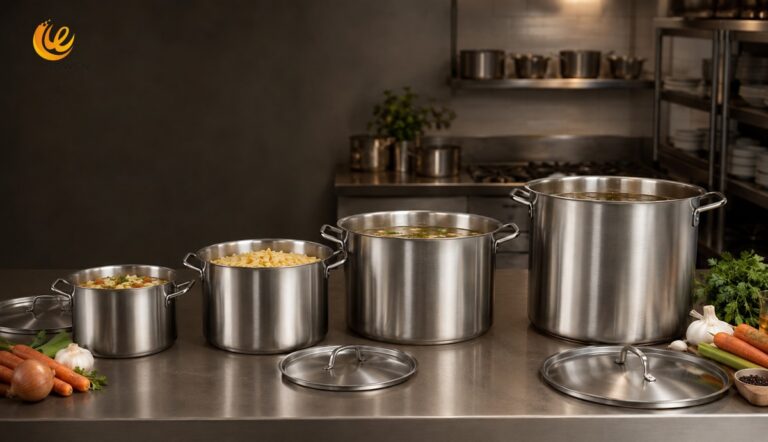
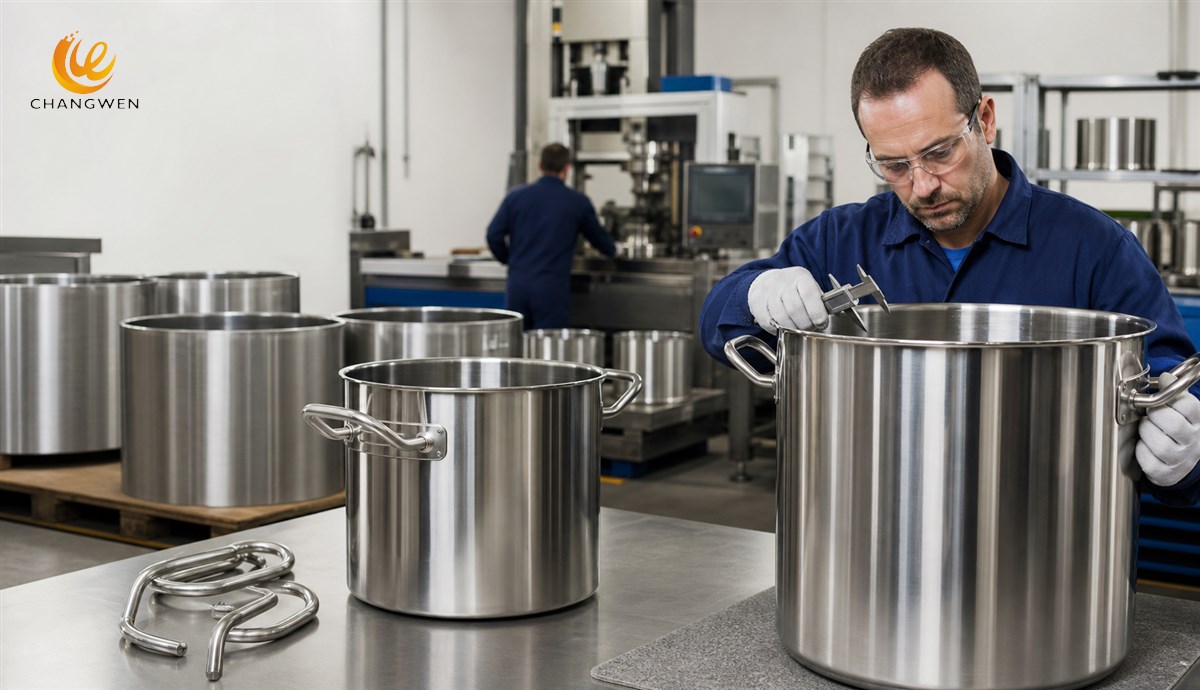
An eligible large stock pot can start at 100 pieces because the commercial value, physical scale, production route, and order structure differ from those of smaller retail cookware. A large pot uses more material and occupies more forming, handling, storage, and shipping capacity per unit. A batch of 100 large vessels can therefore represent a meaningful manufacturing and logistics commitment even though its piece count is lower.
The lower count does not mean every oversized pot is automatically available at 100 pieces. The 100-piece baseline works when the diameter, height, gauge, base, handles, lid, finish, and packing method fit an eligible production plan. A proprietary shape, uncommon stainless steel specification, newly developed fitting, or separate custom carton run can introduce a higher minimum at another layer.
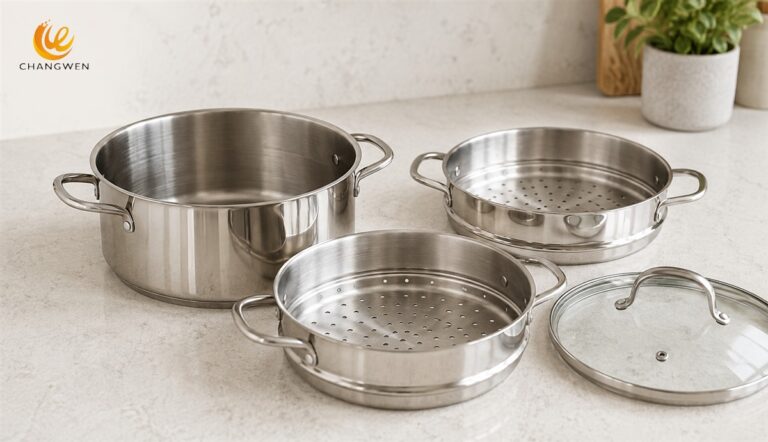
Commercial buyers should also distinguish pieces from sets. A stock pot sold with a lid is normally quoted as one finished unit when the quotation states that the lid is included. A buyer should never assume that “100 pieces” means 100 bodies plus an independently customizable mix of 100 lids. The bill of materials must identify exactly what is included in each finished unit.
Why Does Standard Cookware Usually Start at 1,000 Pieces?
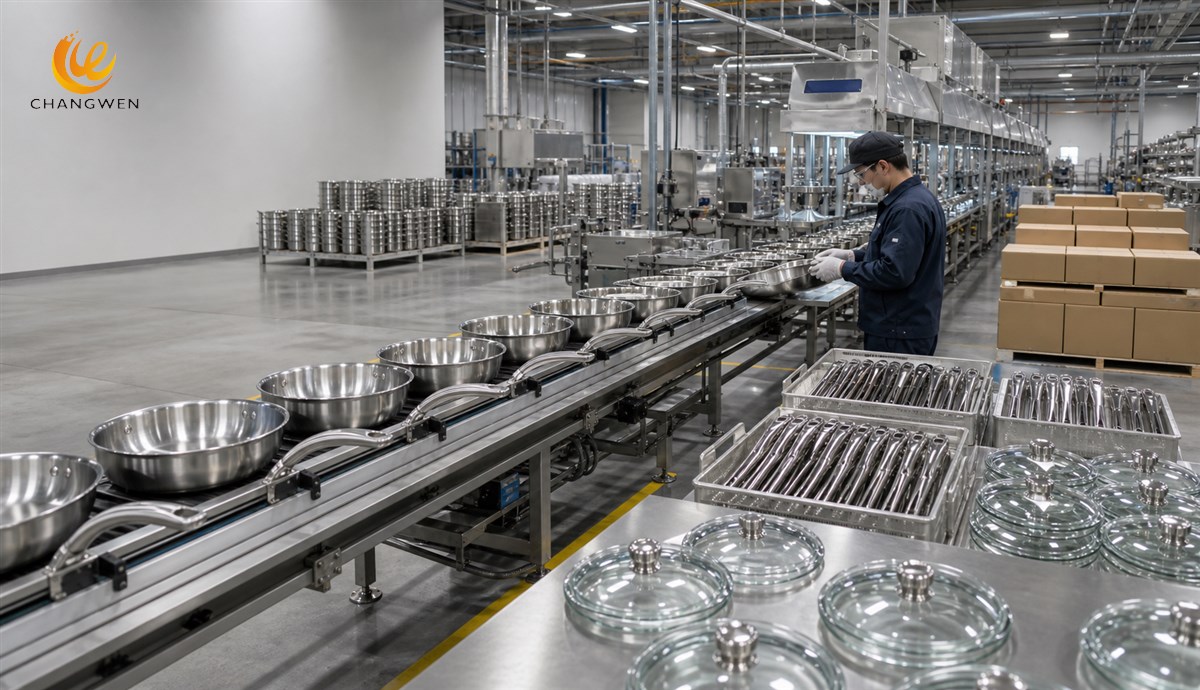
Standard cookware generally starts at 1,000 pieces because a retail-ready product moves through multiple coordinated operations. Forming, trimming, bonding, polishing or coating, handle assembly, logo application, inspection, cleaning, and packing each require preparation and control. Spreading those fixed activities across a viable batch keeps production stable and makes the quoted unit cost commercially realistic.
A 1,000-piece production run also helps align purchased components with finished goods. Handles, knobs, glass lids, induction plates, inserts, labels, and cartons may come from separate production cells or qualified component sources. If the finished-product order is much smaller than a component minimum, unused parts must be stored, charged to the buyer, redesigned out of the product, or absorbed as risk. None of those outcomes is automatically economical.
Does MOQ Apply Per SKU or to the Total Order?
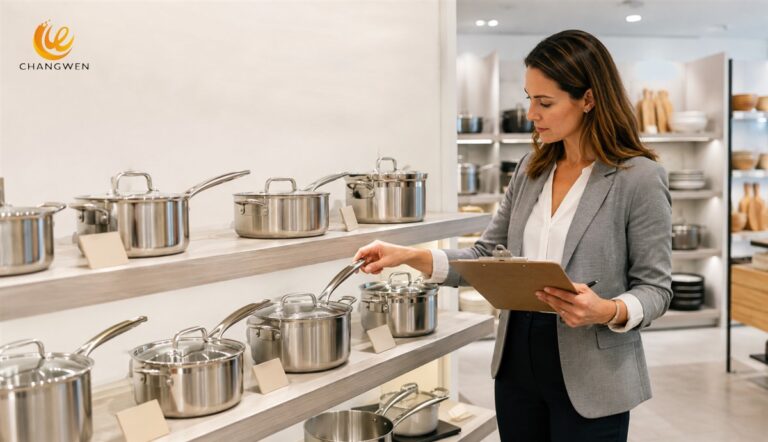
MOQ normally applies to a defined item or SKU unless the quotation explicitly permits a mix. A 24 cm frying pan with a satin interior and black handle is one SKU; the same pan in 28 cm is another SKU because the body and often the packaging change. A second color can also become another SKU because the finish must be prepared, controlled, and inspected separately.
A total order of 1,000 pieces divided among ten unrelated models is not equivalent to 1,000 identical pieces. Ten groups of 100 may require ten changeovers, ten component allocations, ten packaging files, and ten inspection records. The total unit count looks the same in a spreadsheet, but the factory workload is fundamentally different. Buyers should ask which variants may share a production batch before committing to a broad assortment.
What Are the Seven Layers That Determine the Final MOQ?
1. Finished Product Batch
The finished product batch is the quantity that passes through final assembly, inspection, and packing under one approved specification. This layer establishes the visible MOQ, but it is only the starting point. A factory can accept the finished-product number only when all supporting materials and processes are available at compatible quantities.
2. Cookware Body and Construction
The cookware body determines the forming tools, metal input, wall thickness, base construction, and production sequence. An existing body platform usually supports a more efficient minimum than a completely new geometry. Multi-ply construction, impact-bonded bases, deep-drawn shapes, or unusually heavy gauges can change the economic batch because their setups and material flows differ.
3. Handles, Lids, Knobs, and Fittings
A component can become the controlling MOQ even when the cookware body is easy to produce. A standard handle already used in the factory’s supply system is more flexible than an exclusive handle requiring a new mold, surface treatment, or small dedicated purchase. The same reasoning applies to glass lid diameters, welded fittings, silicone parts, and decorative knobs.
4. Surface Finish and Color
A finish creates its own batch when it requires a separate polishing recipe, coating preparation, or color match. Dividing 1,000 bodies into many colors may produce several small finishing batches, so one approved finish usually creates a lower-risk first order.
5. Branding Method
Laser marks and other simple branding methods may fit an existing product with limited disruption, while embossed marks or product-specific decorative parts can require tooling. The logo location, size, contrast, durability, and approved artwork should be decided before the factory confirms MOQ. A vague request for “custom branding” is not precise enough for a binding production quantity.
6. Packaging and Printed Materials
Packaging has a separate supply chain and can set a higher minimum than the cookware itself. Printed color boxes, molded inserts, sleeves, manuals, barcode labels, and master cartons must match the product and destination. A plain carton with a label can be more suitable for a pilot order than a complex retail box whose print supplier requires a larger run. The cookware packaging guide for retail brands explains how pack design affects cost, protection, and channel readiness.
7. Testing and Market Compliance
Testing may not raise the physical MOQ, but it can change whether a small order is commercially sensible. Food-contact, performance, label, and buyer-specific requirements create fixed costs, so the destination market and required reports must be defined before quotations are compared.
How Does Customization Depth Change MOQ?
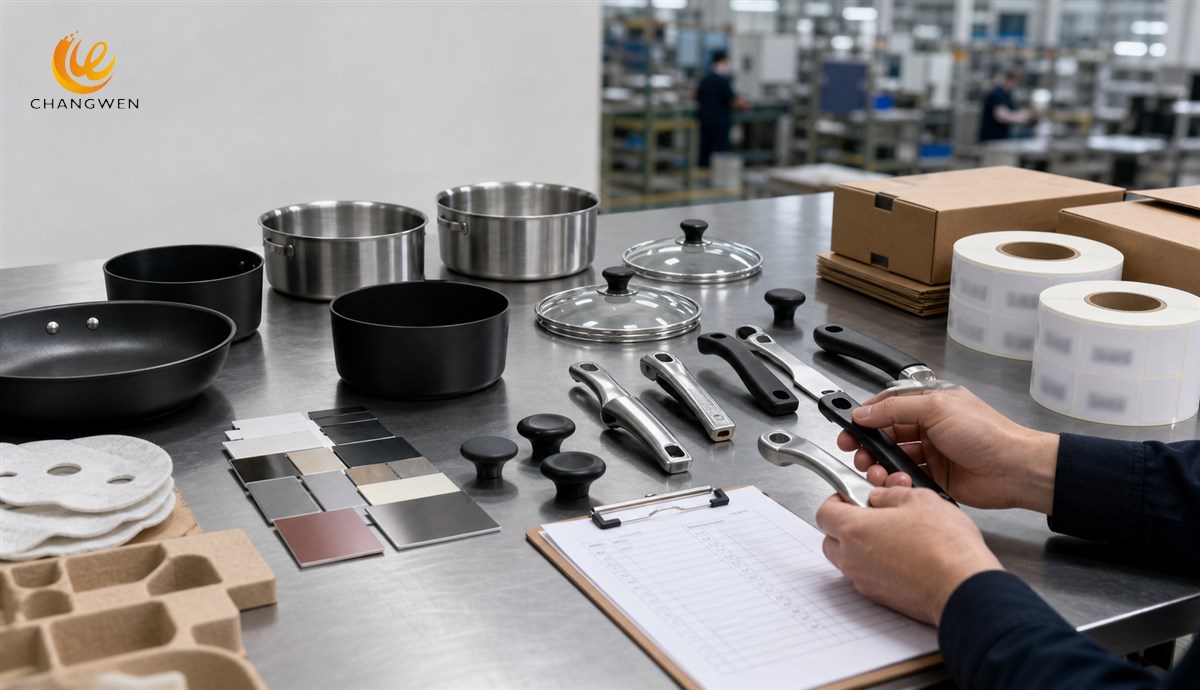
Customization can be divided into three practical levels. A standard-platform program uses an existing body and components with a selected logo and practical packaging. A semi-custom program changes visible elements such as finish, handle, lid, set combination, or box. A full-custom program introduces proprietary geometry, tooling, materials, or components. Each step adds dedicated decisions and reduces the ability to share production resources.
A standard-platform product usually offers the clearest route to Changwen’s baseline MOQ because the factory can use proven tooling and known processes. Semi-custom work may remain near the baseline when components are available and the finish is production-compatible. Full-custom work must be evaluated individually because new dies, molds, fixtures, samples, and validation may require a larger run or a separate tooling investment.
Buyers deciding between existing and new designs can use the OEM versus ODM cookware comparison to select the right development model. The most economical launch is often not the product with the fewest features; it is the product whose distinctive features can be created without forcing every component into an exclusive supply chain.
Why Does a Lower MOQ Usually Increase Unit Cost?
A lower MOQ does not remove setup work; it spreads the same fixed work across fewer units. Engineering review, sample approval, line preparation, tool installation, finish setup, packaging setup, and quality documentation still occur. If a setup cost is divided by 100 units instead of 1,000 units, the fixed-cost share per unit is higher even when the material content is unchanged.
Small batches may also create inefficient material and component balances. If a component source requires more parts than the finished order consumes, the quotation must address the remainder. The buyer may purchase excess components for future production, the factory may charge a higher price to manage the inventory, or the product may switch to a standard part. A transparent quote should identify which solution has been assumed.
Price comparisons should therefore normalize specification, quantity, packaging, testing, trade terms, and tooling. The guide to stainless steel cookware OEM price factors shows why volume is only one part of a complete cost model. A quotation with a lower MOQ can be the better business choice when it reduces inventory exposure, but it should not be expected to deliver the same unit price as a larger, more efficient run.
How Should Importers Calculate the Real Inventory Commitment?
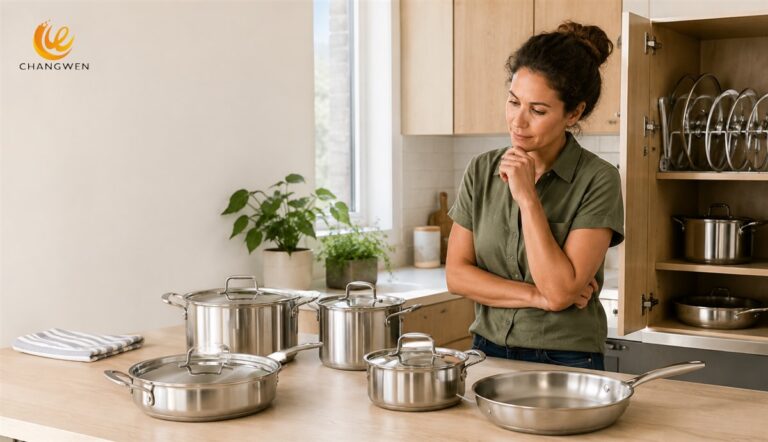
The real commitment equals the MOQ per SKU multiplied by the number of SKUs, plus any non-consumed packaging or components that the buyer must own. For example, a cookware line with several sizes and two colors may create many SKUs even though shoppers see one collection. Forecasting only the collection total can seriously understate cash, storage, and sell-through risk.
A better assortment plan starts with expected monthly sales for every SKU. The buyer then compares opening inventory with production lead time, shipping time, safety stock, and reorder timing. Fast and slow sizes should not receive equal quantities merely because the assortment looks symmetrical. Demand-weighted planning produces healthier inventory than dividing a total purchase evenly.
A first launch should prioritize products that explain the range and produce meaningful sales data. The private label cookware launch guide describes how pilot decisions, positioning, and supplier readiness connect. An intentionally narrow range can protect working capital while giving the factory a cleaner, more repeatable production plan.
Can Buyers Negotiate a Lower Cookware MOQ?
Buyers can sometimes improve MOQ by reducing complexity rather than simply demanding a lower number. Selecting an existing body, a common handle, one finish, and a standard packing structure removes separate constraints. This approach gives the factory a concrete reason to reconsider the minimum and often produces a more reliable pilot than negotiating solely on price.
A buyer can also ask whether compatible orders can share materials or production timing, but such grouping must be approved by the factory. Combining purchase orders on paper does not guarantee that different bodies, colors, or packages can run together. The factory must confirm that shared inputs and process windows are technically compatible.
Another option is to separate product validation from retail packaging. A first batch can use a protective carton with brand labels, followed by a printed retail box after demand is proven. The choice must still match the sales channel and its presentation requirements.
When Should a Buyer Avoid Pushing MOQ Lower?
A buyer should avoid pushing MOQ below a stable production level when product consistency is critical, the design uses a custom finish, or the order needs several exclusive components. An artificially small batch can create disproportionate setup variation, excess component exposure, or a unit price that destroys the intended retail margin. The lowest possible MOQ is not automatically the lowest-risk decision.
Importers should compare supplier capability beyond a headline MOQ. The bulk cookware purchasing checklist covers material, construction, quality control, compliance, capacity, and logistics. A slightly higher minimum from a well-controlled program can create less total risk than a small order that cannot be repeated consistently.
What Information Is Needed for an Exact MOQ Quote?
An exact MOQ quote requires enough information to define one manufacturable product. The request should state the cookware type, dimensions, capacity, material grade, wall and base construction, compatible cooktops, finish, handle and lid requirements, logo method, unit packaging, master carton, destination market, testing scope, target quantity, and delivery term. Reference photos are useful, but dimensioned drawings or an approved physical sample provide stronger control.
For a structured development sequence, review the OEM cookware project workflow. A good RFQ becomes the foundation for sampling, approval, mass-production checks, and future reorders. MOQ is more dependable when it emerges from a controlled specification rather than a brief inquiry.
Is a Sample Order the Same as a Production MOQ?
A sample order is not a production MOQ. Samples are made or selected to verify dimensions, materials, appearance, performance, and packaging concepts before mass production. They usually carry a different price and process because the factory is not running the complete production batch. Receiving one or several samples does not prove that the same product can be mass-produced at that quantity.
A pilot production order is also different from a pre-production sample. A pilot uses a limited production run to validate process repeatability, inspection criteria, packaging, and market response. Whether a pilot below the normal MOQ is possible depends on tooling, components, factory scheduling, and the buyer’s commercial plan. The quotation must state whether the pilot creates leftover components and who owns them.
How Should Reorder MOQ Be Planned?
Buyers can improve reorder flexibility by controlling packaging inventory and forecasting components. If printed cartons must be purchased in a quantity larger than the first cookware run, the agreement should record the remaining count, storage conditions, ownership, and expiry risk. The same record is useful for handles, knobs, labels, and inserts held for future orders.
Demand data should trigger reorders before inventory reaches the production MOQ. The reorder point must cover manufacturing, inspection, shipping, customs, and safety stock. Waiting until only one MOQ remains in the warehouse can cause a stockout if sales accelerate or transport is delayed.
Common MOQ Mistakes and Better Questions
- Mistake: Treating MOQ as the total across an unlimited number of products. Better question: Is the minimum per model, size, color, or purchase order?
- Mistake: Asking for a lower MOQ after approving exclusive components. Better question: Which standard components preserve the design intent at the baseline quantity?
- Mistake: Ignoring packaging until the product is approved. Better question: Does each printed packaging element have its own minimum?
- Mistake: Comparing prices at different quantities. Better question: Can each supplier quote the same specification and tiers?
- Mistake: Assuming sample availability guarantees low-volume production. Better question: What batch is required after sample approval?
FAQ About Typical OEM Cookware MOQ
What is the typical MOQ for OEM cookware at Changwen?
Changwen’s typical starting MOQ is 100 pieces for eligible large commercial stock pots and 1,000 pieces for standard cookware. The exact minimum is confirmed for each specification because tooling, components, finish, packaging, testing, and SKU structure can change the required batch.
Can 100 large stock pots include several sizes?
The 100-piece baseline should be treated as applying to one eligible confirmed specification unless the quotation explicitly allows a size mix. Different diameters and heights may use different bodies, lids, handles, cartons, and production settings, so a mixed-size program requires factory review.
Is the 1,000-piece cookware MOQ per SKU?
The 1,000-piece baseline normally applies to a confirmed cookware item or SKU. A different size, color, construction, handle, or package may create another SKU and another production minimum. The quotation should list the rule for every variant.
Does a custom logo increase MOQ?
A simple logo applied to an existing product may not materially change the finished-product MOQ, but the result depends on the method and location. Embossed branding, custom decorative parts, or special packaging can introduce tooling or component minimums.
Does custom packaging have a separate MOQ?
Custom packaging often has its own minimum because boxes, inserts, manuals, sleeves, and labels are produced through separate processes. If packaging quantity exceeds the cookware batch, the quotation should explain the cost, ownership, and storage of unused materials.
Can new tooling reduce unit cost at the same MOQ?
New tooling can improve product differentiation and repeatability, but it adds fixed investment and does not automatically reduce the first-order quantity or price. Tool cost, expected lifetime, ownership, maintenance, and the production MOQ should be evaluated together.
How can an importer receive an exact MOQ?
An importer should submit one complete RFQ with product dimensions, material, construction, finish, components, logo, packaging, destination, test requirements, and quantity by SKU. Changwen can then identify the controlling MOQ layer and confirm whether the 100-piece stock pot or 1,000-piece cookware baseline applies.
The Practical Rule for MOQ Decisions
The practical rule is simple: define the product first, then confirm the minimum for every layer that makes the product sellable. Changwen’s 100-piece baseline for eligible large stock pots and 1,000-piece baseline for standard cookware provide useful planning anchors, but the binding MOQ belongs to the approved specification and quotation.
A strong sourcing decision balances opening inventory, unit cost, differentiation, quality consistency, packaging, compliance, and reorder reliability. Buyers who reduce unnecessary variation can often create a more flexible program without weakening the product. Buyers who need proprietary features should budget for the batch and tooling that make those features repeatable. In both cases, a transparent bill of materials and SKU-level quotation turn MOQ from a negotiation obstacle into a controllable business decision.