Cookware manufacturing partner since 2002 info@cwchangwen.com · +86 180 2296 3948

100l Stainless Steel Cazo Ultimate Buying Guide

A 100L stainless steel cazo is a large, open cooking vessel, but the “100L” label is only useful when the buyer knows how capacity was measured. For wholesale or private-label procurement, confirm the vessel’s internal volume, working fill level, rim and base diameters, usable depth, steel grade, base construction, handle design, and intended burner before comparing quotes. A wide cazo for batch frying or braising is not interchangeable with a tall 100L stockpot, even when both hold the same volume to the brim.
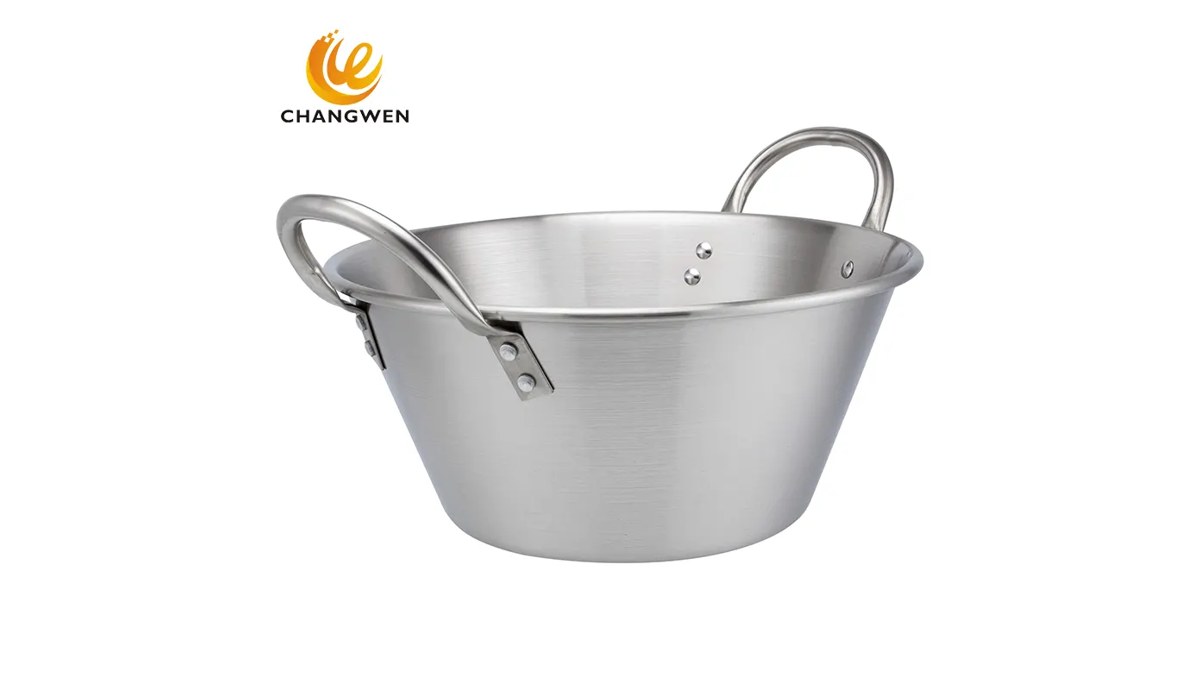
This guide is for importers, foodservice distributors, restaurant groups, and private-label brands evaluating a nominal 100-liter cazo. It treats 100L as a requested specification, not as a verified capacity of any pictured product. Changwen’s stainless steel cazo product page shows deep and shallow forms and lists customizable dimensions; a purchase order still needs a drawing and a measured-capacity method for the exact proposed model.
What is a 100L stainless steel cazo?
A 100L stainless steel cazo is a large-format, usually wide-mouth vessel intended for high-volume cooking where access to the food matters. In Mexican and other Latin American cooking contexts, a cazo can be associated with batch frying, braising, and stewing. The practical defining feature for a buyer is its geometry: a wide opening, often sloping sides, and two side handles rather than the tall, straight cylinder of a conventional stockpot.
The word “cazo” has different meanings across markets, including a small long-handled saucepan in some Spanish usage. A 100L inquiry cannot safely rely on the name alone. A drawing, photos from several angles, and dimensions should establish that the requested item is the large two-handle cazo shown in the quotation, not a saucepan or a stockpot renamed for search traffic.
For a procurement decision, a cazo’s open mouth gives staff room to turn food, skim the surface, and observe a batch. A tall stockpot offers a narrower footprint and greater depth, which can be preferable for liquid-heavy stock or soup. The comparison is about workflow, evaporation, heat source, and handling, not a claim that one shape is universally better.
Does “100L” mean brim capacity or usable cooking capacity?
A nominal 100L cazo may hold about 100 liters only when filled near the rim under a particular measurement method. That is not the same as a safe cooking load. Food displacement, boiling movement, stirring, foam, and splash allowance reduce the usable volume. An oil-frying application requires its own fill limit and operating procedure; a working level suitable for simmering must never be copied automatically to a hot-oil process.
A buyer should request three separate values: measured brimful volume in liters, a marked or recommended working liquid volume for the proposed task, and the vessel’s mass when empty. If a supplier states only “100L,” ask whether the value is calculated from a nominal shape, measured with water, or derived from the catalog name. Two offers with different definitions are not equivalent quotations.
For example, a kitchen that needs 75 liters of broth per batch might consider a nominal 100L vessel, but the fit must be tested with the actual recipe and operating headspace. A 75-liter water load is approximately 75 kilograms before the pot, ingredients, lid, or handling equipment are added. That mass makes a transfer and draining plan as important as the advertised capacity. The U.S. Occupational Safety and Health Administration’s restaurant guidance advises help or tilt containers when lifting or pouring heavy pots; local workplace rules and your own risk assessment still govern the operation.
How can a buyer verify that a tapered cazo really holds 100 liters?
A tapered cazo cannot be estimated accurately from its rim diameter alone because its bottom may be much narrower. For a near-frustum shape, an initial geometric estimate is V = πh(R² + Rr + r²)/3, where R and r are the internal top and bottom radii and h is the internal vertical depth. Use centimeters and divide cubic centimeters by 1,000 to obtain liters. The formula is a screening tool; rolled rims, curved bases, and nonuniform walls require a measured-water check.
Consider an illustrative cazo with a 70 cm internal top diameter, a 50 cm internal bottom diameter, and a 35 cm internal vertical depth. A simple frustum calculation gives approximately 100 liters. A vessel with the same top diameter but a shallower wall or smaller base will hold materially less. This example is not a measurement or specification of Changwen’s pictured model.
For a production sample, fill the level vessel with water in known increments, record the volume at the rim reference point, and mark one or more practical working levels. Photograph the measuring setup and use the same method for every approval sample. A calibrated flow meter or weighed water can improve repeatability, but temperature, spillage, and instrument tolerance should be noted. Record the test method in the specification so incoming goods can be checked consistently.
A buyer should measure inside dimensions rather than exterior dimensions because wall thickness and a rolled rim do not hold liquid. The drawing should identify exactly where height is measured, whether a curved bottom is included, and whether handles or a lid affect packaging but not capacity. This distinction prevents a dimensional tolerance dispute from becoming a surprise after delivery.
How does a 100L cazo compare with a 100L stockpot?
| Buyer question | Wide cazo | Tall stockpot |
|---|---|---|
| What work is easiest? | Open access for turning, skimming, and observing a broad batch | Containing large liquid batches with a smaller top opening |
| What space is needed? | More horizontal burner, aisle, and storage clearance | More vertical clearance, potentially less floor footprint |
| What changes evaporation? | A wider exposed surface may increase evaporation under comparable conditions | A narrower opening may retain more liquid under comparable conditions |
| How is the load handled? | Low, broad load with two side handles; still too heavy to lift when full | Tall liquid column with two side handles; pouring is also hazardous when full |
| What should be quoted? | Rim and base diameter, depth, working fill line, base support | Body diameter, height, lid, base footprint, working fill line |
Neither vessel should be selected from capacity alone. A kitchen may need the cazo’s open working area for a menu process, while a stockpot is better for mostly liquid production and a narrow burner. Buyers considering the latter can use Changwen’s stockpot capacity guide to compare quarts, liters, and kitchen fit without treating that separate guide as a cazo specification.
Which dimensions belong on a 100L cazo drawing?
A complete cazo drawing should show internal rim diameter, internal bottom diameter, vertical internal depth, external overall height, base contact diameter, wall profile, rolled-rim detail, handle projection, handle opening, and empty mass. These figures answer different questions: internal dimensions determine volume; base contact determines burner fit; external dimensions determine storage, packaging, and clearance.
The drawing should also specify the position of a capacity mark if one is required. A marked “100L” line inside a vessel is a different product from a vessel that reaches 100L only at the lip. The mark must have a stated method and tolerance, and the seller should not assume a catalog title defines that mark.
When comparing deep and shallow cazos, ask what the staff must do while cooking. A shallower vessel can make stirring and visual inspection easier but may require a larger burner area. A deeper vessel can reduce floor footprint for a given nominal volume but may complicate access and increase the risk of splashing when ingredients are added. A sample trial with the actual workstation is more informative than choosing by photo.
Which steel grade and thickness should be specified?
Stainless steel grade should be stated for each food-contact component rather than reduced to a vague “stainless” label. Changwen’s current cazo product page lists 201 and 304 as material options for its model, so a buyer should choose the grade according to the destination market, cleaning regime, expected exposure to salt or acidic foods, and target price. The site’s 304 versus 201 cookware comparison offers broader context; a 100L cazo quote still needs its own grade declaration and material evidence.
A nominal wall thickness should be paired with measurement points and tolerances. A supplier’s catalog can list 1.2 mm for a particular cazo, but forming and polishing may make local measurements vary. Specify where the wall is checked, whether the rim and base are excluded, and how many readings are required. Otherwise a “1.2 mm” quote may describe raw sheet thickness while the buyer expects a finished-wall minimum.
Grade and thickness do not alone establish heating behavior. Stainless steel is durable and corrosion-resistant, but its lateral heat spreading is limited compared with an aluminum-containing base. If the proposed cazo uses a layered or bonded base, request the material stack, thickness or mass of each layer, base diameter, and joining method. A buyer should not assume that every wide cazo in the gallery has the same base construction as one product-page description.
Food-contact claims should be tied to the destination market and documentation for the exact item. If a distributor needs third-party certification, a declaration, or a particular test report, put that requirement in the request for quotation and verify the report’s model scope. A general company certificate or an attractive material name does not prove that a specific cazo meets every buyer’s local requirement.
What base design fits the cooking task?
A large cazo used mainly for aqueous simmering and one used for frying can have different thermal priorities. Simmering needs stable support, cleanability, and enough heat input to bring the batch to temperature. Frying also makes recovery after a cold food load important, but the oil-handling system and safe fill line may dominate the equipment decision. A buyer should compare the complete vessel-and-burner system, not a base-layer label in isolation.
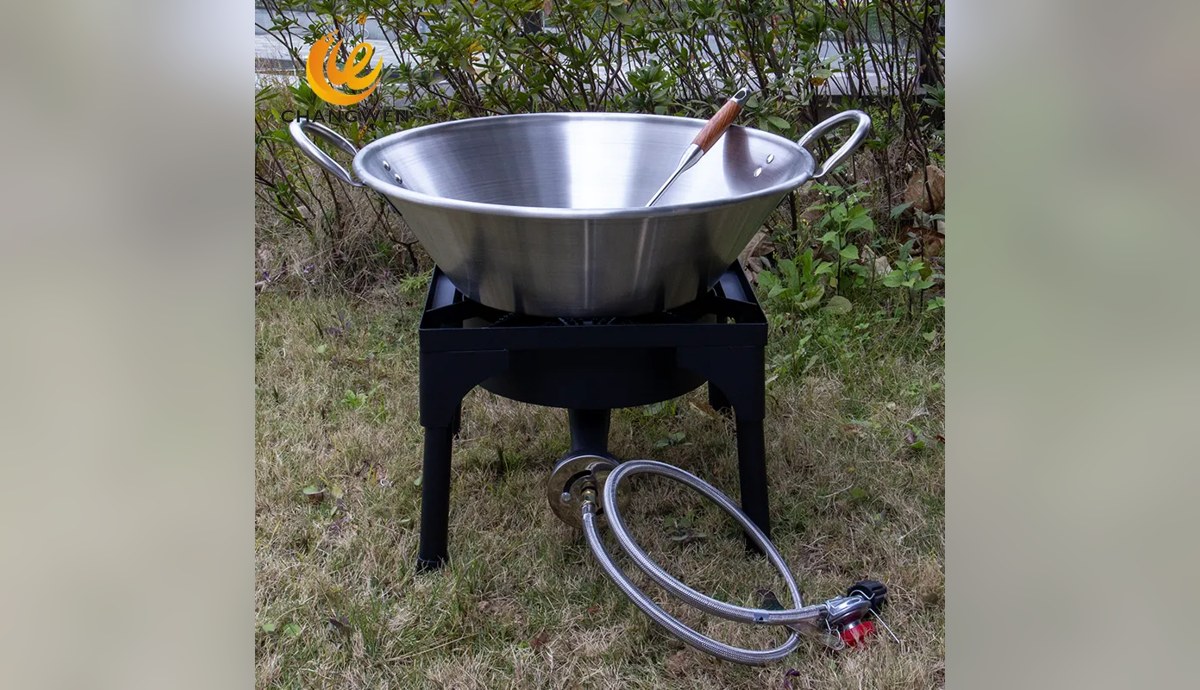
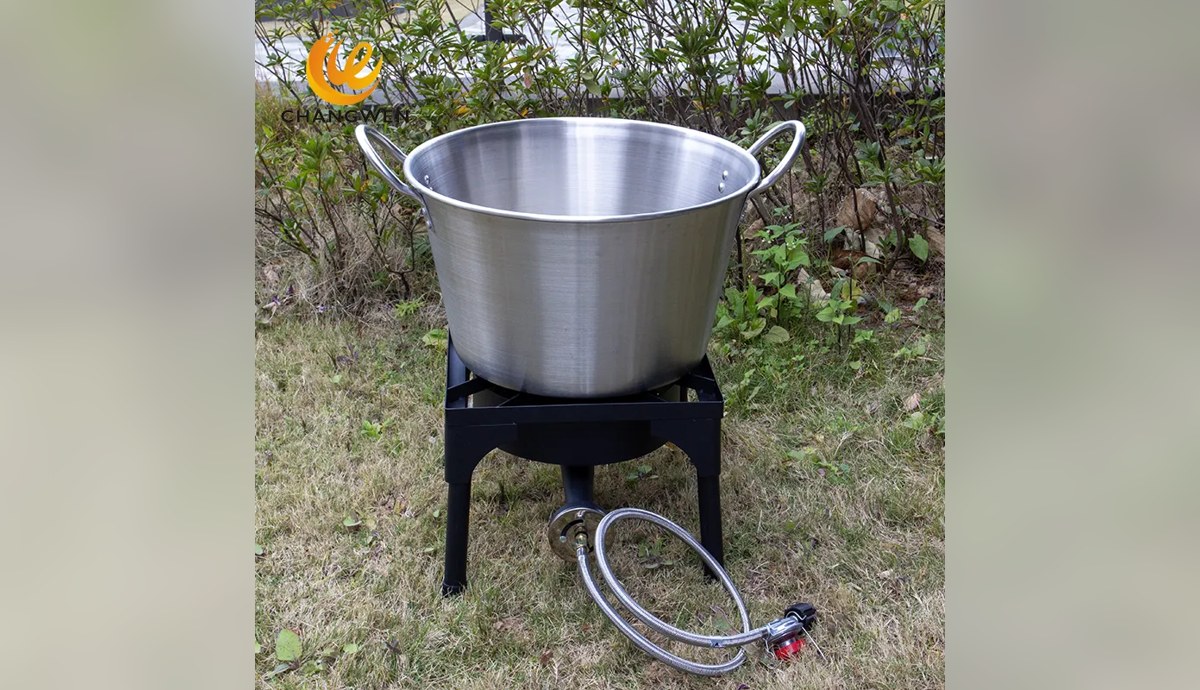
For a gas-fired cazo, request the supported base area, burner diameter, stand dimensions, flame pattern, ventilation requirements, and the manufacturer’s safe operating instructions. A burner that supports only the center of a broad vessel may create an unstable or unevenly heated setup. The pictured outdoor stand is a gallery example, not proof that any 100L cazo or burner combination is certified or suitable for a particular site.
For induction, verify that the actual base has a compatible magnetic layer, a sufficiently flat contact area, and a diameter accepted by the specific induction unit. A magnet test is a quick screen, not a full cooking-performance test. The electrical unit must also be rated for the vessel’s total mass, base diameter, and expected heating duty. A supplier should not label a cazo “induction ready” merely because one layer of steel is magnetic.
For outdoor use, check wind protection, hose routing, regulator compatibility, and the local fuel and fire rules before commissioning a burner. A 100L vessel extends beyond the normal scale of home cookware, and a photo of a pot on a stand is not a substitute for installation approval. The kitchen operator should perform the site-specific hazard review.
How should handles and rim be evaluated?
Two side handles on a large cazo are essential contact points for empty handling, positioning, and controlled movement after cooling. They should not be interpreted as permission to lift a full hot vessel. Ask for handle material, opening size for protective gloves, attachment method, rivet or weld detail, and a documented load test for the specified assembly. The test should include deformation and loosening criteria, not only a pass/fail statement.
Handle clearance matters because a wide cazo may sit close to burner supports or adjacent workstations. A drawing should show the handle’s distance from the body, projection beyond the rim, and height relative to the burner. A handle that looks generous in a catalog photo can still be awkward with heat-resistant gloves or interfere with a narrow aisle.
A rolled rim may improve edge stiffness and make cleaning or pouring more comfortable, but its exact profile should be reviewed for residue traps and drip behavior. Buyers who need controlled transfer should test a representative batch or an approved water simulation. A broad cazo is often better drained with a pump, valve-equipped system, or smaller containers than by tipping the entire vessel.
What is the realistic working volume for soup, braising, and frying?
Working volume is task-specific. A liquid broth needs headspace for simmering and stirring. A braise needs extra room for solid ingredients that displace liquid. A frying operation needs substantially more conservative space for displacement, bubbling, and foaming, plus a controlled oil procedure. No universal fraction of a 100L nominal volume can be promised as safe for all three uses.
For procurement, write a separate batch recipe and maximum fill line for each intended process. Test the largest ingredient load, the addition sequence, the required stirring motion, and the expected foam or boil-up. The approved working level should be visible to operators and should be lower than the measured brimful volume. If the process cannot be completed without crowding or splashing, select a larger vessel or divide the batch.
Food safety is also a process requirement, not a property conferred by stainless steel. For U.S. foodservice, the FDA Food Code is a model for jurisdictions to adopt and includes controls for cooking, cooling, and holding temperature. Operators should follow the applicable local code and validated procedures for their menu; the cazo’s nominal capacity does not establish safe cooling or hot-holding performance.
How should a distributor compare 100L cazo quotes?
Comparable quotes need a frozen specification. Send every supplier the same internal dimensions, capacity-test method, grade, finished-wall criteria, base design, handle detail, finish, packaging, inspection plan, and quantity. Ask for a line-by-line compliance response that separates included features from options. A lower price for a different grade, thinner wall, smaller measured volume, or missing lid is not a genuine saving.
| Quote field | What the buyer should require | Why it changes value |
|---|---|---|
| Capacity | Brimful measured liters, working-level plan, test method | Prevents a nominal “100L” label from hiding a smaller vessel |
| Geometry | Internal rim/base diameters, depth, profile, tolerance | Controls access, burner fit, evaporation, and storage |
| Materials | Grade per component, finished-wall checkpoints, base stack | Controls durability, performance, and compliance evidence |
| Handling | Handle attachment, test load, empty weight, packing method | Controls safety, transport, and damage risk |
| Commercial terms | Quantity, tooling, sample cost, Incoterm, delivery basis | Makes landed-cost comparison possible |
Buyers should separate unit price from total program cost. Tooling, logo application, packaging strength, freight cube, inspection, and replacement handling may change the landed cost more than a small difference in vessel price. The Changwen OEM/ODM page describes customization of size, material, handles, and packaging; the final quote should identify exactly which of those options is included for the proposed cazo.
What should a 100L cazo sample approval include?
A golden sample should be an approved physical reference linked to a dated drawing and bill of materials. The buyer should measure internal geometry and water volume; inspect steel-grade documents; check base flatness or stand fit; assess welds or rivets; verify handle clearance; and examine the rim and finish under consistent lighting. Photograph the sample from above, side, underside, and handle close-up so later inspections have a common reference.
The sample test should include the actual heat source at the intended load, within a controlled and qualified environment. Record time to a defined liquid temperature, stability during stirring, and any local scorching or base movement relevant to the recipe. This is a comparative trial, not a claim that one number applies to every kitchen. A frying use case requires a separate, competent hot-oil protocol rather than using a full-volume water trial as proof of frying safety.
For bulk orders, convert the sample into measurable acceptance criteria. Define permissible visual marks, sharp-edge rejection, handle looseness, capacity tolerance, dimensional tolerance, packaging damage, and required documentation. Specify sampling level and defect classification before production. A vague instruction such as “same as sample” is weaker than a signed sample plus an inspection sheet.
How should a 100L cazo be packaged and shipped?
A wide cazo can occupy substantial carton volume even when the metal is relatively thin. Ask for carton length, width, height, gross weight, stacking limit, and whether multiple units nest without damaging the finish. A protective sleeve or divider should prevent metal-to-metal rubbing, while handle protection should prevent impact deformation. Confirm that any packaging claim is tested for the actual shipping route.
Private-label packaging should state the correct vessel name, nominal and measured capacity convention, material, origin marking where required, care instructions, and any verified heat-source compatibility. Avoid placing “100L working capacity” on a carton if the documented 100L figure is brimful. Careful labeling reduces customer complaints and helps sales teams explain the product honestly.
A distributor should also consider storage and last-mile handling. The packed width may be determined by the handles rather than the rim. A pallet that looks efficient on a spreadsheet may exceed a warehouse doorway or create damage at the carton corners. Request a packing diagram and sample carton before agreeing to final retail or wholesale logistics.
What information belongs in the first RFQ to Changwen?
A useful request for quotation should state that the buyer wants a nominal 100L wide-mouth stainless steel cazo, describe the intended cooking task, and attach target dimensions or ask for a proposed drawing. It should distinguish measured brim capacity from target working capacity. The buyer should also provide the destination market, preferred steel grade, heat source, expected order volume, branding requirements, packaging format, and required documents.
Ask Changwen to identify whether the response is a current catalog model, a dimension change, or a new OEM/ODM design. For each option, request its measured volume, internal geometry, wall and base specification, handle construction, empty weight, sample timeline, tooling requirement if any, and price basis. This turns an ambiguous “100L cazo” inquiry into a comparison that a procurement team can approve.
Changwen offers cookware wholesale, private-label branding, and OEM/ODM customization on its site. To discuss a 100L cazo program, send your specification and target market through the Changwen contact page. A clear brief lets the team confirm whether an existing large cazo fits or whether a custom geometry is needed before you commit to samples or production.
Frequently asked questions about 100L stainless steel cazos
Is a 100L cazo the same as a 100L stockpot?
No. A 100L cazo is typically wider and more open than a tall stockpot, so the same nominal volume can require a different burner, floor footprint, stirring method, and handling plan. Buyers should compare drawings and workflow, not just capacity labels.
Can a 100L cazo be used for induction?
Only if the specific cazo has a compatible, flat magnetic base and the induction equipment is rated for its diameter and loaded mass. Stainless steel grade alone does not establish induction suitability. Ask the supplier and induction-equipment maker for written compatibility before purchasing.
Is a 201 stainless steel cazo always unacceptable?
No universal answer follows from the grade name alone. The choice depends on the destination market, food-contact requirements, cleaning chemicals, corrosion exposure, and buyer’s durability expectations. Compare documented 201 and 304 options against the same geometry and test plan rather than assuming they are interchangeable.
What is the single most important measurement on a 100L cazo quote?
The most important verification is the measured internal capacity at a defined fill point, because the title’s “100L” promise is otherwise ambiguous. Rim diameter, base diameter, and depth should accompany that result so the buyer can also judge burner fit, access, and logistics.