Cookware manufacturing partner since 2002 info@cwchangwen.com · +86 180 2296 3948

Steamer Tier and Capacity Guide: How Much Food Fits in Each Configuration?

Estimated reading time: 13 minutes.
A steamer’s useful food capacity is determined by the usable floor area of each food tier, the clear height below the next tier or lid, and the open paths left for steam. A second identical food tier can nearly double the available layout area, while a third tier can nearly triple it, but neither addition guarantees the same cooking time or equal results at every position. The water pot, lid, drip tray, and accessories should not be counted as food-bearing tiers.
The most reliable buying method is to measure the food that must fit in one layer, apply realistic spacing, and compare that layout with the steamer’s internal dimensions. This approach works for dumplings, buns, vegetables, fish plates, and heatproof bowls because it distinguishes geometric capacity from practical cooking capacity. The examples below are planning illustrations, not guaranteed yields for a specific Changwen catalog item.
What does a one-tier, two-tier, or three-tier steamer actually mean?
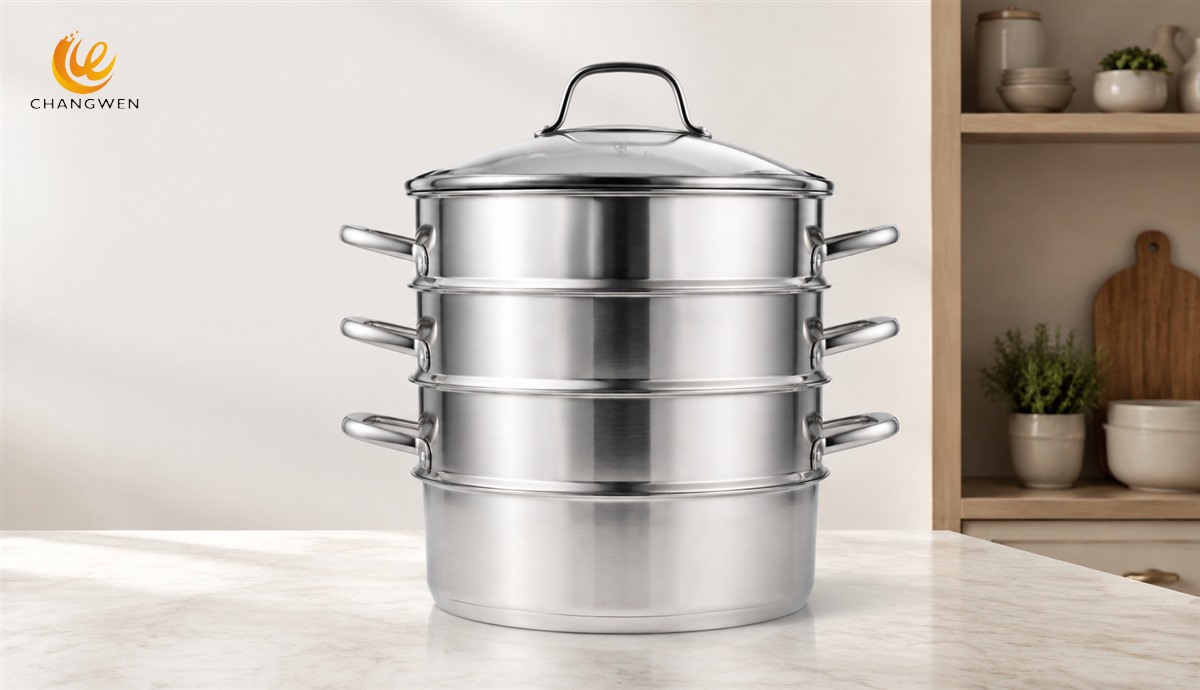
A one-tier steamer has one food-bearing basket above a water pot. A two-tier steamer has two food-bearing baskets, and a three-tier steamer has three. The base pot supplies steam and may sometimes serve as a stockpot when used separately, but it does not hold food during normal stacked steaming and should not be counted as a steaming tier.
Package piece count is a separate measurement from tier count. A water pot, two steamer inserts, and one lid may be sold as four physical pieces even though the working configuration has two food tiers. Buyers comparing product listings should therefore request both an exploded contents list and an assembled configuration. The site’s guide to what piece count means in a cookware set explains why lids and inserts can change the number printed on a package.
| Configuration | Food-bearing surfaces | Primary advantage | Main constraint |
|---|---|---|---|
| One food tier | One tray floor | Simple loading and direct access | Limited area for a single-layer layout |
| Two food tiers | Two tray floors | More area or separation of compatible foods | A larger load can need more time and monitoring |
| Three food tiers | Three tray floors | Maximum area within one vertical stack | Greater assembled height, weight, and timing complexity |
Why does nominal volume fail to show how much food fits?
Nominal liters or quarts usually describe the volume of a pot-shaped component when filled toward its rim. Steamed food is rarely packed as a liquid, so that number does not reveal how many buns fit without touching, whether a fish plate clears the wall, or whether a bowl leaves room under the lid. The stockpot capacity guide is useful for liquid volume, but a steamer basket needs a different capacity method.
Steamer capacity has three independent dimensions. Usable diameter controls the layout footprint. Clear internal height controls whether buns, bowls, or thick food fit below the next component. Steam access controls how much of that geometric space can be occupied without obstructing perforations and circulation. The smallest of these constraints usually determines the practical load.
Water capacity still matters, but it answers a different question: how long the system can generate steam under the operating instructions. More reservoir volume does not create more tray area. Users should follow the product manual’s minimum and maximum water levels, prevent the pot from boiling dry, and avoid assuming that a taller water pot permits an unattended longer run.
How can usable tray area be calculated?
For a round tray, an initial area estimate is pi multiplied by the square of the usable radius. The usable diameter must be measured across the flat perforated floor, not across the outside rim, handles, or sloping walls. A 24 cm outside diameter can therefore provide less than 24 cm of flat loading width.
| Illustrative usable diameter | Approximate floor area per tier | Two-tier nominal area | Three-tier nominal area |
|---|---|---|---|
| 20 cm | 314 cm2 | 628 cm2 | 942 cm2 |
| 24 cm | 452 cm2 | 904 cm2 | 1,356 cm2 |
| 28 cm | 616 cm2 | 1,232 cm2 | 1,848 cm2 |
These areas are mathematical reference values for perfect circles, not food yields. Real trays lose space at the curved perimeter, around a central post if present, and wherever a liner, bowl, or food gap is required. A diameter increase also has a nonlinear effect: a 28 cm usable circle provides about 36 percent more floor area than a 24 cm usable circle, not merely 17 percent more. Diameter can therefore matter as much as adding a tier.
Nominal stacked area is not identical to simultaneous cooking capacity. Two trays provide twice the geometric area only when both have the same usable diameter and neither requires a special adapter. Cooking a larger mass also increases the energy needed to heat the food and can alter steam recovery after loading. The area calculation should be treated as a layout screen, followed by an actual cooking validation.
How many dumplings or buns fit on each tier?
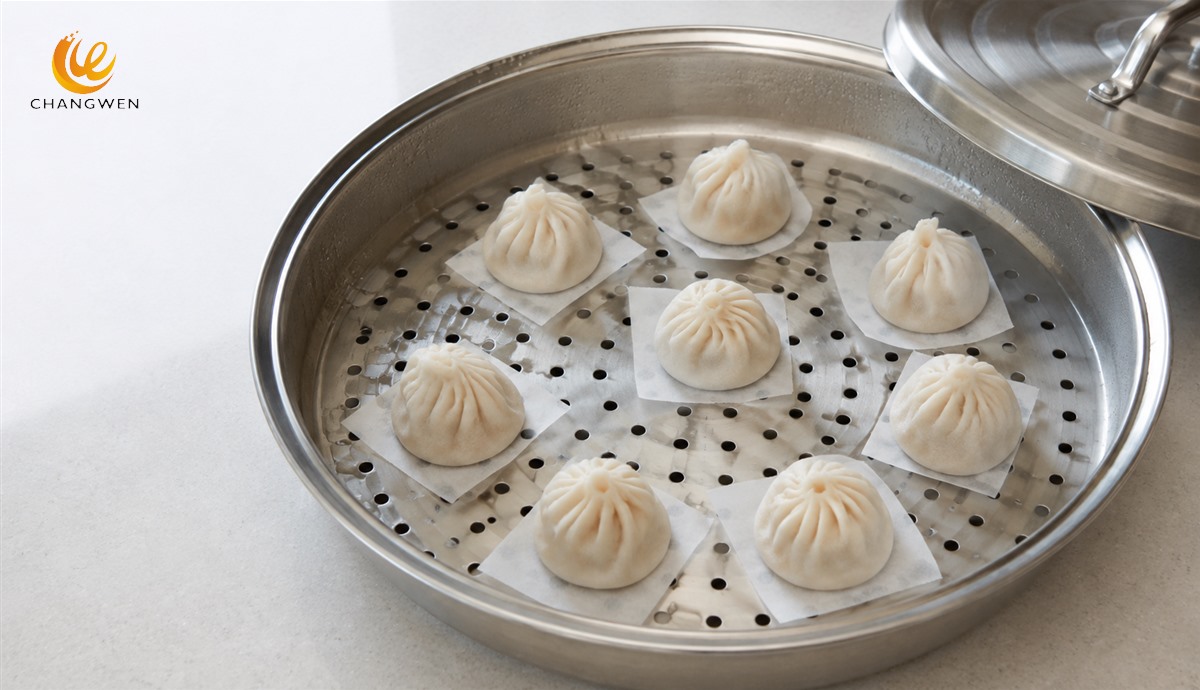
Dumpling and bun capacity should be counted with a physical or paper-template layout, not estimated from liters. Measure the widest cooked footprint expected for one item, add the intended gap around it, and place circles of that combined diameter inside the tray’s usable floor. Foods that expand during steaming need their finished size in the calculation rather than their raw size.
For example, a buyer testing a 24 cm usable tray might arrange eight sample buns with visible gaps and exposed perforations. If that exact layout cooks evenly and meets the finished product specification, one tier has a validated capacity of eight for that particular bun. Two tiers would begin with a 16-item planning load and three tiers with 24, but both stacked loads still require cooking tests before those counts become claims.
A larger number squeezed onto the metal is geometric maximum occupancy, not useful capacity. Contact between expanding dough pieces can change shape, parchment can block holes, and a crowded center can receive steam differently from an open perimeter. Individual parchment squares or a correctly perforated liner preserve more steam paths than a solid sheet that seals most of the tray floor.
How much vegetable, seafood, or meat fits?
Loose vegetables are better specified by a test mass and maximum bed depth than by visual fullness. A thin, even layer offers more exposed surface than a deep pile, while similarly sized pieces tend to finish more consistently than a mixture of large and small cuts. The acceptable load is the mass that meets the buyer’s time and uniformity criteria in a defined test, not the mass that can be forced under the lid.
A whole fish or long fillet is controlled by shape rather than weight. Measure the actual flat floor, then check whether the food or plate can sit without bending against the wall and without covering all available steam openings. An oval fish may fit diagonally even when its length exceeds the tray radius, but only a template or sample placement can verify the usable orientation.
Raw meat, poultry, and seafood introduce food-safety and drip-management questions that a capacity table cannot solve. Separate raw products from ready-to-eat foods and prevent cross-contamination according to the kitchen’s approved procedure. Use a food thermometer and the applicable official safe-temperature guidance; appearance, a suggested steaming time, or position in the stack is not a reliable substitute for measured doneness.
How do bowls and plates change practical capacity?
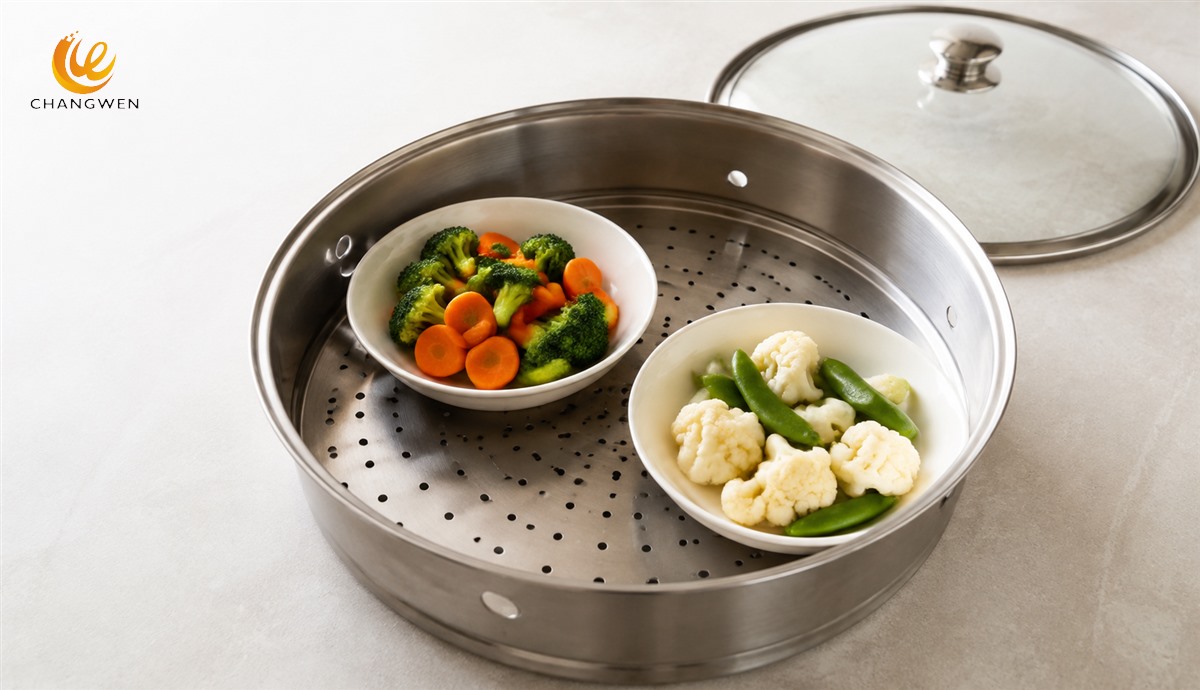
Bowls and plates turn a circular steamer into a fit-and-clearance problem. The dish must rest stably on the tray, leave a route for steam around its perimeter, and clear the tier above or lid. A shallow dish may occupy less height but more diameter, while a narrow bowl may fit the floor yet collide with a domed lid or the bottom of the next basket.
Measure the dish at its widest rim rather than at its base. Then compare the dish height, including food, with the steamer’s loaded clear height. The required gap depends on the approved design and use instructions, so wholesale buyers should specify a minimum loaded clearance instead of assuming that external basket height equals usable height.
Does adding tiers multiply output?
Adding identical tiers multiplies layout area more predictably than it multiplies hourly output. A three-tier stack has three loading surfaces, yet it also contains more cold food, more metal, and a longer steam path than one tier. Warm-up, recovery, condensation, and food arrangement can change the cycle time, so throughput must be calculated from validated batch size divided by validated cycle time.
A two-tier configuration is often the practical middle ground when a cook wants separate surfaces without creating a tall, heavy stack. One tier provides the simplest observation and access. Three tiers make sense when vertical space is more available than burner space and the menu can use the added area consistently. None of these configurations is universally best.
Different foods can share a stack only when their cooking requirements and food-safety controls are compatible. A short-cooking vegetable and a longer-cooking bun may require staggered loading, while raw drips can make vertical placement unsuitable for certain combinations. Do not assume the bottom tier is always the only fast tier or that changing positions is safe; behavior depends on the steamer design, load, and heat source.
Which steamer configuration fits each type of kitchen?
| Kitchen pattern | Likely starting point | Reason to move up | Reason to stay smaller |
|---|---|---|---|
| Occasional home steaming | One tier | Regularly repeating a second batch | Small loads and limited storage |
| Family meals with multiple steamed dishes | Two tiers | Three compatible loads repeatedly overlap | One or two trays meet the actual menu |
| High-variety or batch-focused kitchen | Two or three tiers after testing | Validated demand uses every tier | Handling time or height limits reduce benefit |
| Retail assortment | Distinct good-better-best use cases | Evidence supports a larger target segment | Configurations would duplicate each other |
A household should start with the largest normal single meal rather than the largest imagined event. If one tray holds the normal load and a second batch is rare, the simpler configuration may be easier to store and wash. If two steamed components must arrive together every week, the second tier solves a repeated timing problem and earns its space.
A restaurant or catering buyer should map the steamer to the menu and production schedule. Record each steamed item, portion footprint, batch demand, cycle frequency, and required holding condition. The resulting peak overlapping load reveals whether added diameter, another tier, or a second independent steamer is the better answer.
What physical limits should be checked before choosing three tiers?
Assembled height is the first limit because the steamer must fit beneath cabinets, ventilation equipment, and any shelf over the hob. Measure from the cooking surface to the lowest obstruction and include the lid handle plus hand clearance. A stack that technically fits but cannot be lifted safely is not a usable configuration.
Loaded weight is the second limit. Each additional tier adds metal, food, and condensed water, and a hot stack may need to be separated before transport. Buyers should evaluate handle position, grip clearance, balance, and the approved lifting method with realistic loads. An empty showroom lift does not reproduce a hot service condition.
Burner and base fit form the third limit. A wide steamer needs stable support and an appropriate heat source, while induction compatibility depends on the actual base construction. The base pot should not overhang controls or create handle conflicts with adjacent cookware. Product instructions and the appliance manufacturer’s limits take priority over general sizing advice.
Storage and washing complete the fit check. Confirm whether baskets nest, how much shelf width the handles require, and whether the parts enter the sink or dishwasher used by the kitchen. The guide to choosing between cookware set sizes applies the same principle: extra components add value only when they have a recurring job and a practical home.
How should a buyer run a repeatable capacity test?
A repeatable capacity test begins with one defined food or a dimensionally accurate substitute. Record usable tray diameter, clear height, food dimensions, gap rule, tier count, total mass, and load pattern. Photograph the tray before cooking so the placement can be reproduced by product teams, suppliers, and quality inspectors.
Run the intended configuration rather than testing one basket and extrapolating. Use the specified water level, heat source, lid, and starting conditions. Record the time to stable steam if relevant, cycle duration, water remaining, product temperatures where food safety applies, and observable uniformity across center, edge, lower, and upper positions.
Repeat the test because one successful batch cannot show normal variation. A useful approval rule defines acceptable completion, appearance, texture, and temperature before testing begins. If a three-tier result needs longer than a one-tier result, compare portions per hour rather than declaring the taller configuration either better or worse from a single cycle.
Document limitations beside the result. A claim such as “eight 55 mm finished buns per tier under the approved spacing pattern” is more useful than “large capacity” because the reader can understand the assumption. If another food is taller, denser, or arranged differently, the validated count does not automatically transfer.
What specifications should wholesale and OEM buyers request?
A steamer request for quotation should separate dimensions, materials, configuration, performance targets, branding, packaging, and validation. The configuration line should list the water pot, exact number of food baskets, lid, handles, rack or divider, and any optional parts. The capacity line should state both nominal pot volume and usable per-tier dimensions, because those numbers serve different decisions.
- Outside diameter, usable flat-floor diameter, basket internal height, and loaded clear height
- Number of food-bearing tiers and approved maximum stack configuration
- Water pot capacity, marked or instructed fill range, and base construction
- Material grade and thickness for the pot, inserts, lid rim, and handles
- Perforation diameter, pattern, open area, edge clearance, and liner compatibility
- Handle attachment, grip clearance, lid style, steam vent, and nesting arrangement
- Finished weight, loaded-use expectations, carton dimensions, and pack configuration
- Target foods, sample load pattern, acceptance criteria, and required compliance documentation
Brand owners should avoid asking only for “24 cm, three layer, large capacity.” That phrase leaves usable diameter, actual food tiers, clear height, material, and test load undefined. A drawing plus a physical golden sample gives both parties a stable reference for production and inspection.
Changwen’s custom stainless steel cookware service describes options for steamer pots, tier count, size, material, lid and handle, base construction, labels, and packaging. Buyers developing a coordinated line can also review the stainless steel cookware set manufacturing page to align the steamer with saucepans, stockpots, and other assortment pieces.
What is the best steamer tier choice?
The best steamer configuration is the smallest stack that holds the normal validated load with enough steam access, height clearance, and handling margin. Choose one tier for simple recurring loads, two tiers when a second surface solves a regular batch or timing constraint, and three tiers when testing proves that the extra vertical area improves useful throughput.
Diameter and tier count should be decided together. A wider two-tier model may offer more usable area and easier access than a narrower three-tier model, while the narrower stack may suit a kitchen with limited burner width. Compare usable floor area, finished food footprint, clear height, total assembled size, and cycle performance before comparing nominal liters or package pieces.
Frequently asked questions about steamer capacity
Does a two-tier steamer hold twice as much food as a one-tier steamer?
Two identical food tiers provide approximately twice the nominal tray-floor area of one tier. Practical capacity may be less than a simple doubling if food blocks steam paths, the tiers differ in size, or the larger batch cannot meet the same performance criteria. Validate the complete two-tier load.
Should the water pot count as a steamer tier?
The water pot should not count as a food-bearing steaming tier when it supplies steam below perforated baskets. To prevent listing confusion, describe every component explicitly and state the number of food trays separately from total package pieces.
Is diameter or tier count more important?
Diameter determines the area available on every tier, while tier count multiplies the number of loading surfaces. A moderate increase in diameter can add substantial circular area, so compare calculated usable area and actual food layouts rather than assuming that more tiers always provide more value.
Can different foods be steamed on different tiers at the same time?
Different foods can share a stack only when their timing, aroma transfer, drip exposure, and food-safety controls are compatible. Use validated loading and sequencing instructions, keep raw foods from contaminating ready-to-eat foods, and verify doneness with the appropriate method.
How should a retailer state bun or dumpling capacity?
A retailer should state the tested item size, spacing pattern, count per tier, number of tiers, and any liner used. A bounded statement based on a reproducible load is more informative than an unqualified “large capacity” claim.
Build a steamer range around measurable capacity
Changwen provides stainless steel cookware wholesale, private-label, OEM, and ODM support for buyers developing steamer pots and coordinated cookware ranges. A productive inquiry should include the target market, desired diameter, number of food-bearing tiers, usable height, material choice, base construction, handle and lid preferences, expected load, logo method, packaging, and order quantity.
Changwen can use that brief to discuss customization and sampling around a defined application rather than an ambiguous capacity label. To start an evaluation, send the intended food dimensions or plate sizes together with the required configuration through the Changwen contact page. The clearest project begins with a measurable tray layout and ends with an approved sample and documented acceptance criteria.