Cookware manufacturing partner since 2002 info@cwchangwen.com · +86 180 2296 3948

Who Owns the Product? OEM vs ODM Cookware Through Five Control Decisions

Read time: 13 minutes
OEM cookware is manufactured to a buyer-led design or detailed specification, while ODM cookware begins with a manufacturer-led design that a buyer selects and adapts. The practical difference is not the logo on the pan. The practical difference is who holds design authority, who pays for development, who owns or controls tooling, who approves changes, and whether the product can move to another factory.
OEM gives a cookware brand more control and a stronger path to exclusivity, but OEM also requires clearer specifications, more validation work, higher development commitment, and greater responsibility for design decisions. ODM reduces development time and uses proven manufacturing platforms, but ODM normally limits structural customization and may leave the base design available to other buyers. Many successful cookware programs use a hybrid model: an existing factory platform is retained while selected components, performance requirements, finishes, or packaging become buyer-controlled.
The terms OEM and ODM are used inconsistently across factories and markets. A quotation should therefore describe responsibilities and ownership in precise contract language instead of relying on a three-letter label. Intellectual-property rights, tooling ownership, exclusivity, and transfer rights depend on the written agreement and applicable law, so buyers should obtain qualified legal advice for important product programs.
What is OEM cookware manufacturing?
OEM cookware manufacturing means a factory produces cookware against a buyer-controlled design, specification, reference sample, or performance requirement. The buyer may define the material grade, layer structure, body geometry, wall thickness, handle system, lid fit, surface finish, tolerances, testing plan, packaging, and approved suppliers. The factory contributes manufacturing expertise, but the buyer remains the main design authority unless the agreement assigns particular engineering responsibilities elsewhere.
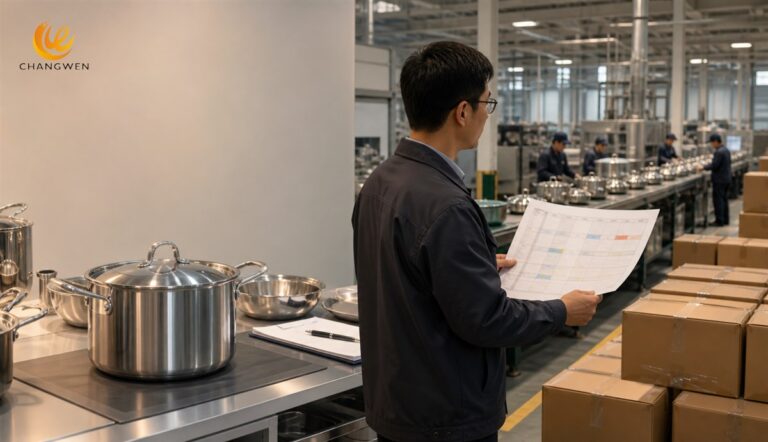
An OEM cookware project works best when the buyer can translate the commercial idea into measurable requirements. A premium appearance is not a sufficient specification because different factories can interpret premium differently. A controlled requirement might define brushed-finish direction, acceptable visual limits, target weight, base flatness, handle alignment, thermal performance, or packaging protection. The European retail OEM cookware project guide shows how product briefs, materials, compliance, samples, packaging, and reorder controls connect in a complete program.
What is ODM cookware manufacturing?
ODM cookware manufacturing means the factory leads the underlying product design and offers that design as a production-ready platform. The buyer usually selects a body shape, construction, handle, lid, finish, color, logo method, set combination, or packaging format from options the factory already understands. Existing tooling and process knowledge reduce development work because the manufacturer has already solved many production questions.
ODM is often suitable when speed, controlled investment, or market testing matters more than structural exclusivity. ODM can also reduce technical risk when a buyer lacks an internal cookware engineering team. The limitation is that a proven factory design may be sold in other channels unless the agreement provides territory, channel, period, or customer exclusivity.
What is the core difference between OEM and ODM cookware?
The core difference between OEM and ODM cookware is design authority. OEM normally starts with the buyer’s defined product outcome, while ODM normally starts with the manufacturer’s existing design solution. Cost, MOQ, lead time, customization, and exclusivity change because each factor follows the location of design authority.
| Decision area | OEM cookware | ODM cookware | Why the difference matters |
|---|---|---|---|
| Starting point | Buyer specification, drawing, sample, or performance brief | Manufacturer’s existing product platform | The starting point determines how much development remains |
| Design authority | Primarily buyer-controlled | Primarily manufacturer-controlled | The design authority approves technical decisions and deviations |
| Structural customization | High when tooling and process allow | Limited to the platform’s available options | Deep changes increase development cost and validation work |
| Tooling | Often new or buyer-funded | Usually existing and manufacturer-controlled | Tooling affects exclusivity, MOQ, timing, and transferability |
| Development time | Usually longer | Usually shorter | New decisions require samples, tests, and approvals |
| Upfront investment | Usually higher | Usually lower | Engineering and tooling costs must be recovered |
| Exclusivity potential | Stronger when ownership is documented | Limited unless separately negotiated | A shared platform can appear under multiple brands |
| Supplier portability | Potentially higher with complete files and transferable tooling | Usually lower for the manufacturer’s proprietary platform | Portability affects continuity and negotiating position |
Who controls the cookware specification?
An OEM buyer normally controls the final product specification and approves every controlled revision. The factory can recommend design-for-manufacturing improvements, but the factory should document the reason, expected effect, and required validation before implementing a change. This structure protects consistency because production remains tied to an approved technical baseline.
An ODM manufacturer normally controls the structural baseline and defines the option boundaries. The buyer can select from approved variants, but a requested change may be declined when the change conflicts with existing tooling, process capability, or certifications. ODM therefore works efficiently when the buyer’s desired product fits the platform instead of requiring repeated exceptions.
A specification-control table should identify each product characteristic, the decision owner, the document containing the requirement, and the party that can approve a deviation. The table prevents a familiar sourcing problem in which the buyer assumes a feature is controlled while the factory treats the feature as an adjustable production detail.
Who owns the cookware design and intellectual property?
OEM buyers often expect to own the finished design they supplied or funded, but ownership should never be inferred from the word OEM. The contract should identify buyer-provided intellectual property, manufacturer background intellectual property, newly developed project intellectual property, permitted uses, confidentiality duties, and rights after termination. A purchase order that only lists a unit price rarely resolves these questions.
ODM manufacturers usually retain the underlying product design because the design existed before the buyer’s project. A buyer may still own trademarks, packaging artwork, product photography, instructions, and custom decorative elements. An ODM agreement can also grant limited exclusivity without transferring the entire design, such as an exclusive color combination for one country or one sales channel.
Who owns the molds, dies, and production fixtures?
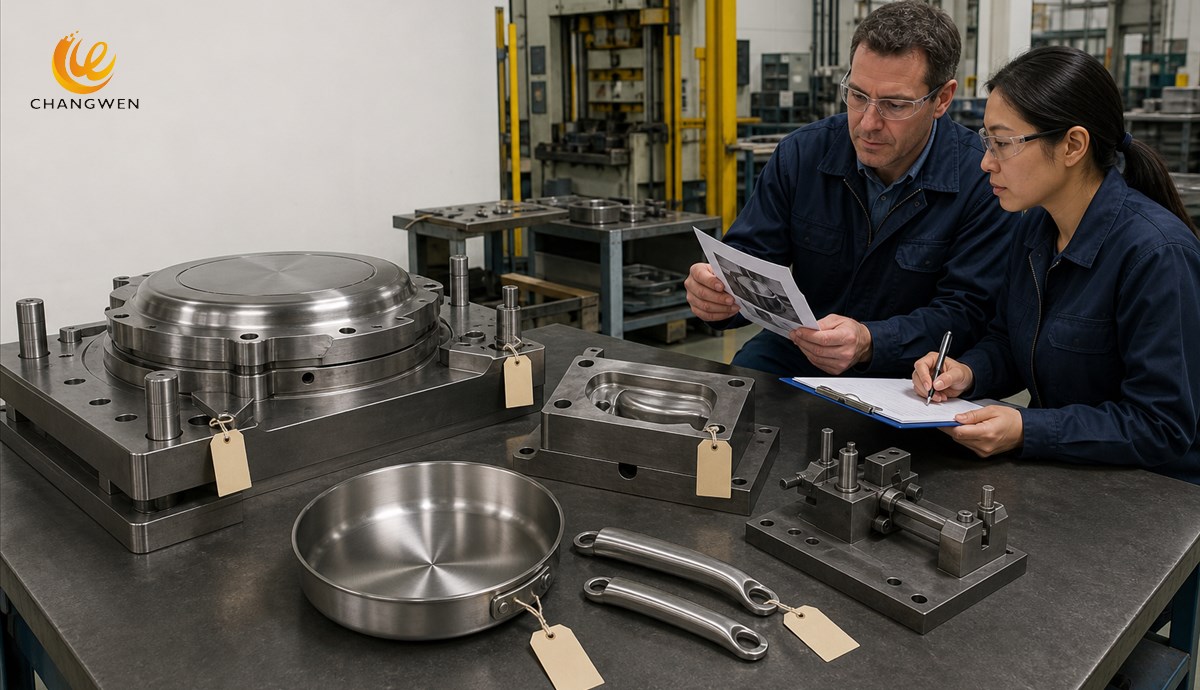
Tooling ownership is a separate decision from product ownership. A buyer who pays for a deep-drawing die, casting mold, trimming tool, welding fixture, embossing tool, or inspection gauge should document the asset number, storage location, maintenance duty, permitted use, remaining life, and return or transfer procedure. Payment alone may not define every right.
ODM cookware usually relies on tooling funded and controlled by the manufacturer. Shared tooling lowers the buyer’s entry cost because development expense is spread across production volume. The same advantage limits exclusivity because the factory needs the freedom to use the platform for other compatible programs.
Who approves engineering changes and production deviations?
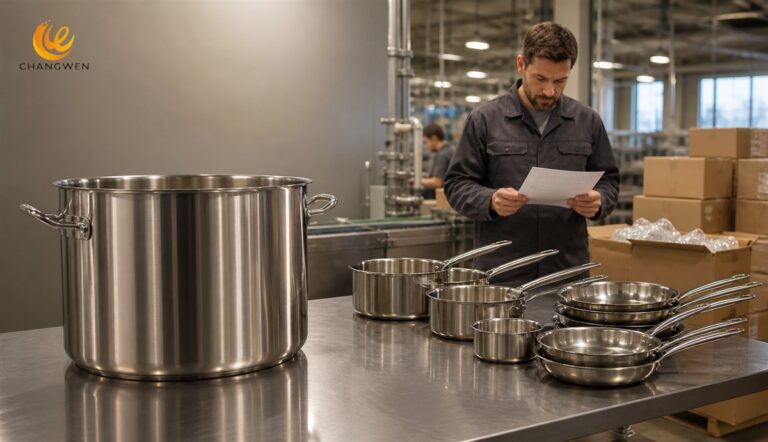
OEM production normally requires buyer approval when a controlled material, dimension, supplier, finish, process, or test method changes. The requirement protects the link between the approved sample and mass production. A factory substitution that appears minor can affect corrosion, coating adhesion, induction performance, handle temperature, packaging fit, or food-contact evidence.
ODM production gives the manufacturer more authority over the platform, but the buyer should still receive notice when a change affects the contracted specification, appearance, performance, compliance evidence, or approved sample. An ODM platform is not permission for uncontrolled variation. The purchase agreement should define notification thresholds and reapproval requirements.
Change control becomes especially important during repeat orders. The approved bill of materials, limit samples, drawings, packaging files, and test plan should carry a revision identifier. The OEM tri-ply cookware guide demonstrates why material layers, thickness, handle construction, and verification methods must remain connected throughout manufacturing.
How do OEM and ODM affect cost, MOQ, and lead time?
OEM cookware usually requires more non-recurring investment because the project may need engineering, prototypes, tooling, fixtures, testing, documentation, and several approval rounds. The unit price can also include tighter material controls, unique components, smaller purchasing leverage, or additional inspection. The stainless steel cookware OEM price guide explains how material, construction, customization, packaging, quantity, and process requirements shape a quotation.
ODM cookware usually launches faster because the main geometry, tooling, and process route already exist. ODM MOQ can be lower when the buyer chooses standard components and combines production with other platform demand. Custom colors, packaging, handles, or exclusive parts can create separate MOQ requirements even when the base cookware is standard.
Which cookware components can follow different manufacturing models?
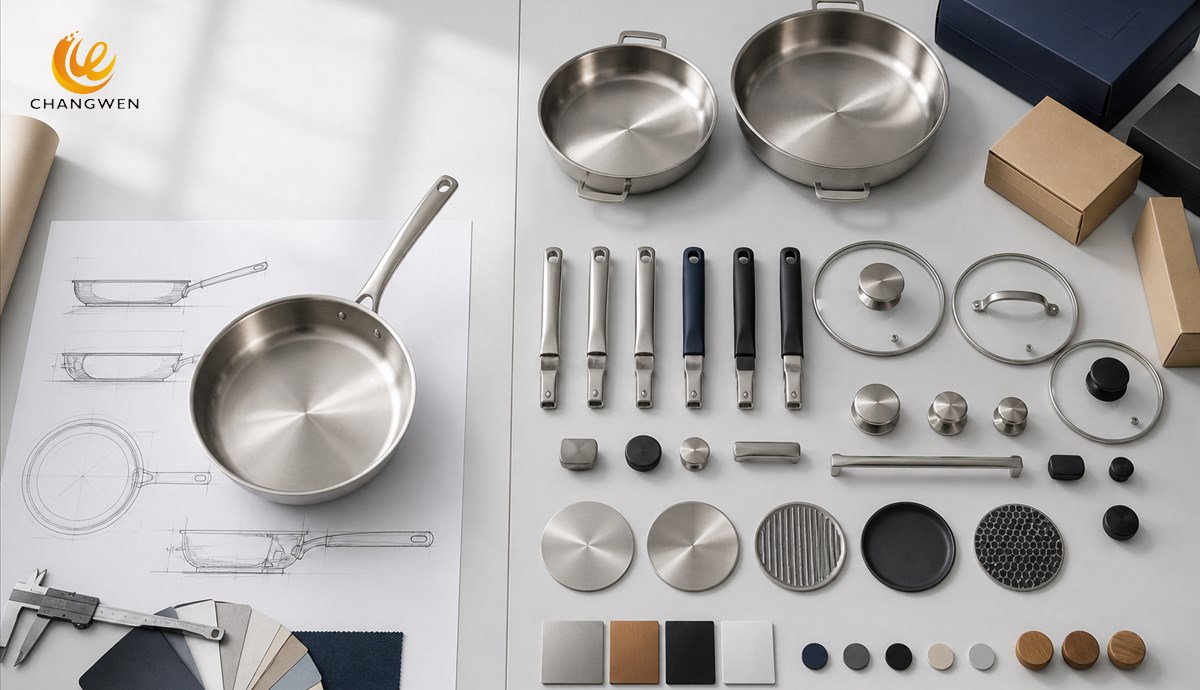
A single cookware SKU can contain both OEM and ODM elements. The body, lid, handle, base, coating, logo, accessories, and packaging do not need to follow one ownership model. Component-level decisions often create a more economical program than labeling the entire product OEM or ODM.
| Component | ODM-friendly approach | OEM-driven approach | Typical decision trigger |
|---|---|---|---|
| Cookware body | Existing diameter and profile | Unique geometry, thickness, or layer structure | Performance or visual silhouette must differ |
| Handle | Catalog handle with finish choice | Exclusive shape, balance, attachment, or heat target | Handle is central to brand identity or function |
| Lid | Existing glass or steel lid | Unique vent, rim, knob, fit, or stacking geometry | Lid function changes use or storage |
| Surface | Approved standard finish or color | Controlled texture, polish pattern, or coating system | Appearance or performance claim requires control |
| Branding | Standard laser mark or stamp position | Custom embossing, medallion, or integrated detail | Brand recognition requires a permanent feature |
| Packaging | Standard protective structure with new graphics | Custom unboxing, nesting, inserts, or retail structure | Channel requirements or shelf impact justify tooling |
Component-level planning makes the RFQ clearer because each customization request has a business reason. Buyers can review the stainless steel cookware customization guide for practical options covering appearance, materials, handles, lids, logos, packaging, and product acceptance.
When should a cookware brand choose OEM?
A cookware brand should choose OEM when the product depends on a controlled specification that an existing platform cannot provide. OEM is appropriate when unique geometry, material construction, thermal behavior, attachment design, stackability, ergonomics, appearance limits, or proprietary accessories create meaningful customer value.
OEM is also appropriate when the buyer needs stronger exclusivity, consistent global specifications, retailer-mandated requirements, or the ability to qualify another production source later. Those benefits require adequate volume, engineering resources, validation budget, and disciplined document control. OEM becomes risky when the buyer requests full customization but cannot define what success means.
An established brand does not need to choose OEM for every product. A signature frying pan may justify a buyer-owned system, while supporting saucepans can remain on a modified ODM platform. The product strategy should invest the most control in the SKUs that carry the brand promise.
When should a cookware brand choose ODM?
A cookware brand should choose ODM when rapid market entry and lower development exposure matter more than structural exclusivity. ODM is useful for a new category, a seasonal program, a regional assortment, a price-sensitive channel, or a product whose differentiation comes mainly from branding, merchandising, service, and packaging.
ODM is also useful when the factory has a mature platform with documented performance and the buyer lacks an internal product engineering team. The manufacturer can guide practical combinations and avoid unnecessary tooling. The buyer should still validate materials, performance, compliance, quality consistency, and packaging rather than assuming that an existing design is automatically suitable.
Private label is closely related to ODM but usually involves a narrower customization layer. The private label cookware guide explains how branding, product choice, compliance, market channels, and supply-chain planning fit a ready-to-brand program.
When is a hybrid OEM-ODM cookware model better?
A hybrid OEM-ODM model is better when the buyer needs visible or functional distinction but wants to preserve proven manufacturing economics. The manufacturer may supply an existing body platform while the buyer controls the handle, finish specification, testing threshold, set architecture, accessories, packaging, and selected market exclusivity.
A hybrid model can also be used over time. A brand can validate demand with ODM products, identify the strongest SKU, and then invest in OEM development for the proven hero product. The validation-first private label cookware launch guide explains how market evidence, unit economics, samples, pilot orders, and reorder signals can support that transition.
The hybrid agreement should define the boundary between shared and exclusive elements. A buyer should know which features the manufacturer may offer elsewhere, which tools or files belong to the buyer, which colors or combinations are restricted, and whether exclusivity depends on annual purchase volume.
How should buyers write an OEM or ODM request for quotation?
An RFQ should begin with the target customer, sales channel, market, product role, price position, estimated quantity, launch date, and required claims. Those commercial inputs allow the factory to recommend a suitable platform before technical decisions become expensive.
An OEM RFQ should include drawings or a structured product brief, controlled materials, dimensions, tolerances, performance criteria, testing requirements, packaging, expected approvals, tooling deliverables, and forecast range. An ODM RFQ should request available platforms, option boundaries, existing test evidence, tooling status, previous production experience, MOQ by component, exclusivity possibilities, and the changes that would trigger new validation.
Every RFQ should label each requirement as included, optional, excluded, or requiring development. This format exposes assumptions before quotation comparison. The cookware manufacturer versus trading company guide can help buyers decide whether direct process control or a broader sourcing network better matches the program.
Which contract questions reveal the real manufacturing model?
Contract questions reveal the real manufacturing model more reliably than marketing terminology. A buyer should ask who owns the base design, who owns new improvements, who pays for tooling, who may use the tooling, who holds editable files, who approves material substitutions, who maintains compliance evidence, and what happens when the relationship ends.
A buyer should also ask whether the same product can be sold to another customer, country, channel, or marketplace. Exclusivity should define product features, territory, channel, duration, performance conditions, remedies, and permitted exceptions. A broad promise of exclusivity without measurable boundaries is difficult to administer.
How should sample approval differ between OEM and ODM?
OEM sample approval should verify that a new or buyer-controlled design meets the intended function and can transfer into repeatable production. The approval plan may require several prototypes, engineering tests, tooling corrections, limit samples, a pilot run, and reconciliation between drawings, material records, inspection plans, and finished units.
ODM sample approval can focus more heavily on fitness for the buyer’s market and consistency with the established platform. The buyer should verify that selected materials, finishes, accessories, logos, packaging, and claims match the approved configuration. Existing platform evidence is useful only when the evidence applies to the supplied construction and remains current.
What common OEM and ODM misunderstandings create sourcing risk?
The first misunderstanding is that OEM always means complete originality. A buyer-led specification can still use standard factory technology and components. The second misunderstanding is that ODM means no customization. ODM can support many market-facing changes while keeping the underlying platform controlled by the manufacturer.
The third misunderstanding is that paying for tooling automatically creates exclusivity and transfer rights. Tooling payment, asset ownership, design ownership, use restrictions, maintenance, and release obligations should be written separately. The fourth misunderstanding is that an ODM certificate covers every variant. A change in material, coating, handle, accessory, or manufacturing site can alter the relevance of existing evidence.
The fifth misunderstanding is that one model should cover the entire brand. OEM and ODM are project choices, and different SKUs can use different models. A portfolio approach prevents a buyer from overspending on unproven products or underinvesting in the product that needs genuine differentiation.
Frequently asked questions
Is OEM cookware better than ODM cookware?
OEM cookware is not universally better than ODM cookware. OEM is better when control, exclusivity, or a unique specification justifies development investment. ODM is better when speed, proven production, and lower initial exposure are more important.
Is private label cookware the same as ODM cookware?
Private label and ODM cookware overlap, but private label usually describes a finished or nearly finished product with branding and packaging changes. ODM can involve a broader selection and adaptation process while the manufacturer retains authority over the base design.
Can an ODM cookware design be exclusive?
An ODM cookware design can receive negotiated exclusivity for defined features, territories, channels, customers, or periods. Exclusivity is not automatic and should state conditions such as minimum annual volume, protected combinations, and permitted exceptions.
Who owns OEM cookware tooling?
OEM cookware tooling belongs to the party identified in the contract. A buyer who funds tooling should document ownership, permitted use, maintenance, storage, identification, transfer, and release rights rather than relying on the invoice alone.
Can a brand move an OEM cookware product to another factory?
A brand can move an OEM cookware product more easily when the brand controls complete drawings, specifications, test methods, approved samples, supplier information, and transferable tooling. A move can still require process validation because different equipment and operators can produce different results.
Should a new cookware brand start with OEM or ODM?
A new cookware brand often benefits from ODM or a hybrid model when demand is unproven. OEM becomes more attractive after the brand identifies a product difference customers value and can support tooling, validation, inventory, and longer development.
What is the final decision rule for OEM vs ODM cookware?
The right manufacturing model is the least complex model that protects the product difference the customer will value. A buyer should choose OEM when buyer-controlled design, performance, exclusivity, or portability creates enough business value to justify development responsibility. A buyer should choose ODM when an existing platform meets the market need and speed or investment discipline matters more than structural uniqueness.
A component-level hybrid often produces the strongest balance. The buyer can retain proven cookware bodies and processes, invest in distinctive high-value elements, and document ownership at the exact boundary where control changes. The final agreement should name that boundary clearly because the real OEM-ODM difference lives in decisions, assets, and rights rather than in the letters printed on a quotation.