Cookware manufacturing partner since 2002 info@cwchangwen.com · +86 180 2296 3948

Which Cookware Features Deserve Shelf Space? A Retail Value Test

Read time: 14 minutes
A cookware feature deserves shelf space when it solves a relevant customer problem, can be understood quickly, supports the target price and margin, improves assortment choice, and creates more value than the space and complexity it adds. A feature should not win distribution merely because it looks new or increases the specification count. Retailers need a repeatable value test that connects product design to conversion, gross margin, shelf productivity, return risk, and supply readiness.
The retail value test in this guide scores eight dimensions before a feature enters the assortment. The score does not predict sales by itself. The score creates a disciplined comparison between stackability, induction compatibility, lid design, pouring rims, detachable handles, measurement marks, construction, and accessories. Retailers can validate the strongest candidates through sample review and a limited pilot.
Short answer: keep a cookware feature when shoppers value the benefit, staff and packaging can explain it, the feature supports profitable pricing, the product uses space efficiently, and the supplier can reproduce it reliably. Remove or redesign a feature when its benefit is hard to notice, duplicates another SKU, expands the carton without improving value, or increases complaints and quality variation.
What is a cookware retail value test?
A cookware retail value test is a weighted decision model for judging whether a product feature earns a place in a retail assortment. The model converts a vague discussion about premium design into eight questions with evidence. Each question represents a commercial condition that must be satisfied after the product leaves the factory.
The model evaluates the incremental feature rather than the entire pan or set. A glass lid should be compared with the lid alternative on the same vessel. A detachable handle should be compared with a fixed handle under the same capacity and price architecture.
The model also separates must-have requirements from optional selling features. Food-contact compliance, structural safety, stable handles, and accurate labeling are entry conditions rather than merchandising bonuses. A product that fails a mandatory requirement should not receive shelf space even if its visual appeal scores highly.
Which eight factors determine whether a cookware feature earns shelf space?
The eight-factor scorecard balances customer value, store economics, and execution risk. The suggested weights total 100 points and provide a starting framework, not a universal industry standard. A supermarket, specialty store, online marketplace, and club channel should adjust the weights because each channel sells, displays, and replenishes cookware differently.
| Retail value factor | Suggested weight | Question the evidence must answer |
|---|---|---|
| Customer problem relevance | 20 | Does the feature solve a frequent and important cooking or ownership problem? |
| Benefit clarity | 10 | Can a shopper understand the benefit within a few seconds? |
| Demonstrability | 10 | Can packaging, display, video, or staff prove the benefit credibly? |
| Margin contribution | 15 | Does the expected price premium exceed added landed cost and markdown risk? |
| Shelf productivity | 15 | Does the SKU generate sufficient value for its frontage, cube, and inventory depth? |
| Assortment role | 10 | Does the feature fill a real choice gap without unnecessary cannibalization? |
| Return and service risk | 10 | Will the feature reduce problems or create new misuse, breakage, and expectation gaps? |
| Supply readiness | 10 | Can the specification be produced, inspected, packed, and replenished consistently? |
Each factor can be rated from one to five, then converted by its weight. A score of one means the evidence is weak or negative, while a score of five means the evidence is strong and repeatable. Retail teams should record the source behind every rating so the final number remains an auditable decision rather than a polished opinion.
How do retailers measure customer problem relevance?
Customer problem relevance measures how often a problem occurs and how strongly the target shopper wants it solved. A stay-cool handle addresses handling comfort, a pouring rim addresses transfer control, and stackable geometry addresses storage. The feature receives a high score only when the target segment experiences the problem and believes the proposed solution is credible.
Retailers should define the customer job in one complete sentence before reviewing the sample. A useful statement names the user, situation, problem, and desired result. For example, an apartment household needs several cooking functions without using multiple cabinet shelves. That statement gives stackability a clear evaluation context and prevents a general claim from substituting for a specific benefit.
Evidence should combine customer questions, reviews, return reasons, store feedback, search behavior, and product testing. A frequently requested feature is more relevant than a feature that appears only in a supplier presentation. A feature can still introduce a new benefit, but a new benefit needs stronger demonstration because the shopper may not already understand why it matters.
Why must a cookware feature be understandable in seconds?
Benefit clarity matters because shelf attention is limited. A shopper can see a straining lid, nesting shape, helper handle, or visible capacity difference quickly. An internal construction change may deliver meaningful performance, but the retailer needs packaging, a cutaway, a demonstration, or concise staff training to make that invisible benefit understandable.
A feature name is not the same as a customer benefit. A statement about an encapsulated base describes construction, while a statement about stable heating across common cooking tasks describes the intended result. Retail communication should remain accurate and bounded, because an exaggerated benefit can increase returns when normal use does not match the promise.
Demonstrability receives a separate score because some valuable benefits are easy to explain but difficult to prove. A detachable handle can be demonstrated physically. Heat distribution requires a controlled comparison. Retailers should prefer evidence that shoppers can verify over decorative badges that cannot be connected to use.
How should a feature be tested for margin contribution?
Margin contribution compares the expected retail price effect with every incremental cost created by the feature. The calculation should include factory cost, packaging, freight, duty where applicable, inspection, damage allowance, markdown exposure, and after-sales service. A feature that adds a small factory cost can still be expensive if it requires a larger carton or creates more returns.
The correct comparison is incremental profit per unit and per shelf position, not gross margin percentage alone. A feature may lower margin percentage while increasing gross profit dollars, or it may raise the ticket but slow sell-through. Retailers should model realistic volume at several price points before assuming that premium construction automatically creates premium economics.
Price architecture also determines whether the feature belongs on one hero SKU or across the full range. A distinctive lid may justify a good-better-best step when placed on the better tier. Adding the same lid to every SKU can erase visible trade-up logic and burden entry-price products with cost that their shoppers will not pay.
What does shelf productivity mean for cookware?
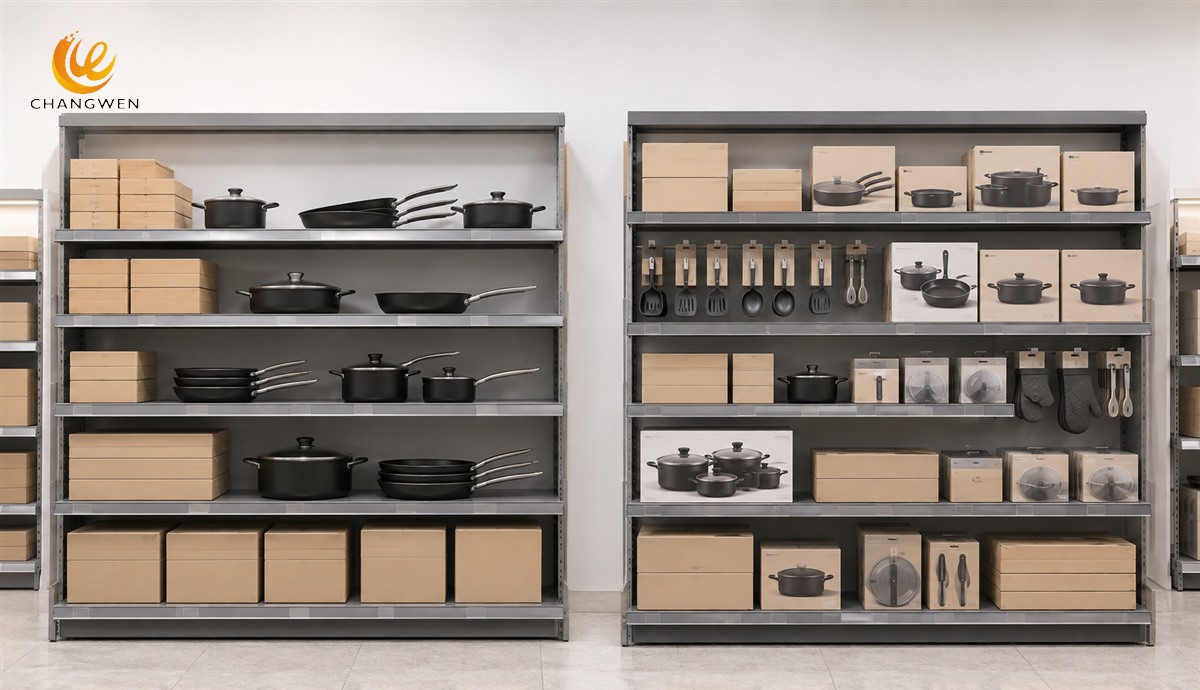
Shelf productivity measures the commercial return generated by the physical space and inventory commitment of a SKU. Cookware requires more cube than many kitchen accessories, so the retailer should evaluate frontage, depth, carton dimensions, nesting efficiency, units per shelf, replenishment frequency, and sales value together.
A bulky feature can reduce productivity even when customers like it. A large knob, long fixed handle, tall lid, or extra accessory may expand the carton and lower the number of units per pallet or shelf. A compact feature such as nesting geometry can improve storage for the shopper and logistics for the retailer, which creates value at two points in the chain.
Piece count should never substitute for space productivity. Lids and accessories can increase the advertised count without adding independent cooking functions. Retailers comparing sets can use the guide to what cookware set piece count really means to separate packaged pieces from functional vessels.
How does a feature support a clear assortment role?
An assortment role explains why a shopper would choose one SKU instead of the adjacent options. A feature can create an opening-price product, a core volume product, a premium trade-up, a space-saving solution, a specialist cooking tool, or a giftable set. A feature that cannot define a choice may create duplication rather than useful breadth.
Cannibalization is acceptable when the new SKU improves profit, customer reach, or range clarity. Cannibalization is harmful when two products serve the same customer job at similar prices and divide inventory without adding demand. The retail value test should compare the proposed SKU with its nearest internal alternative, not only with an empty theoretical market.
Set size is a strong example of assortment role. A compact set can serve first-home or small-kitchen shoppers, while a larger set can serve broader meal preparation or gifting. The comparison of 3-piece, 5-piece, and 7-piece cookware sets shows why user fit matters more than assuming that the largest configuration deserves the most space.
Which cookware features commonly pass or fail the test?
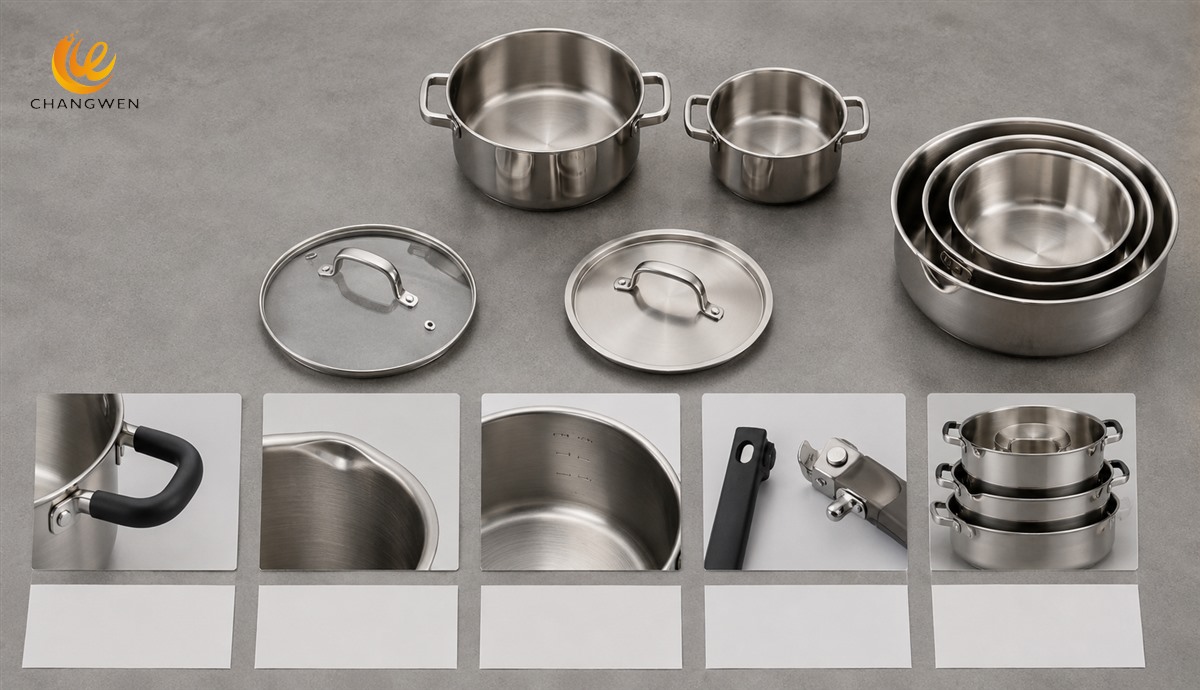
No cookware feature passes in every channel, but common patterns can guide the first review. Induction compatibility often supports broad utility where induction use is material, while a decorative finish may depend more heavily on local taste and trend timing. Stackability can improve both household storage and shipping cube, while an extra tool bundle can add visible count but weaken quality perception or packaging efficiency.
| Feature | Potential retail value | Evidence required | Common risk |
|---|---|---|---|
| Induction-compatible base | Broader heat-source compatibility | Compatibility validation and clear labeling | Shopper confusion about zone fit or performance |
| Stackable geometry | Storage convenience and lower packed cube | Nesting test, surface protection, carton measurements | Scratching or difficult separation |
| Detachable handle | Compact storage and flexible use | Cycle, load, misuse, and attachment testing | Mechanism wear or incorrect engagement |
| Straining lid and pouring rim | Fewer tools during draining and transfer | Controlled pour test with intended food loads | Steam exposure or poor lid retention |
| Interior measurement marks | Faster portioning and recipe preparation | Accuracy, legibility, and durability checks | Marks that fade or do not match local units |
| Extra accessories | Gift value and visible completeness | Usage research and item-level quality review | Low use, larger carton, and diluted value |
| Premium finish | Visual differentiation and gifting appeal | Target-customer preference and abrasion testing | Trend dependence and visible wear |
A feature should fail the first gate when it creates a safety concern, unsupported claim, or unclear operating condition. A detachable mechanism that lacks robust engagement testing should not be rescued by strong space savings. A decorative treatment that conflicts with care expectations should be redesigned before merchandising investment.
A feature should enter a pilot when the customer benefit appears strong but commercial evidence remains incomplete. Pilot status is different from full-range approval. The retailer can restrict the feature to selected stores, one channel, one size, or one price tier while collecting conversion, return, review, and replenishment data.
How should retail channels change the feature weights?
A supermarket usually gives greater weight to instant benefit clarity, efficient packaging, dependable replenishment, and accessible pricing. The cookware may receive limited staff explanation, so the package and visible sample must communicate quickly. A complex hidden feature can underperform if the shopper cannot discover it at the shelf.
A club or high-volume format can give greater weight to perceived bundle value, pallet efficiency, packaging strength, and broad household usefulness. A large piece count may attract attention, but the cookware packaging strategy must protect heavy components and preserve a clear value story without wasting cube.
How can capacity and size features be evaluated without duplicating SKUs?
Capacity should be evaluated as a customer-use feature rather than a numerical upgrade. A larger stockpot supports batch cooking but uses more shelf space, so the stockpot capacity guide in quarts and liters can map size to meals before another capacity is added. Frying-pan diameters also need distinct cooking loads and burner fits; the guide to choosing a frying pan size helps prevent nearby sizes from fragmenting inventory without creating a new customer role.
What is the step-by-step retail value test?
- Define the target shopper and channel. State who will buy the cookware, where the purchase occurs, and which price tier the assortment must support.
- Name the feature and baseline. Describe the proposed change and the existing construction it replaces so incremental value can be measured.
- Write the customer job. Connect the feature to one frequent problem, one desired result, and one realistic cooking or ownership situation.
- Collect benefit evidence. Use customer language, sales feedback, reviews, testing, and sample demonstrations rather than supplier adjectives.
- Calculate complete incremental cost. Include product, tooling allocation, packing, logistics, inspection, expected returns, and markdown exposure.
- Measure space impact. Record retail carton dimensions, display frontage, nesting, units per case, units per pallet, and planned shelf depth.
- Map the assortment role. Identify the nearest existing SKU, intended trade-up step, demand gap, and acceptable cannibalization.
- Review risk and readiness. Define safety, durability, misuse, labeling, inspection, capacity, lead-time, and replenishment requirements.
- Score every factor. Rate each dimension from one to five, attach evidence, convert the ratings by weight, and document disagreements.
- Choose an action. Approve, redesign, pilot, restrict to one channel, or reject the feature based on score and mandatory gates.
How should the weighted score be interpreted?
A score above 75 can identify a strong candidate for range approval when every mandatory gate also passes. A score from 60 to 74 often supports a selective launch or one-tier placement. A score from 45 to 59 usually calls for redesign or a small pilot. A score below 45 suggests that the feature should not consume shelf space without new evidence.
These thresholds are editorial starting points and should be calibrated against actual category performance. A retailer can score past winners, weak sellers, and discontinued SKUs to see whether the model separates them. If the model rewards products that historically failed, the weights, definitions, or evidence standards need adjustment.
Mandatory gates remain outside the weighted total. Compliance, structural safety, truthful claims, stable supply, and acceptable quality cannot be traded away for strong visual appeal or margin. A high total score does not override a critical failure.
What evidence is strongest when teams disagree?
Observed customer behavior is stronger than stated enthusiasm when both are available. Sales conversion, repeat purchase, return reasons, and controlled pilots show what shoppers do under real constraints. Interviews and surveys remain valuable for explaining motives, but respondents can overstate interest in a feature when price and shelf tradeoffs are absent.
Controlled product tests are stronger than isolated demonstrations for performance claims. The method should match the benefit, use representative loads, define pass criteria, and record limitations. A dramatic video can communicate the result, but the underlying test report protects the retailer from promising more than the evidence supports.
How does the retailer convert a winning feature into an OEM specification?
A winning feature should be translated from a benefit statement into measurable product requirements. Stackability needs vessel geometry, contact points, protection method, nesting height, and separation force. A pouring system needs rim geometry, lid orientation, retention behavior, intended loads, and an agreed test method.
The OEM brief should also define what cannot change. Material grade, thickness, base construction, handle attachment, finish, logo position, markings, accessories, carton dimensions, protective materials, and labeling should be controlled at the appropriate revision. A visible feature is only valuable when the production version matches the approved sample.
Packaging should be developed with the product rather than after sample approval. Retail carton dimensions affect shelf productivity and freight, while inserts affect protection and unboxing. Product and packaging decisions therefore belong in the same value test instead of separate late-stage conversations.
MOQ and production timing can change the commercial result. A feature that requires unique tooling or a special component may increase minimum quantities, development time, and inventory exposure. Retailers should review the guide to typical MOQ for OEM cookware before approving a feature that depends on a low-volume launch.

How should a feature pilot be measured after launch?
A pilot should compare the new feature with a defined control SKU over a sufficient selling period. Track unit sales, conversion where available, gross profit, markdowns, stockouts, return rate, complaint themes, review language, and shelf or page engagement. The control should serve a similar shopper and price band so the feature effect is not confused with an unrelated assortment difference.
Success criteria should be written before the pilot begins. A feature may deserve expansion if it improves gross profit and customer response without creating unacceptable returns or supply instability. A feature may need redesign if clicks increase but conversion falls, because the presentation is attracting interest without delivering clear value.
Frequently asked questions
Should retailers choose more features or fewer features?
Retailers should choose the smallest feature set that creates a clear customer benefit and assortment role. More features can justify a premium, but each addition also creates cost, explanation, quality, and packaging demands. A focused product is stronger than a specification list that shoppers cannot understand.
Can an online bestseller automatically justify physical shelf space?
An online bestseller provides useful demand evidence but does not automatically justify store space. Online pages can explain complex benefits, carry more variants, and use different fulfillment economics. Physical placement still requires a test of frontage, inventory depth, rapid comprehension, and local shopper behavior.
Who should approve the final retail value score?
The final score should be reviewed across buying, merchandising, product, quality, packaging, sourcing, and supply functions. A cross-functional decision prevents one attractive strength from hiding a cost or risk that appears later in the process.
Build cookware features around measurable retail value
The best cookware feature is not the feature with the longest technical description. The best feature solves a relevant problem, communicates quickly, supports profitable pricing, earns its physical space, strengthens the assortment, limits returns, and can be produced consistently. The eight-factor retail value test makes those conditions visible before inventory and packaging commitments become expensive.
Changwen provides cookware wholesale, private-label, OEM, and ODM support for retailers, distributors, and kitchenware brands. The available development scope includes stainless steel cookware, custom pots and pans, cookware sets, materials, sizes, handles, lids, finishes, logos, and packaging configurations. Retail teams can use this value test to turn a range idea into a clearer sample brief.
Send Changwen your target channel, shopper profile, price tier, planned quantities, required cookware formats, preferred features, packaging constraints, and launch schedule. The Changwen team can review feasible configurations, prepare samples, align product and packaging specifications, and support a wholesale or customized cookware quotation. Contact Changwen about your cookware assortment project to begin a structured feature and sample review.