Cookware manufacturing partner since 2002 info@cwchangwen.com · +86 180 2296 3948

Prove It Before You Scale: How to Start a Private Label Cookware Brand

Quick answer: The safest way to start a private label cookware brand is to validate one clear customer problem, build a realistic unit-economics model, launch one focused hero product, and release manufacturing funds only after evidence passes defined gates. A small controlled pilot is usually more valuable than a broad first collection because it tests product quality, packaging, demand, fulfillment, and replenishment before inventory risk grows.
Read time: 13 minutes.
This guide does not repeat the standard sequence of choosing a niche, finding a factory, adding a logo, and opening a sales channel. It presents a validation-first operating system for founders who want to learn quickly, protect cash, and turn a product concept into a repeatable cookware business.
What is a validation-first private label cookware launch?
A validation-first launch separates assumptions from commitments. The founder tests customer demand before ordering inventory, verifies unit economics before approving packaging, validates a production-like sample before mass production, and confirms reorder logic before expanding the assortment. Each stage has a measurable decision gate.
The model reduces risk because private label inventory is difficult to reverse. A custom logo, printed box, handle color, or product insert can make unsold goods unsuitable for another buyer. Learning after a large order is therefore more expensive than learning through prototypes, customer interviews, waitlists, samples, and a pilot batch.
Validation does not mean endless research or a risk-free launch. The purpose is to spend the next dollar only when the previous stage has reduced the most important uncertainty. A founder should move faster when evidence is strong and stop or revise when evidence contradicts the original idea.
Which launch gates should a cookware founder use?
| Gate | Question | Evidence required to continue |
|---|---|---|
| 1. Problem | Does a defined customer care about this cookware problem? | Consistent interviews, behavior, search demand, or purchase signals |
| 2. Economics | Can the product support margin after all costs? | Conservative contribution model and cash requirement |
| 3. Product | Does the hero product deliver the promised outcome? | Approved specification, tests, and target-user feedback |
| 4. Production | Can the factory reproduce the approved sample? | Pilot batch, inspection, traceability, and compliance evidence |
| 5. Launch | Can the channel acquire and serve customers profitably? | Conversion, return, fulfillment, and support data |
| 6. Reorder | Should the brand replenish or expand? | Sales velocity, margin, reviews, defects, and forecast |
A gate should define continue, modify, and stop conditions before the founder becomes emotionally or financially committed. A product that fails a gate is not necessarily a bad idea; it may need a different customer, price, construction, feature, package, or channel.
Gate 1: How do you validate the customer problem?
A customer problem should describe a specific user, cooking situation, failure, and desired outcome. “People want better pans” is too broad. “Apartment cooks using induction need a compact pan that heats evenly and stores efficiently” provides testable product and channel implications.
Founders should interview target users about recent behavior rather than hypothetical preference. Useful questions explore what cookware they own, what failed, what they replaced, what they paid, how they researched, and which compromise they accepted. A stated preference is weaker than a recent purchase, return, complaint, or workaround.
Market evidence can include search behavior, retailer assortment gaps, product reviews, customer-service questions, professional-kitchen observations, preorders, waitlists, or small advertising tests. No single signal proves demand. Converging evidence from multiple sources reduces the chance that the brand is solving a problem customers do not prioritize.
How narrow should the first target customer be?
The first target should be narrow enough to guide design and messaging but large enough to support the business. A product for “all home cooks” forces generic choices. A product for induction users with small kitchens can make clearer decisions about diameter, handle storage, base construction, packaging, and content.
A narrow launch does not permanently limit the brand. It creates a beachhead where product-market fit can be observed. After the hero product earns repeatable demand, the brand can expand to adjacent users or complementary cookware without losing a coherent reason to exist.
The founder should write a one-sentence promise that includes user, problem, product, and outcome. If the sentence depends mainly on “premium quality” or “affordable price,” the differentiation needs more work because competitors can make the same claim.
Gate 2: What unit-economics model should exist before sourcing?
A private label cookware model should begin with net selling price after discounts and channel fees, then subtract landed product cost, fulfillment, payment fees, returns, warranty, customer service, expected defects, and variable marketing. The remainder is contribution margin available for overhead and growth.
Landed cost includes more than the factory quotation. Tooling, samples, packaging, testing, inspection, inland transport, freight, duty, brokerage, insurance, storage, and financing can materially change the result. Founders should calculate a base case and a downside case rather than rely on an optimistic spreadsheet.
Cash timing matters because deposits, production, transit, and channel payout can create a long gap between spending and recovery. A profitable product can still fail when the founder cannot finance reorders before the first batch fully converts to cash.
How should founders set a price without copying competitors?
Price should reflect customer value, market alternatives, channel economics, and required margin. Competitor prices provide context, but copying a price before understanding construction and cost can create an impossible product brief.
A founder can test price through landing pages, interviews, wholesale conversations, or small paid campaigns without making unsupported promises. The test should present a realistic product concept and measure meaningful behavior, such as joining a waitlist or starting checkout, not only positive comments.
Discount strategy belongs in the model from the beginning. If the channel expects promotions, the normal margin must survive the planned discount. A product that works only at full list price may not fit the intended marketplace or retail channel.
Gate 3: Why should the first launch use one hero product?
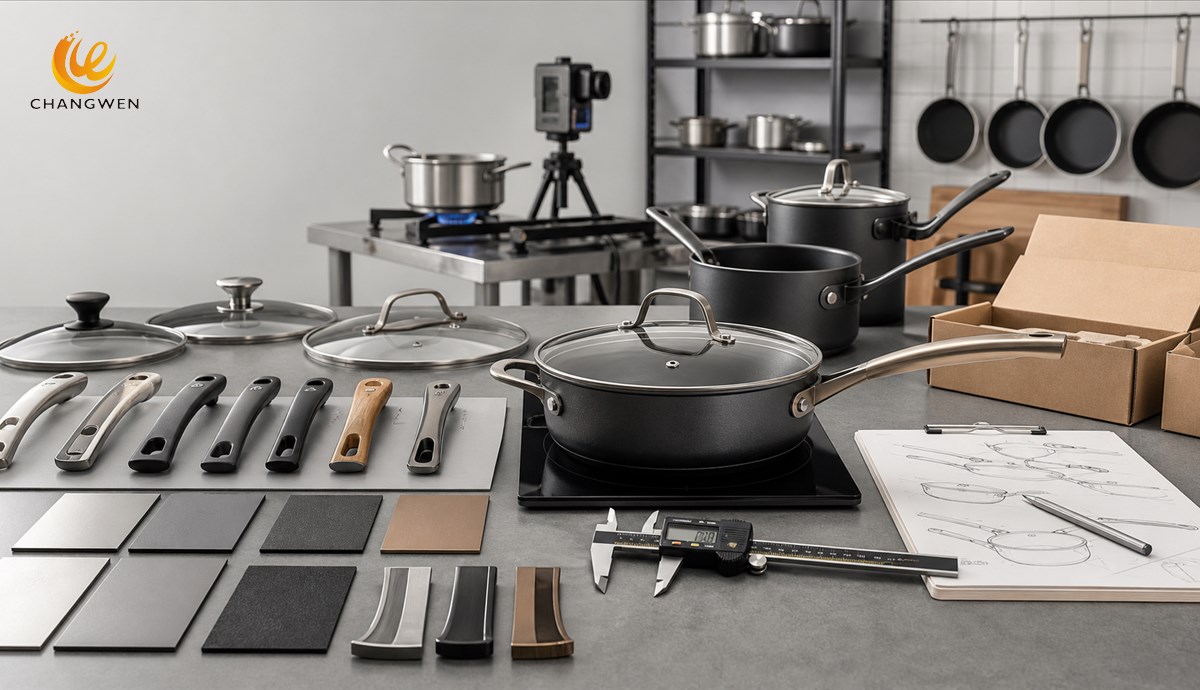
A hero product concentrates cash, testing, content, reviews, inventory, and learning. A founder can understand why one SKU succeeds or fails more clearly than a six-piece collection with different sizes, demand patterns, defects, and reorder needs.
The hero product should solve the central customer problem while creating a path to future products. A frying pan can lead to saucepans and stockpots when the design language and user promise transfer. A niche product with no logical extensions may still work, but the brand should understand its customer lifetime-value limits.
A set can be the hero product when the customer truly buys a system, but sets multiply cost and packaging complexity. The founder should compare the conversion advantage of a set with higher inventory, freight, return, and damage exposure.
How should a product brief translate the brand promise into cookware?
A product brief should define user, cooking tasks, target price, material, construction, dimensions, weight, heat-source compatibility, handle behavior, lid, rim, finish, coating where relevant, durability, cleaning, packaging, claims, destination market, and test requirements.
Every feature should connect to a customer outcome. A thicker conductive layer can support heat distribution; a removable handle can support storage; a rolled rim can improve pouring. Features that do not strengthen the promise add cost, complexity, or failure points.
The brief should separate mandatory, preferred, and negotiable requirements. This hierarchy helps manufacturers propose alternatives without weakening the core product. The OEM cookware project framework shows how multi-material requirements can be translated into an actionable development brief.
How should founders select a manufacturing route?
White-label stock products offer the fastest launch and lowest development burden but provide limited differentiation. Private label customization adds branding, finish, handles, packaging, or selected specifications to an existing platform. Full OEM development creates the most control but requires more time, tooling, validation, and volume.
The correct route matches the unproven risk. A first-time founder should avoid funding proprietary tooling before validating demand unless the unique construction is the reason customers will buy. Existing platforms can test positioning, while later generations introduce deeper engineering after evidence justifies investment.
Factories and trading companies can both support a brand, but the founder should verify who controls specifications, production, quality, and corrective action. The manufacturer versus trading company guide explains which model fits different complexity, volume, and internal-resource profiles.
What should founders verify before paying for samples?
The founder should verify the legal supplier identity, production location, relevant process capability, material documentation, sample plan, MOQ, tooling ownership, compliance support, lead-time assumptions, quality controls, packaging capability, and change-notification process.
A sample quotation should state which elements are production-intent and which use temporary tooling or hand finishing. A visually perfect prototype can hide normal factory variation. Founders should understand what the sample proves and what remains unverified.
The supplier should receive a controlled brief rather than scattered messages. Drawings, bills of materials, finish references, artwork, and test requirements need revision identifiers so every participant evaluates the same product.
How should target users evaluate prototypes?
Target-user testing should focus on the promised outcome and foreseeable use. Participants can evaluate heating, balance, handle comfort, pouring, lid fit, storage, cleaning, weight, appearance, and instructions. The founder should observe behavior rather than lead users toward positive responses.
Prototype feedback should distinguish preference from failure. A color dislike may affect merchandising, while a loose handle or unstable base is a functional defect. The team should categorize feedback by frequency, severity, target-user relevance, and cost to change.
One prototype cannot demonstrate production consistency. The founder should use prototypes to refine the design, then use multiple production-intent samples to establish measurable approval limits.
What product tests belong before a private label launch?
Tests depend on material, construction, claims, and destination market. Relevant checks can include material verification, dimensions, weight, capacity, base flatness, induction recognition, heat behavior, bonding, coating, handle strength, lid fit, corrosion, migration, dishwasher durability, packaging, and repeated use.
Compliance scope should be confirmed with qualified laboratories or local advisers. A manufacturer certificate or report is useful only when it matches the actual factory, product, material, method, and market. Founders should avoid legal certainty based on a generic document.
Claims should follow evidence. “Dishwasher safe,” “food grade,” “induction compatible,” and durability claims require defined support. Packaging and product pages should not promise more than the approved construction can deliver.

Gate 4: Why use a pilot order before the full launch?
A pilot order tests normal manufacturing conditions rather than the possibility demonstrated by a development sample. The pilot should use intended materials, tooling, operators, processes, packaging, inspection rules, and shipment handling.
The pilot quantity should be large enough to reveal variation but small enough to limit exposure. The appropriate number depends on process risk, tooling, MOQ, test needs, channel commitments, and cash. A pilot is not useful when the factory hand-selects every unit or applies exceptional finishing that will not continue.
Pilot approval should compare random units with the specification and golden sample. Measurements should include minimum, maximum, average, and defect patterns for critical characteristics. Passing averages can hide unacceptable extremes.
What should a pilot-order scorecard contain?
| Area | Evidence | Decision question |
|---|---|---|
| Product conformity | Measurements, function, finish, materials | Does normal output match the approved brief? |
| Quality consistency | Defects, variation, traceability, corrective action | Is the process controlled rather than sorted? |
| Packaging | Pack tests, dimensions, presentation, barcodes | Will the product survive and sell in the channel? |
| Delivery | Milestones and on-time completion | Are lead-time assumptions credible? |
| Economics | Actual landed and fulfillment costs | Does contribution margin survive reality? |
The founder should document corrective actions before scaling. A pilot defect is useful learning only when the cause is understood, affected stock is contained, and the process change is verified.
How should private label packaging be validated?
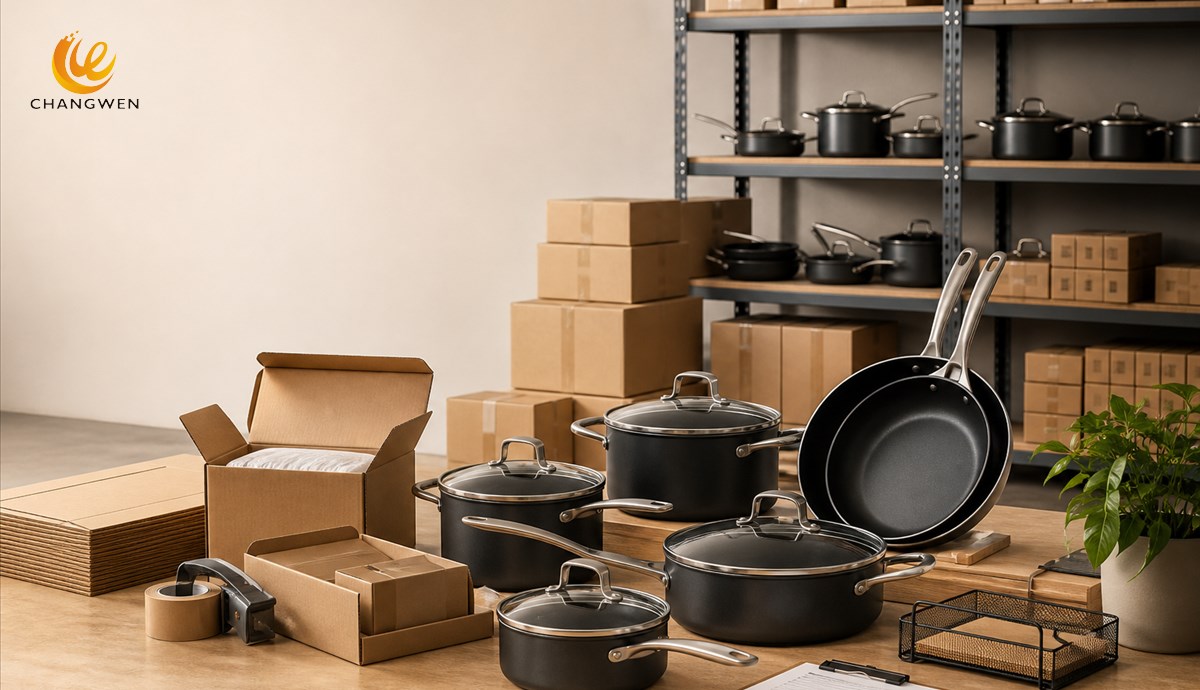
Packaging must protect the product, communicate the promise, satisfy channel requirements, and preserve freight economics. Cookware needs protection against scratches, loose lids, long handles, glass breakage, moisture, and movement inside the box.
Retail and e-commerce packs face different priorities. Retail packaging emphasizes shelf communication and display, while parcel shipping requires stronger impact protection. One package can serve both when validated, but assumptions should be tested.
Founders should approve a physical packaging sample with artwork revision, barcode verification, instructions, origin marking, dimensions, gross weight, master-carton configuration, and appropriate transit tests. The cookware packaging ideas guide provides channel-specific design considerations.
How much inventory should the first launch carry?
First-order quantity should balance manufacturer economics, expected demand, lead time, cash, channel commitment, storage, and downside risk. Ordering the lowest unit price can create excess stock when the discount requires an unrealistic quantity.
A basic inventory model estimates weekly sales, lead time, review period, safety stock, and reorder point. The founder should test downside sales and delayed replenishment scenarios. Inventory decisions should use contribution cash, not only revenue forecasts.
Components and printed packaging can create hidden inventory even when finished-goods MOQ appears low. The agreement should identify leftover handles, lids, labels, cartons, and deposits and state ownership, storage, and reuse conditions.
Gate 5: How should the brand run a controlled launch?
A controlled launch limits channels, audience, and inventory long enough to measure product-market fit. The brand should define its primary conversion goal, support process, return policy, fulfillment standard, review request, defect escalation, and data dashboard before traffic arrives.
Launch content should demonstrate the product’s actual promise with clear use, care, size, material, and compatibility information. Honest guidance reduces returns and creates more useful reviews than vague lifestyle claims.
Founders should separate product problems from marketing problems. Low traffic indicates limited reach; low conversion may indicate offer or trust; high returns indicate expectation or product mismatch; high defects indicate manufacturing control. Each signal requires a different response.
Which launch metrics matter more than revenue?
Revenue does not show whether the brand can scale profitably. Useful metrics include conversion rate, contribution margin per order, customer acquisition cost, return rate, defect rate, reason-coded support contacts, review themes, delivery performance, inventory weeks, and cash conversion.
Founders should analyze cohorts rather than only totals. Customers acquired through discounts may return or review differently from customers acquired through educational content. Channel-level evidence prevents a strong result in one source from hiding an unprofitable source.
Qualitative evidence matters when the first batch is small. Repeated comments about weight, handle heat, sticking, cleaning, size, or packaging can identify a product change before statistical confidence is possible.
Gate 6: When should the brand reorder?
A reorder should be based on sales velocity, remaining inventory, production and transit lead time, safety stock, contribution margin, defects, returns, and confidence in demand. Waiting until stock is nearly gone creates expensive air freight or lost availability.
The founder should freeze the approved product before reorder. Material, dimensions, finish, packaging, artwork, and inspection standards should carry controlled revisions. The manufacturer must notify the brand before any component, process, subcontractor, or factory change.
A reorder is also a chance to correct validated issues without redesigning everything. Changes should be prioritized by customer impact, risk, cost, and evidence. Too many simultaneous changes make it difficult to know what improved performance.
When should the brand add a second SKU?
A second SKU should solve an adjacent need for the same customer and use shared brand, channel, operational, or manufacturing advantages. Expanding because the catalog looks small creates inventory complexity without guaranteed demand.
The hero product should first demonstrate stable quality, predictable acquisition, acceptable returns, positive contribution, and repeatable replenishment. A complementary lid, size, saucepan, or stockpot can then increase order value and customer retention.
Every new SKU should pass the same validation gates. Success of the first product reduces some uncertainty but does not prove demand or economics for the next product.
What budget categories do founders often miss?
Founders often budget for product and freight while underestimating samples, tooling, testing, inspection, photography, copy, packaging development, barcodes, insurance, duties, brokerage, warehousing, fulfillment setup, returns, replacements, customer service, advertising tests, and working capital.
A contingency reserve should reflect technical and supply risk rather than a generic percentage alone. New tooling, custom coating, fragile glass, complex packaging, and untested channels create more uncertainty than a proven stock platform.
The founder should distinguish one-time setup costs from per-unit and recurring costs. This distinction clarifies break-even volume and prevents the first batch from appearing unprofitable when setup investment supports future orders.
What legal and commercial foundations should exist?
A founder should obtain appropriate professional advice for business formation, trademarks, product liability, tax, import responsibilities, contracts, privacy, consumer rules, labeling, and destination-market compliance. Requirements vary by jurisdiction and channel.
The manufacturing agreement should define specification, tooling, intellectual property, confidentiality, compliance responsibilities, inspection rights, change control, delivery, payment, defect remedies, warranty, records, and dispute handling. A purchase order should reference the controlled product documents.
Insurance and warranty planning should match foreseeable product risk. Cookware interacts with heat, food, appliances, and users, so founders should avoid treating product liability as an issue to solve after launch.
What common mistakes make private label launches fail?
The first mistake is launching too many SKUs before one product is validated. The second is designing packaging before unit economics. The third is choosing a supplier from sample appearance alone. The fourth is placing a large order to reduce unit price before proving demand.
The fifth mistake is assuming compliance documents match the actual product. The sixth is hiding material or care limitations in marketing. The seventh is waiting until stockout to reorder. The eighth is changing product, price, channel, and advertising simultaneously, which destroys useful learning.
A gated launch does not eliminate every mistake, but it limits their cost and makes causes visible. Evidence should determine the next commitment.
Frequently asked questions
How much money is required to start a private label cookware brand?
The required capital depends on product construction, tooling, MOQ, testing, packaging, freight, channel, and working-capital timing. A complete cash-flow model is more useful than a universal startup figure.
Can a cookware brand start with one product?
Yes. One hero product often creates clearer positioning, lower inventory complexity, concentrated reviews, and faster learning. The product should create a logical path to future assortment expansion.
Is private label different from OEM cookware?
Private label often starts with a proven platform customized for a brand, while full OEM can involve deeper engineering and tooling. Industry usage varies, so the contract should describe the actual scope instead of relying on labels.
Should founders accept the manufacturer’s MOQ?
Founders should understand what drives each minimum and compare it with realistic demand and cash. Shared components, standard finishes, simpler packaging, or phased releases may reduce exposure.
When is a private label cookware product ready to scale?
The product is ready to scale when quality is repeatable, unit economics are positive under realistic conditions, demand is measurable, returns are understood, and replenishment can occur before stockout.
Final launch principle
A private label cookware brand should scale evidence, not optimism. Validate the customer problem, prove contribution economics, build one focused product, verify normal production through a pilot, launch in a controlled channel, and reorder only when product and business metrics support the next commitment.
The existing complete private label cookware guide explains the broader brand-building sequence. The validation-gate model in this article helps founders decide when each step deserves more capital.